FATIMA: Who shall we look up today?
OLLIE: What about an explorer who went to the South Pole?
FATIMA: Okay, sounds good. Holo-Lab, can we meet an explorer who went to the South Pole?
HOLO-LAB: Searching. Searching… Found. An explorer who went to the South Pole, Robert Falcon Scott.
FATIMA: Hi, Mr Scott, I’m Fatima.
OLLIE: And I’m Ollie.
ROBERT SCOTT: How do you do, Fatima? How do you do, Ollie? I’m Robert Falcon Scott. I set out in 1911 to be the first person to reach the South Pole. I knew that Ernest Shackleton and Roald Amundsen, a Norwegian explorer, also wanted to get their first. The race was on.
FATIMA: That sounds exciting.
ROBERT SCOTT: And dangerous.
OLLIE: What happened?
ROBERT SCOTT: We left Cardiff on a ship called the Terranova, in June 1910, with everything I needed for the expedition. We had problems right away. It was so incredibly cold; the equipment we brought with us wouldn’t work and the ponies couldn’t cope either.
OLLIE: What did you do?
ROBERT SCOTT: We struggled on, the dogs pulling our sledges through awful weather and across difficult terrain. By the middle of winter, it was too cold even for the dogs so they turned back, leaving only five of us: myself, Wilson, Oates, Bowers and Evans, to make the final push to the South Pole.
FATIMA: Wow! So there were only five of you, alone on all that ice?
OLLIE: And you had no way to call anyone? No radio, nothing?
ROBERT SCOTT: That’s right, we had no way to communicate at all and had no choice but to continue on the trek south. Finally, on the 17th January 1912, we arrived at the South Pole.
FATIMA: So you were the first to get there!
ROBERT SCOTT: Well, no. We saw the Norwegian flag flying and realised that Amundsen had beaten us. He had already arrived there on the 14th December.
OLLIE: Oh no!
ROBERT SCOTT: Indeed. Now we faced the 800 mile journey back, knowing that we hadn’t been the first to get to the pole.
FATIMA: That must’ve been terrible for you.
ROBERT SCOTT: Quite. It got even worse. The temperature suddenly dropped to -40°C. That’s 45 degrees colder than the average winter temperate in the UK. Despite our insulting clothes made of canvas, wool and reindeer fur, the weather had become so extreme that it was hard to move. This slow progress also meant we didn’t have enough food.
FATIMA: What happened?
ROBERT SCOTT: We lost Evans in mid-February. By March, Oates was very badly frostbitten and could not move very fast. Fearful he was holding us up, he bravely sacrificed himself in the hope we would survive.
OATES: I’m just going outside. I may be some time.
ROBERT SCOTT: Our expedition ended on the 29th March 1912. We were just twenty kilometres from a supply depot. I left a letter for my wife.
OLLIE: What did you say to her?
ROBERT SCOTT: I told my wife that I loved her and had no regrets about my journey. How it is better to have tried and failed than never to have tried at all. And although we didn’t make it back, we had the spirit to try. We took risks. Luck didn’t come our way but we were determined to do our best. That’s the most important thing. Go out there and follow your dreams. I wish you all the very best of luck with whatever you choose to do in life.
OLLIE: Wow! What an amazing person!
FATIMA: I want to be a brave explorer.
Video summary
Robert Falcon Scott's ill-fated journey to the South Pole is brought to life in this short animated film for primary pupils.
As we relive the epic adventure, we discuss letter writing, working with averages and temperature change, maps and scale, polar habitats, properties of materials, topographical features and climate conditions.
This short film is from the BBC series, Explorers.
Teacher Notes
This short film could be used as a starting point for a topic focused on the polar regions, or Scott himself.
Alternatively it could be used in conjunction with one or more of the other Explorers films to compare exploration at different times in history.
Scott came from Plymouth. Your pupils could explore Devon’s rich history of explorers and how they have changed Britain.
The film introduces some aspects of the geography of the South Pole:
- This could be investigated further through looking at maps and atlases and exploring the topography and climate of the polar ice biome.
- The climate could be compared to that of other regions explored in the other films, for example the tropical climate experienced by Christopher Columbus or the desert climate experienced by Ibn Battuta.
- Pupils could plot Scott's journey using digital mapping tools.
This short film is also a perfect starting point for learning about the living things found in and around the South Pole:
- You could use classification keys to help group, identify and name living things, and construct and interpret food chains and food webs using animals found in the ocean around the Antarctic.
- You could also learn about the life cycles of polar animals, discuss how the environment is affected by humans, or discuss how polar animals have adapted to survive in the cold.
The film also introduces the idea of insulating materials in the explorers' clothes, which could be linked to science work on the properties of materials:
- Pupils could carry out an experiment using ice and insulating or conducting materials such as wool and foil – which is best at keeping the ice frozen?
- Alternatively you could link this to work on forces and friction: investigate moving over ice and snow and the influence of friction. Why did they use sledges to carry their equipment?
Maths, geography and science skills could be combined when looking at average temperatures and comparing average temperatures in the Antarctic to those in England. Pupils could learn about negative numbers in this real life context.
The film shows Robert Falcon Scott writing a letter home to his wife, which is a great starting point for learning about letter writing:
- Your pupils could write their own letters home or write a letter to Robert Falcon Scott or another explorer.
- Alternatively you could investigate the diaries written by the explorers and focus on diary writing.
Pupils could use their technology skills to design and make an insulated tent for the polar explorers to use, or mittens that would keep hands warm at freezing temperatures, or a sledge that would move smoothly over snow.
In art, you could look at Edward Wilson's watercolour painting of a bird, discovered in a hut in Antarctica in 2017, and have a go at painting similarly detailed watercolours of Antarctic birds and animals.
This short film could be used to study a variety of cross-curricular topics at KS2 in England and Northern Ireland, Progression Step 3 in Wales and 2nd Level in Scotland. Including;
- Science
- Geography
- English
- History
- Design and technology
- Art
- Maths
More from Explorers
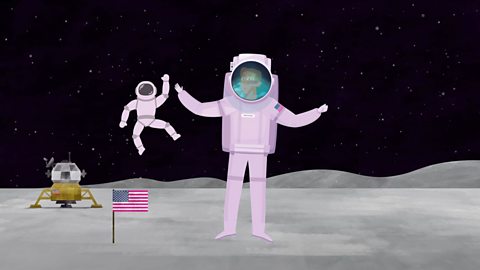
Neil Armstrong. video
Neil Armstrong's historic voyage to the Moon is explored in this short animated film for primary pupils.
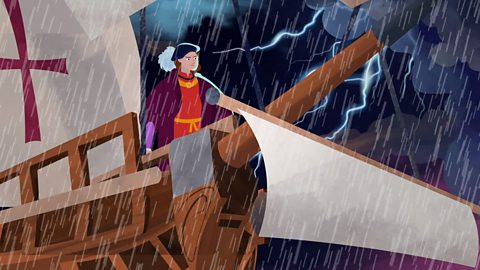
Christopher Columbus. video
This short animated film for primary pupils takes a look at Christopher Columbus' epic adventures to the Americas and the changes in travel and exploration over time.
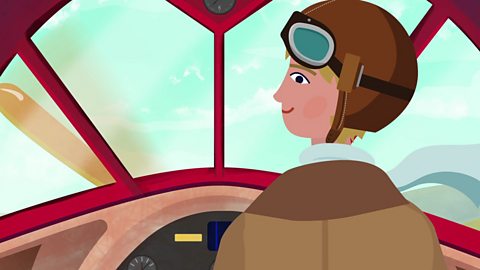
Amelia Earhart. video
The life of Amelia Earhart, a courageous pilot who broke records in the air, is introduced to primary pupils in this short animated film.
Ibn Battuta. video
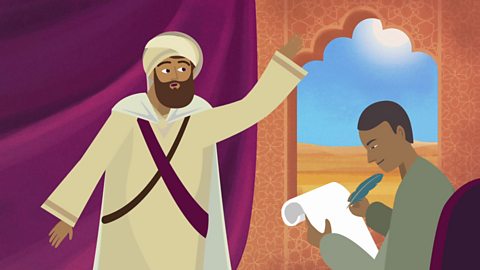
Through Ibn Battuta's epic 29-year journey, primary pupils can explore core learning topics such as creative writing, pilgrimage, Hajj and early Islamic civilisation.