PRESENTER:'When you go to China, almost the first thing you notice 'after the friendliness of the people, is the writing.
PRESENTER:'They don't have an alphabet like ours, every word has its own picture.
PRESENTER:'The earliest writing comes from 3,500 years ago, 'when China was ruled by the Shang dynasty.
PRESENTER:'And I'm in the town of Shanqiu, which is named after those kings.
PRESENTER:'Over 100 years ago, the remains of palaces of the Shang 'were discovered in a place called Anyang.
PRESENTER:'These archaeologists were very excited 'to find thousands of cow bones and turtle shells covered with writing. 'They called them Oracle Bones.
PRESENTER:'And even more exciting, they could still read some of them.
PRESENTER:'And that's because some Chinese writing signs 'haven't changed very much.
PRESENTER:'Let's take the sign for a very important thing 'for the Shang and for us, 'Rain.'
DR YIJIE ZHUANG:That's the… character for rain, I mean, in modern language.
DR YIJIE ZHUANG:And in Oracle bones, it's like this. With three drops.
DR YIJIE ZHUANG:So essentially it's the same idea, fundamentally.
DR YIJIE ZHUANG:And same for the character of the sun.
DR YIJIE ZHUANG:That's the character for sun in modern language. And then in Oracle Bones, it's essentially the same. A circle with one dot in the middle.
PRESENTER:Yeah.
DR YIJIE ZHUANG:So it's still the same idea, fundamentally.
PRESENTER:'So the Chinese writing invented by the Shang 'wasn't an alphabet like our writing, it was pictographic. 'That means their signs show the things they're meant to be. 'It's a series of pictures.
PRESENTER:'Put them together and you can start to tell a story. 'Like this.
PRESENTER:'Once upon a time, a man went into a forest. 'looking for wood.
PRESENTER:'With his blade he cut down trees. 'He trimmed off the small branches, 'and he built himself a boat.
PRESENTER:'It was a good sturdy boat, 'so he took it out to sea.
PRESENTER:'And then he got out his net to catch fish for his children's supper.
PRESENTER:'He cast his net several times. 'And finally he caught one.
PRESENTER:'But then the weather began to change, 'a big cloud covered the sun. 'And the man began to worry.
PRESENTER:'And then the weather got worse, and it started to pour with rain.
PRESENTER:'But luckily, the man had brought his umbrella.
PRESENTER:'The sea got very rough, but you'll be glad to know 'that he got home to his family. 'And they all had fish for their supper.
PRESENTER:'So let's look at the Shang signs and words that we've learnt.
PRESENTER:'Sun.
PRESENTER:'Water.
PRESENTER:'Mountain.
PRESENTER:'Person.
PRESENTER:'Tree.
PRESENTER:'Blade.
PRESENTER:'Boat.
PRESENTER:'Net.
PRESENTER:'Cloud.
PRESENTER:'Rain.
PRESENTER:'and umbrella.
PRESENTER:'So now you can read a bit of Shang. 'How good is that?'
Historian Michael Wood describes the discovery of Shang tombs in Anyang, where archaeologists discovered cow and turtle bones with writing on, the first writing known in China.
Archaeologists today could still read the writing, as it used pictographs, where each character makes a word picture, rather than an 'English-style' alphabet.
There are thousands of pictographs in use in China. Many of the characters are very similar to those used today in China.
There are enough pictographs used and explained in telling a story about a man going fishing for his tea for you to be able to write your own story.
This short film is from the BBC series, The Story of China. A series exploring the stories, people and landscapes that have helped create China's distinctive character and genius over four thousand years.
Teacher Notes
You could ask your class:
What are Oracle Bones?
Can they find out what the Shang used them for?
Why is it so important to have written evidence about an Ancient Civilisation?
What does written evidence add to our knowledge of the Shang?
How similar is Shang writing to our own?
Use the pictograms at the end of the story to produce your own short story - Shang style.
Curriculum Notes
This short film is relevant for teaching history at Key Stage 2 in England, Wales and Northern Ireland and at Second Level in Scotland.
More from The Story of China
How People Were Created. video
Michael Wood visits a farmer's festival in the plain of the Yellow River to honour the gods FuXi and NuWa. He explains the story or myth of how the first Chinese people were created.
How Humans Got Fire. video
Michael Wood climbs the Hill of Shang and visits a temple to the Gods of Fire and Water. He tells how one of the king's sons, Ebo, stole fire by tricking the gods.
How King Yu Controlled the Flood. video
Michael Wood describes the importance of the Yellow River, and how every year it flooded and brought death and destruction to this part of China.
How the Early Chinese Made Bronzes. video
Michael Wood visits a state of the art science laboratory in Nanjing. He investigates a beautiful bronze bowl, over 2,500 years old.
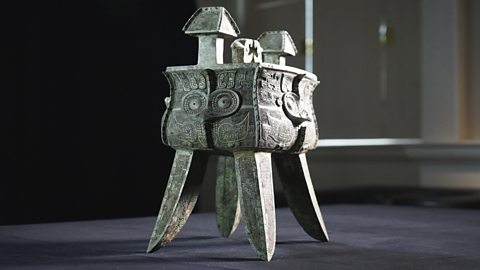
How We Know About the Shang. video
Michael Wood explains how we know about the Shang dynasty and gives a survey of the evidence that tells us the Shang really existed.
The Rise and Fall of the Shang. video
Michael Wood explores the reasons behind the rise and fall of the Shang dynasty.