PRESENTER:'In China, history goes back much further than in Britain.
PRESENTER:'China's first proper kingdom was the Shang, 3,500 years ago. 'The Chinese call these dynasties, 'which means kingdoms made by one family.
PRESENTER:'We've been talking about the Shang dynasty, 'and the Shang kings.' Well the name Shang originally comes from a place, and we're standing on it.
PRESENTER:'This is the mound of Shang.
PRESENTER:'The Shang lasted 500 years, 'they had 17 generations of kings. That's a lot of great-grandfathers.
PRESENTER:'Ancient legend said the Shang conquered China in battle.
PRESENTER:'The first Shang king was the good king Tang, who cared for the people. 'And once even offered his own life in sacrifice 'when the people were starving in famine.
PRESENTER:'The Shang ruled in the middle of China 'in the plain of the Yellow River.'
PRESENTER:Wheat fields of the middle plain.
PRESENTER:'It's a land full of rich yellow wheat fields, 'and just like today, most Chinese people back in Shang times, 'were farmers.
PRESENTER:'But these farmers needed to stop their enemies from raiding their land 'and taking their crops and animals, 'and that's why they chose brave warriors to be kings.
PRESENTER:'Shang kings were warriors, 'and they knew how to work with bronze 'and how to make spears and swords.
PRESENTER:'They cast their bronze swords in moulds of clay or stone.' So there's the sword in the stone.
PRESENTER:'Some of them with beautiful patterns raised on the surface of the blade, 'weapons fit for kings.
PRESENTER:'With these swords, Shang armies were stronger than their neighbours. 'They also knew how to make chariots and to train horses for battle.
PRESENTER:'And these burials of kings from later times 'show us what their chariots looked like.
PRESENTER:'Here, you can see the skeletons of the horses 'still pulling their chariots with their round wheels.'
PRESENTER:Amazing sight, isn't it? This is one of more than a dozen chariot burial pits that have been uncovered in the middle of Luoyang in the last few years. This was excavated in 2003.
PRESENTER:'The horses were put in the burial pits 'so they could go to heaven with their masters 'to pull his chariots in the world after death.
PRESENTER:''Where, of course, the king still expected to be a king. 'As kings do.
PRESENTER:'But the Shang had the idea that kings had to be good. 'That it was their job to fight, but also to look after the people.
PRESENTER:'So they were always trying to speak to the gods 'to check they were doing the right thing.
PRESENTER:'And above all, they watched the stars 'to see that the heavens were on their side.
PRESENTER:'Because the stars, they thought, were living spirits 'who watched them, and could punish them at any time.
PRESENTER:'And then, after 500 years of good rule, 'a man called Di Xin became king. 'And everyone was shocked by how cruel he was.'
PRESENTER:In the end, the last of the Shang kings turned into a monster. He became a wicked villain like the characters in a fairy-tale.
PRESENTER:'And anybody who argued with him, he had put to death.' When his most honest counsellor tried to make him behave better, the wicked queen ordered the counsellors heart to be cut out.
PRESENTER:'Then one day, 'all the people living in the middle kingdom looked up at the sky, 'and saw a very unusual sight.
PRESENTER:'Five bright planets began to cluster together 'in one small part of the sky.
PRESENTER:'It was a sign from the gods.
PRESENTER:'And that meeting of five planets 'we know only happens every 516 years.'
PRESENTER:'So the astronomers at Beijing planetarium 'offered to help us find the exact day 'when the gods turned against the Shang.
PRESENTER:'It's usually very difficult to find exact dates 'this far back in history, but here science can help us.'
PRESENTER:So it's what historians always want to do, is actually go back in time, and Mr Liu can do it for us. He can actually take us back to late May, 1058BC, on his computer system.
MR LIU:This time, this place, the sky.
PRESENTER:'The people everywhere 'said that heaven had spoken against the wicked king of the Shang. 'And then more strange sights were seen.
PRESENTER:'A great red bird landed on the altar of the king's temple. 'And the bird spoke, saying, "Heaven has commanded that the king of the Shang must be overthrown.
PRESENTER:'And that's what happened. 'Because in China, if the kings were bad or cruel, 'people thought they had lost the right to rule.
PRESENTER:'And in the end, all the king's enemies gathered' and brought an army against his royal palace.
PRESENTER:And then he realised that he'd lost the favour of the gods, or as the Chinese call it, the mandate of heaven.
PRESENTER:'And all his allies deserted him. 'And when his palace and his royal city went up in flames' he put on his precious jade suit and he walked into the fire.
PRESENTER:That was the end of the Shang dynasty.
Michael Wood explores the reasons behind the rise and fall of the Shang dynasty, from around 3,500 years ago.
He explains how agricultural wealth was the basis of the dynasty, which remained stable as long as people thought the kings were strong enough to defeat their enemies.
They also had to be just and look after the people.
Ultimately, a cruel and wicked king called Di Xin was judged to have lost the 'Mandate of Heaven' and thus, the people joined to defeat him, leading to the end of the Shang dynasty.
This clip is from the BBC series The Story of China. A series of videos exploring the stories, people and landscapes that have helped create China's distinctive character and genius over four thousand years.
Teacher Notes
You could think about why was King Tang, and the Shang, were able to set up a successful dynasty?
You could discuss the reasons it was justified to overthrow Di Xin?
You might think about how we know with such accuracy the date the Shang dynasty ended and why is this so unusual?
Finally you could discuss how you might sum up the achievements of the Shang dynasty in China? What was their significance? What have they left us? What makes something significant?
Curriculum Notes
This clip is relevant for teaching history at Key Stage 2 in England, Wales and Northern Ireland and at Second Level in Scotland.
More from The Story of China
How People Were Created. video
Michael Wood visits a farmer's festival in the plain of the Yellow River to honour the gods FuXi and NuWa. He explains the story or myth of how the first Chinese people were created.
How Humans Got Fire. video
Michael Wood climbs the Hill of Shang and visits a temple to the Gods of Fire and Water. He tells how one of the king's sons, Ebo, stole fire by tricking the gods.
How the Shang Invented Writing. video
Michael Wood describes the discovery of Shang tombs in Anyang, where archaeologists discovered cow and turtle bones with writing on, the first writing known in China.
How King Yu Controlled the Flood. video
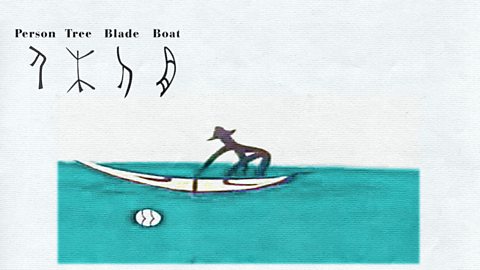
Michael Wood describes the importance of the Yellow River, and how every year it flooded and brought death and destruction to this part of China.
How the Early Chinese Made Bronzes. video
Michael Wood visits a state of the art science laboratory in Nanjing. He investigates a beautiful bronze bowl, over 2,500 years old.
How We Know About the Shang. video
Michael Wood explains how we know about the Shang dynasty and gives a survey of the evidence that tells us the Shang really existed.