JOE:'Today's Dengineer is 11-year-old Cammy from Hampshire.'
CAMMY:I need help from the Dengineers because with three sisters and two brothers the house can get very busy at times.
JOE:'Life can prove difficult for Cammy. 'Not only is he surrounded by lots of brothers and sisters 'but he also has a condition that makes life a little bit more challenging.
CAMMY'S DAD:'Cammy has a sensory processing disorder 'so it causes certain physical issues.'
CAMMY'S DAD:Certain smells, certain noises can cause him anxiety so he can be OK a lot of the time but sometimes he can have real problems with it.
MARAL:Hi Cammy. So I've seen some of your ideas and I've noticed that you like colours blue and green so I definitely will incorporate those colours into the design. My research has told me that curved walls are quite good. Do you think they will benefit your den?
CAMMY:Yeah.
MARAL:I know that you want this space to be just for you so maybe a massive sign that says "This is Cammy's den" so nobody's allowed to come in without your authorisation. How does that sound?
CAMMY:So cool just to have my own space and my own place to be myself in.
JOE:'Maral has designed a den that will look like a wall of bubbles 'with curves and domes. 'Inside, liquid tiles will form a pathway to a calm zone 'with a padded pod that will give Cammy a space to relax. 'There will also be a hammock 'and plenty of storage for Cammy's sensory tools.'
JOE:'With the build bubbling away nicely 'there's one very important accessory that needs to be fitted.'
LAUREN:-Maral the first feature of the den is up. What's all this about?
MARAL:So this is a swing seat that Cammy is going to hopefully use and it helps him with sensory integration. Helps him relax and focus.
LAUREN:Can I have a little go?
MARAL:Go for it.
LAUREN:Yeah.
MARAL:Hopefully it should carry the weight.
LAUREN:If I can get my bottom upon it.
BOTH:There we go.
LAUREN:Yay, I'm in! Ooh. Do you know what? I thought I might be too heavy for it but this is keeping me up isn't it?
MARAL:That is the idea 'cause we don’t want Cammy falling down.
LAUREN:No, so how does it work?
MARAL:So actually, we have had to add further strength to the ceiling joists that actually run along this area above the hammock. We've actually had to add, a steel plate and further nuts and bolts to carry the weight of Cammy and yourself.
MARAL:I've got a model here, so this is where the hammock is potentially sitting and if it was just a single joist it would add too much stress on that joist once Cammy is actually sat in the hammock and it could easily snap.
JOE:-Cammy's hammock is fitted to the ceiling with a steel plate 'and a large threaded nut and bolt. 'It's fixed across more than one joist to make it secure. 'When someone sits on the hammock 'the weight is spread across the ceiling joists and down the walls.
JOE:'This balanced spread of the weight 'means that the hammock is suitable for both children and adults.'
Presenters Lauren Layfield and Joe Tracini and The Dengineers team help Cammy from Hampshire create a sensory den that is just for him, away from all his siblings.
One of the key features is a swing seat that hangs from the ceiling.
To make sure it can support Cammy's weight they have added a steel plate and fixed it across more than one joist.
They demonstrate how when someone sits in the hammock the weight is spread evenly across the ceiling joists and down the walls making it suitable for both children and adults.
Teachers Notes
This could be used to introduce the process of design, and as a prompt for class discussion and learning in areas such as initial research, designing and making a structure.
Pupils could conduct a number of tests with different weights hanging from a model structure and adjusting how the weight is distributed across the structure to make it secure.
Curriculum Notes
This clip will be relevant for teaching Design and Technology at KS2 in England, Wales, and Northern Ireland and 1st and 2nd level in Scotland.

More from The Dengineers
How fibreglass can be used to make solid structures. video
The Dengineers team demonstrate how flexible materials such as fibreglass can be used to create solid structures.
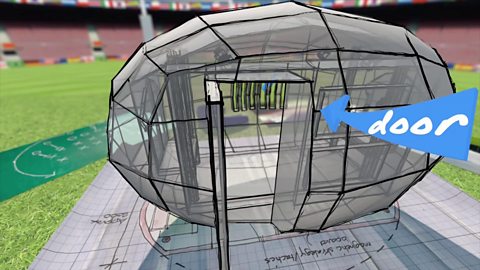
How do sliding doors work? video
The Dengineers team demonstrate how sliding doors work whilst creating a martial arts den.
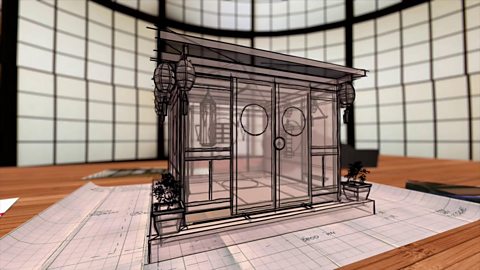
How to create a structure with angled walls. video
The Dengineers team demonstrate how to create a stable structure with walls that angle outward.
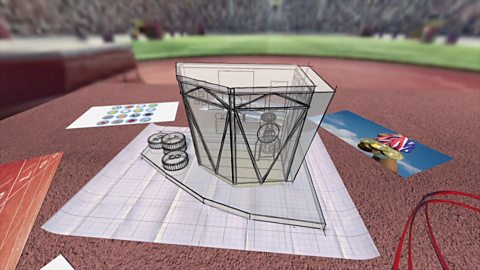
How to create a working drawbridge. video
The Dengineers team demonstrate how to create a working drawbridge on a castle-themed den.
How to create a ventilation system. video
The Dengineers team demonstrate how to create a ventilation system to stop a den from overheating.
What is a pitched roof? video
The Dengineers team demonstrate how a pitched roof works.
How to create a magnetic marble-run wall. video
The Dengineers team demonstrate how a magnetic wall works.
How to create a structure with a rotating roof. video
The Dengineers team demonstrate how to create a roof that can rotate 360 degrees.
How is dry ice created? video
The Dengineers team demonstrate the science behind creating dry ice.
How to make a wheelchair accessible zip wire. video
The Dengineers team demonstrate how to create a zip wire that is accessible to everyone.
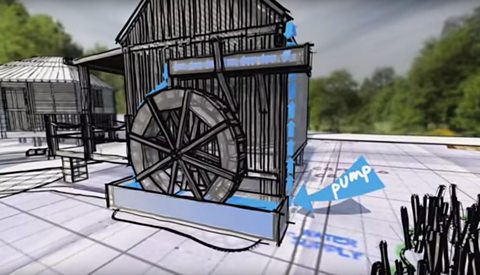
How to create an eco-friendly water wheel. video
The Dengineers team demonstrate how to create a water-recycling water wheel.