LAUREN:'Today's Dengineers are the amazing folk 'of Claire House children's hospice 'which is a Children in Need supported project.'
CHILD #1:Dengineers, we really need your help to build us an awesome den for our new hospice.
CHILD #2:Where we can make lasting memories with our friends and families.
SEGE:Now I know all your Dengineers couldn't be here today but I'm going to explain the den to you so you can go away and tell all your friends, yeah?
SEGE:I think we should create a bit of a village that's all up in the air on stilts. Does that sound good?
CHILD #3:Yeah.
SEGE:I've designed these places where you can all go and hang out, all your parents and your friends and your siblings and just have a lot of fun in your own little wonderland.
BOTH:Yeah.
SEGE:So am I good to go then? Is this the sign off? Can I get started?
BOTH:Yeah.
SEGE:Fantastic. I can't wait.
JOE:'Sege's plans for our biggest den ever 'have been the stamp of approval from the Dengineers.'
LAUREN:'He's designed a treehouse inspired village 'including places to communicate, 'party and chill out with friends and family.
LAUREN:'As if that wasn't huge enough 'Sege has also designed a zipline 'which is accessible for every child at the hospice 'and a happy path, which will contain hundreds of happy memories 'sent in by CBBC viewers.'
JOE:'The teams start to construct the steel frames 'for the den's amazing zipwire.'
LAUREN:'A part of the den which has given our Sege 'a bit of an engineering headache.'
SEGE:It's very important that this zipwire is accessible to everyone at the hospice. So we've had to create a basket shaped cradle so that the wheelchair can go on and their carer.
JOE:Must give you a few engineering challenges.
SEGE:This is the first time I've ever worked with a zipwire–
JOE:Right.
SEGE:and I've learned a lot. Your regular zipwire has just one cable on it, doesn't it. OK, now let me just show you first how a zipwire on one cable works.
SEGE:OK?
JOE:OK.
SEGE:So if you just care to take that end.
JOE:Yeah.
BOTH:OK.
JOE:Yeah.
SEGE:Now imagine this is one person. OK, If I send one fella down.
SEGE:That's how that works–
JOE:It was intense.
SEGE:but watch this.
JOE:Yeah.
SEGE:This is the cradle.
JOE:It's the basket.
SEGE:Yes. So keep it nice and tight, watch what happens.
JOE:Nightmare.
SEGE:Not good and do you know why that's not good? Because look how that is tipping?
JOE:Well it's not even is it?
SEGE:So anybody in the cradle is going to fall out.
JOE:Yeah.
SEGE:OK.
JOE:So how have you solved that problem?
SEGE:On this zipline, we're using two… two cables. I think this is the first time this has ever been done.
JOE:Wow.
SEGE:Watch this.
JOE:Yeah.
SEGE:OK so do the same again Joe, keep it nice and tight.
JOE:Duck down a bit. Like that.
SEGE:Go a bit lower.
JOE:Look at that!
SEGE:How good is that?
JOE:That's like the best zipline ever. And everybody can enjoy it. 'This zip has been designed with two wires 'instead of the usual one wire system. 'This helps spread the weight and balance the cradle.
JOE:'For an added bit of engineering wow 'there's a special pneumatic brake at the end of the zip 'which reacts and adjusts to whatever weight is inside the cradle 'allowing for smooth stopping no matter how many people are in there.'
Presenters Lauren Layfield and Joe Tracini and The Dengineers team help the kids from Claire House Children's Hospice create a tree-house inspired village den.
They investigate one of the main features, a zip wire that is wheelchair accessible.
To achieve this they have to create a basket shaped cradle that is attached to two wires to stop the cradle from tipping, and keeping it balanced.
Teacher Notes
This could be used to introduce the process of design, and as a prompt for class discussion and learning in areas such as initial research, designing and making a structure.
Pupils could look at other ways they can make the zip wire accessible and enjoyable for all.
They could also investigate other fun activities that could be adapted for extra accessibility.
Curriculum Notes
This clip will be relevant for teaching Design and Technology at KS2 in England, Wales, and Northern Ireland and 1st and 2nd level in Scotland.

More from The Dengineers
How fibreglass can be used to make solid structures. video
The Dengineers team demonstrate how flexible materials such as fibreglass can be used to create solid structures.
How do sliding doors work? video
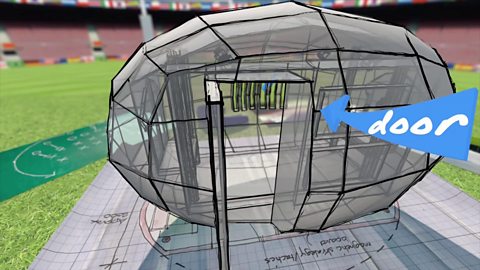
The Dengineers team demonstrate how sliding doors work whilst creating a martial arts den.
How to create a structure with angled walls. video
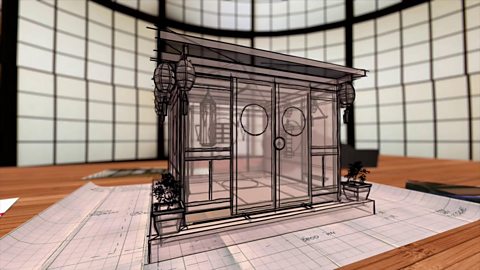
The Dengineers team demonstrate how to create a stable structure with walls that angle outward.
How to create a working drawbridge. video
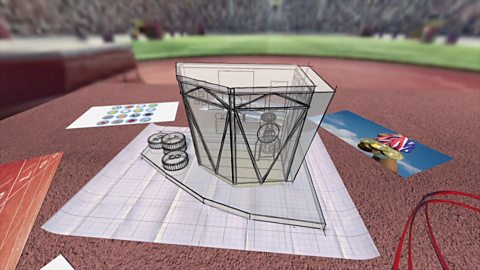
The Dengineers team demonstrate how to create a working drawbridge on a castle-themed den.
How to create a ventilation system. video
The Dengineers team demonstrate how to create a ventilation system to stop a den from overheating.
What is a pitched roof? video
The Dengineers team demonstrate how a pitched roof works.
How to create a magnetic marble-run wall. video
The Dengineers team demonstrate how a magnetic wall works.
How to create a structure with a rotating roof. video
The Dengineers team demonstrate how to create a roof that can rotate 360 degrees.
How is dry ice created? video
The Dengineers team demonstrate the science behind creating dry ice.
How to create a secure swing seat. video
The Dengineers team demonstrate how to create a swing seat that is strong enough to support the weight of both children and adults.
How to create an eco-friendly water wheel. video
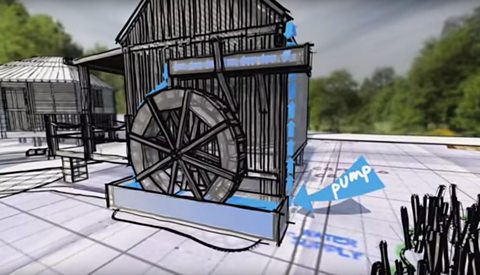
The Dengineers team demonstrate how to create a water-recycling water wheel.