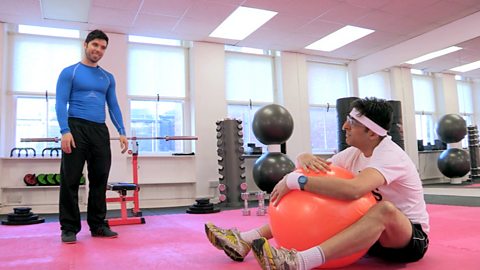
Angles angles who needs angles? Well you need angles. To stand up. To sit down. To stand up again. To walk. To moonwalk. Look here I can't moonwalk. The point is every time you move you're using angles. You don't even know it. Check this out. Right angle! And er… Acute angle! Do you know what else is cute? This haircut. It's a new style that I'm thinking of showcasing. But I don't know I don't think I can get away with that any more. Besides the whole palm tree thing is very last year. No no I think I need to rethink my look and who better to help me out than top hair professor Mr Sharz Din. Sharz how are you?
Very good thank you very much. How are you?
I'm not too bad. So maths and hair. Surely two completely mutually exclusive separate worlds?
Not at all. Erm what's very interesting about that is that we actually use maths all the time particularly geometry. And the most important part of it of course is the understanding of angles.
OK so could you maybe talk me through specifically how you use angles in hair and at the same time sort out my barnet?
Why don't we have a little look at a couple of models and see how angles work on the head shape?
OK sounds good.
This is the lovely Helen.
Hello. And who's this chatterbox here?
Er, this is er, Sally.
To be honest I've been giving Sally a really good scalp ritual for two minutes and I'm getting nothing back off her. Are you all right, love? Anyway what are we going to do today then?
Well first of all what we're going to do is an iconic haircut called the graduated bob. And it starts off at the back shorter at the nape rounder at occipital bone travelling into a horizontal line to complement the jaw.
OK so it's a genuine combination of different angles.
It certainly is. Are you ready to get started?
Are you ready to go? I'll take that as a yes.
Whoa whoa whoa whoa! Stop right there!
What?
It's not looking quite how it should is it?
I'm not hearing HER complain.
Why don't you put your scissors down and I'll show you how we work with angles?
Bit harsh.
We've sectioned Helen's hair off. Into two right angles I notice. Very good. And two right angles coming together make that section perpendicular.
OK.
Now how we start is if we imagine the jaw is horizontal or at zero degrees…
Yeah.
And that would make that angle 90 degrees I'm going to cut Helen's hair at 45 degrees right in between. Now after that the angle then becomes less and less or more ACUTE as I work around the head.
You're stepping down, down, down, down, more and more acute as you work around the head and then you finally hit zero.
Very good. Excellent.
Wow who knew there was so much maths in hair? Check the skills. The man is simply a wizard with the scissors but he couldn't do this without the maths to back it up. Maestro it's beautiful! Look at all the angles!
It's nice how it all combines.
So can you repeat that trick with your angle skills and do something with this?
We can try. Right Sanj this is your new look. Vertical 45 degrees horizontal. What do you think?
I think it's the future of hair. You've actually created a new hairstyle. I've even got a name for it.
What's that?
The protractor!
Video summary
Angles feature in our lives in ways which we normally don't notice, even our movements.
Sanjeev Kohli takes us on a trip to the hairdresser's where a stylist, Sharz Din, explains that angles are important in his technical work.
We are shown how angles define a particular cut, the graduated bob.
The terminology of angles is used throughout in a practical way.
This clip is from the series Who Needs Maths?
Teacher Notes
This clip gives learners an insight into using angles in the workplace - in a surprising situation.
It can be used as a lesson on the terminology used in describing angles.
For many this will be revision but will show these terms being used in a practical way.
Learners could discuss other ways that angles feature in everyday life - in diverse ways such as in an aeroplane changing direction and in the movement of the hands of an analogue clock.
Extend activity into calculating the missing angle in a diagram, measuring angles, making a scale drawing involving an angle.
Research the use of angles in 3-figure directional bearings and consider why zeros are included when the angle is less than 100 degrees.
This clip is relevant for teaching maths at Key Stage 3 and Third/Fourth Level in Scotland.
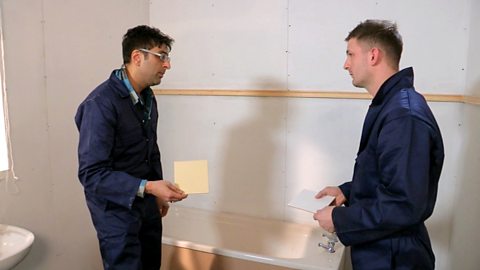
Area. video
When tiling a room, measuring area is important to determine the number of tiles needed.
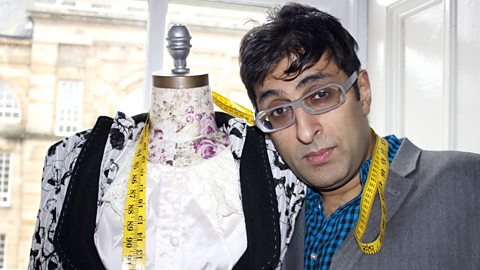
Measurement. video
Making clothes needs careful measurements of length, time and circumference.
Percentages. video
Percentages are vital in the worlds of fitness and nutrition. Can you give 110% effort?