Measurement. Who needs measurement? Well, we all need measurement. You measure everything. You measure time. You measure distance. You measure space. You measure trousers. I could go on. The point is, it's hard to get a measure on how much we need measurement.
I've been invited to a very important party tonight, so I've been clothes shopping. Hit the sales and, you know what it's like. You go sale shopping and sometimes you buy stuff that doesn't quite fit. Clearly, measurement is the issue here, so I need to find someone who can do some clothes maths.
And this is Elle. She seems stressed. Sorry, she's a seamstress.
Yeah! I make and alter clothes.
So do you think you can rescue these clothes and make me look sharp for this party and also, is there any maths involved in that?
Well, maths is really important in dressmaking and altering clothes. Measurement is key. And when you get measurements wrong, this is kind of what can happen. For example, this is far too big across the shoulders. And that's a little bit long in the sleeve. And then the trousers, you can see they're a bit snug and a tad short. Erm…
You've got a good eye.
What is your inside leg measurement?
Er, 34 inches?
34 inches? Well, most of the time I work in centimetres. 86. Just over 86 centimetres.
OK.
It's quite long. So if I could ask you to hold that there. And you can see that these trousers are only 73 centimetres, which is far too short.
That's really quite short, isn't it?
Yeah…
Can these be rescued, then?
Well… The only thing I could do is add some more material on to the bottom. Erm, but it would be different material and it would be quite an interesting look.
I think I'll give that a miss.
Are you sure?
Yeah, I think so. So, erm, trousers for the bin, you think?
I'm afraid so.
OK. Right, OK, well, fair enough. Move on. Jacket.
The jacket. Because the jacket's bigger, it's easier to make things smaller so you can take fabric out.
So you think then that you will be able to make this jacket look immeasurably sharp for the party?
I'm pretty sure there's something we can do.
So fashion isn't just about the look. The maths is crucial, too. Elle needs to be spot-on with her sums. One centimetre either way and I could be in fashion Alaska.
Elle's taking care of my jacket to make sure I look dangerously good for the party tonight. Good enough even to justify a hat! Only one problem. I've got a massive head. Huge! Seriously, it's got its own moon and everything. This is the question. Do we have the maths to find a hat big enough for this watermelon?
This is Pea. She's a milliner. That doesn't mean she's in a higher tax bracket, it means she makes hats from scratch, which is very impressive. OK now, be honest. You're the expert. Is there a hat for this bonce?
Absolutely, Sanjeev. There's hats for everybody these days!
A hat for everyone, she says. I'm not sure she knows what she's letting herself in for.
Wow!
All right, now see that's what I'm talking about. Yeah, I like that. Er, do you think maybe though, you could make it in a different material or something?
Absolutely!
Luckily this style is one-size-fits-all. Now, let's see where the maths comes in.
This is the crown of the hat, Sanjeev. In order for me to work out how much wire I need, I need to know the circumference of this circle.
Oh, the circumference. Ah, so you'll be measuring the diameter of the circle.
Yep, the diameter is 12 centimetres.
Magic. This gives me a chance to showcase my very favourite equation.
To work out the circumference, Pea needs to multiply pi by the diameter. But that's not the only measurement Pea needs for her business to be a success.
It's very time consuming, this hat-making business, isn't it?
Yeah, it really is.
So on average, how long would it take to make a hat?
I would probably be spending about 30 minutes on a consultation with someone. Possibly, 45 minutes pattern cutting. And then, maybe three and a half hours making a hat?
That's four hours and 45 minutes in total.
Yeah. I look at the time it's taken to make the hat and then I look at the cost of the materials. And then I'll come up with the final price for the completed hat.
Whoa, whoa, whoa, whoa! Am I getting charged for this? Well, Pea had to give me the hat for free because Elle sewed the money into the jacket pocket after she did this lovely fitting. Result! I'm off to a party! See you later!
Video summary
Sanjeev Kohli has bought a new outfit but the trousers and jacket don't fit.
He visits Elle Wilson, a seamstress, for alterations and finds that measurements are vital to the process.
He then commissions a hat to be made by a milliner, Pea Cooper.
This involves measurement and working out the circumference of a circle.
The milliner calculates the time she needs to make the hat because this will affect the price she charges.
This clip is from the BBC series Who Needs Maths?
Teacher Notes
This could encourage a general discussion about the importance of accurate measurement.
Ask the students to practice calculating the circumference, radius and diameter of a circle.
Students could do their own measuring of objects around the classroom or school, then work out the maths to alter them to a different size, either bigger or smaller.
For example, they could measure a playground bench, then calculate how much would need to be sawn off to get it through a classroom door, or how big the classroom and furniture would have to be if all the students grew or shrank by a certain amount.
This clip is relevant for teaching maths at Key Stage 3 and Third/Fourth Level in Scotland.
Ratios and fractions. video
Making a recipe stretch to serve more people needs the help of ratios and fractions.
Volume. video
Will all the boxes fit into the van? Calculating their volume reveals the answer.
Percentages. video
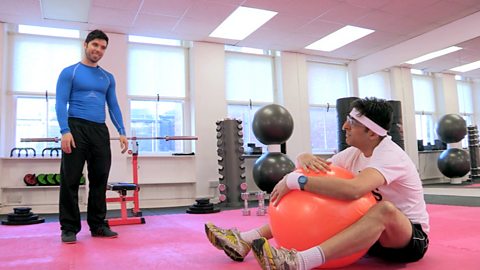
Percentages are vital in the worlds of fitness and nutrition. Can you give 110% effort?