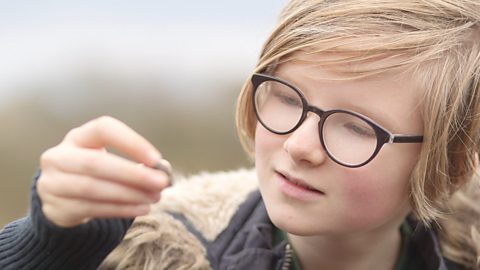
How have animal skeletons adapted over thousands of years of evolution? In this short film for primary schools Martin Hughes-Games looks at the skeletons of animals and humans and explains how and why they have changed.
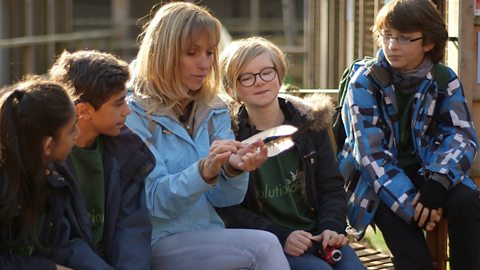
Martin joins a team of young science enthusiasts to look at four limbed animals’ skeletons and learn how they are adapted for different functions.
They also compare the structure of a dolphin’s flipper to a human arm to explain the similarities in structure.
Charles Darwin used observations like these to develop his theory that we have a common ancestor.
This short film is from the BBC series, Evolutionwatch.
Teacher Notes
This short film could be played before a school visit to a zoo or wildlife park.
You could ask your pupils to look at x-rays of animal skeletons and identify the function of the limb, then guess which animal it belongs to.
As part of a classroom activity, you could draw around one pupil to produce a body outline, then draw in the bones for the limbs.
Curriculum Notes
This short film will be relevant for teaching primary science, particularly on the topics of animals and evolution.
More from Evolutionwatch:
Why do animals and plants have camouflage? video
In this short film for primary schools, Michaela Strachan looks at fish and mammals and explains how they have evolved to become better camouflaged to suit their environment.
What is selective breeding? video
In this short film for primary schools Michaela Strachen introduces the concept of inherited characteristics in animals and vegetables, and we see how dog breeders and vegetable growers make use of artificial selection.
Different types of leaves. video
In this short film for primary schools Martin Hughes-Games investigates variation in leaf material from a pine and broad leaf forest and discusses why some leaves drop and some leaves stay all year round.
How animals have adapted to become successful predators. video
In this short film for primary schools Michaela Strachan visits an owl sanctuary with some primary school pupils to find out how a barn owl is adapted to be a successful predator.
Timeline of life on Earth video
In this short film for primary schools Martin Hughes-Games describes the role of a palaeontologist; someone who studies ancient living things and how planet Earth has evolved over millions of years.