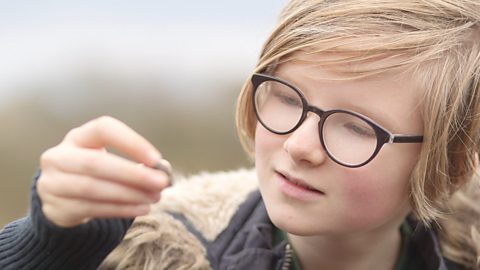
In this short film for primary schools Michaela Strachan visits an owl sanctuary with some primary school pupils to find out how a barn owl is adapted to be a successful predator.
She explains several facts about how the owl has evolved and the students take part in an experiment in getting the owl's attention by making mouse noises.
Michaela explains several owl adaptations, including how it has evolved to have a curved beak to catch prey, feather adaption for silent flight, lots of extra bones in their neck which enables them to move their head around, and how their ears are adapted to enable them to pinpoint where a sound comes from.
This short film is from the BBC series, Evolutionwatch.
Teacher Notes
Students could collect some owl pellets and identify the bones within the pellet (you may need external support with this).
As a class activity, pupils could stand in a circle blindfolded. One pupil could be acting as predator (owl) and one as prey (mouse). The owl-pupil is blindfolded to mimic using their ears to hunt. The mouse-pupil squeaks until the owl catches them.
_ A less energetic version of this game could be to use funnels and tubes to act as ears so that the pupils can locate each other._
Pupils could examine different types of feathers.
Curriculum Notes
This short film will be relevant for teaching primary science, particularly on the topics of animals and evolution.
More from Evolutionwatch:
Why do animals and plants have camouflage? video
In this short film for primary schools, Michaela Strachan looks at fish and mammals and explains how they have evolved to become better camouflaged to suit their environment.
How have animal skeletons adapted? video
How have animal skeletons adapted over thousands of years of evolution? In this short film for primary schools Martin Hughes-Games looks at the skeletons of animals and humans and explains how and why they have changed.
What is selective breeding? video
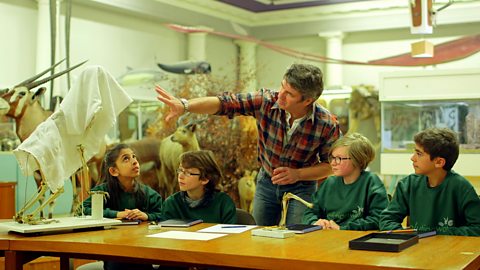
In this short film for primary schools Michaela Strachen introduces the concept of inherited characteristics in animals and vegetables, and we see how dog breeders and vegetable growers make use of artificial selection.
Different types of leaves. video
In this short film for primary schools Martin Hughes-Games investigates variation in leaf material from a pine and broad leaf forest and discusses why some leaves drop and some leaves stay all year round.
Timeline of life on Earth video
In this short film for primary schools Martin Hughes-Games describes the role of a palaeontologist; someone who studies ancient living things and how planet Earth has evolved over millions of years.