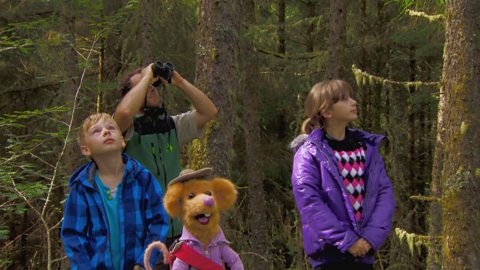
William visits the Dorset coast and discovers how fossils are created from plants and animals that lived millions of years ago.
The video
William Whiskerson, mouse explorer. Finds adventure, 'round every corner. Where will he go? Who will he meet? His amazing adventures, will make you squeak. William Whiskerson, mouse explorer.
Narrator: Here comes William Whiskerson in his amazing traveling globe.
William Whiskerson: Greetings, adventurers. I am William Whiskerson, the famous mouse explorer.
Narrator: William is on a beach. 'But which part of the United Kingdom is he in today?
William Whiskerson: Cheese Phone, reveal my location.
Narrator: The Cheese Phone shows William where he is on a map of the world.
Cheese Phone: Hello, William. Today you're in the south of England, in a town called Lyme Regis. The cliffs and beaches of Lyme Regis are part of an area known as the Jurassic Coast. The area's full of important clues that tell us how the Earth has changed over 185 million years.
William Whiskerson: I've got a message coming through on my Cheese Phone.
Kadisha: Hello, William. This is Cameron and I'm Kadisha. Welcome to Lyme Regis.
Cameron: Would you like to come on a fossil hunt with us?
William Whiskerson: That sounds amazing. Lock the location, Cheese Phone.
Narrator: The map shows William where to meet Kadisha and Cameron.
William Whiskerson: Explorers, away!
William Whiskerson: Pleased to squeak you, Kadisha and Cameron.
BOTH: Pleased to squeak you, William.
William Whiskerson: What are all these people doing here?
Kadisha: Swimming and playing.
Cameron: And building castles and sunbathing.
Narrator: Lyme Regis has lovely beaches, which is why lots of people like to go there on holiday. Whilst looking around the town, William notices a funny shape that keeps appearing. It appears on buildings, in the walls, even on the streetlights.
William Whiskerson: Hey, you two, look at that strange shape. I've never seen anything like that before. It looks like a snail.
Kadisha: That isn't a snail. That's an ammonite.
William Whiskerson: An ammonite?
Kadisha: Yes.
William Whiskerson: What's an ammonite?
Cameron: A type of fossil.
William Whiskerson: Oh, a fossil.
Narrator: A fossil is a special rock that holds a secret. The explorers decide to ask the Cheese Phone more about them.
William Whiskerson: Cheese Phone, can you tell us about fossils?
Cheese Phone: Certainly, William. Here's the story of how a fossil is made. This is an ammonite. Ammonites were once sea creatures with squid-like tentacles and a curly shell like a snail. They lived at the same time as dinosaurs. When an ammonite died, its shell would lie at the bottom of the sea. Layers of mud covered the shell. This protected it and stopped it from crumbling away. Over time, the mud and shell hardened and turned into rock. As this happened, the shell became a fossil. Fossils can be found all around the coast of Lyme Regis.
William Whiskerson: Thank you, Cheese Phone.
ALL: Explorers, away!
Narrator: The explorers decide to find out more about fossils, and travel to another part of the beach, where they meet Chris, the fossil expert.
William Whiskerson: Pleased to squeak you, Chris.
Chris: Pleased to squeak you, William. Now, what we're going to be doing today, William, is we're going to be looking to see if we can find fossils on the beach. And fossils are the remains of creatures that lived in Lyme about 200 million years ago. So we'll have to look very carefully in among the smaller rocks.
William Whiskerson: Ah, that sounds really exciting. Explorers, away!
Chris: Right. Let's have a look and see if we can find any.
Narrator: The explorers set off to hunt for fossils.
Kadisha: You know the sparkly bits? They're crystals.
Narrator:They search the beach for clues to see if they can find any strange patterns or shapes on the surface of the rocks.
Cameron: I've got one.
Narrator: These could be fossils.
Kadisha: Yeah, a few more.
Cameron: It's a fat one.
William Whiskerson:Can't find any here.
Kadisha: Where should we put this one for our collection, with them? I'll tell you what. Shall we put them right there?
Cameron: Okay.
Narrator: Kadisha and Cameron find another fossil. Can you see the shape in the rock?
William Whiskerson: Found one. I think it's an ammonite.
William Whiskerson: Chris, can you show us some of the fossils that you found on this beach?
Chris: Certainly, William. Probably one of the most well-known fossils from Lyme are these coiled shells, and I know you found some of those. Can you remember what they were called?
Kadisha: Yes. Ammonites.
Cameron: Ammonites.
Chris: Ammonites.
William Whiskerson: Ammonites.
Chris: But when people see them they see a coily shell. They think they were a type of snail. But they're not snails, they're way more exciting than snails. They're related to squids and octopuses, and cuttlefish and things like that. And they've got tentacles for catching their food, and they've got a beak in the middle to bite their food, and very well-developed eyes, and this coily shell. When they die, all the flesh rots away, and all we find are the shells of them, and lots of different types.
Kadisha: Just like those ones.
Chris: Just like those ones. And we don't just find ammonites. We find bigger things than ammonites as well. But less commonly, we find parts of this creature. Now, it's a type of creature that's not alive today. It's an ichthyosaur. And we find not the soft parts, but we find the hard bones from inside. And one of the nicest bits to find are the jaws at the front. The most common bit that we find of ichthyosaurs are the backbone. The spine.
Kadisha: Like the spine right down there, like we have.
Chris: Like you have. It goes all the way down the body, and an ichthyosaur would have had about 180 bones like that.
Narrator: Hunting for fossils along the beach can be lots of fun, but it's important that you always have a grown-up with you. Rocks from the cliffs that run along the beach can become loose, so you mustn't get too close.
Chris: Now, would you like to go to the museum and see some other bigger fossils?
Kadisha: Yes, please.
William Whiskerson: That sounds amazing.
ALL: Explorers, away.
Narrator: Inside the museum, the explorers get to have a closer look at some big fossils.
Chris: You found some small fossils on the beach and I told you a little bit about them, and I said in the museum we'd see some bigger fossils. This is a big skeleton of an ichthyosaur.
William Whiskerson: What, an itchy-saur?
Chris: Not an itchy-saur, an ichthyosaur. And ichthyosaur means 'fish lizard'. Can you guess at all what this is?
Narrator: What do you think? Here's a clue. It's something a dinosaur would leave behind after it had gone to the toilet.
Cameron: Poo.
Chris: Poo. Yeah.
William Whiskerson: Dinosaur poo?
Chris: There you go. That's real fossil poo. It's about 200 million years old. And it doesn't smell at all now.
Narrator: Yes, explorers, even poo can be fossilized. It can reveal what dinosaurs ate millions of years ago. After the museum, the explorers have a treat on the beach.
William Whiskerson: This fossil hunting has made me hungry.
Cameron: Me, too.
Kadisha: Yeah, and me.
William Whiskerson: I've had a great time hunting for fossils with you two.
Cameron: So have we.
Kadisha: I have a present for you.
William Whiskerson: What is it?
Kadisha: It's an ammonite.
William Whiskerson: Thank you. My very own ammonite. Goodbye, explorers.
BOTH: Goodbye, William.
ALL: Explorers, away!
Narrator: Can you remember where William went today? William visited his friends Kadisha and Cameron in Lyme Regis. They learned all about fossils, and went on the beach to meet Chris, a fossil expert. Can you remember what they did? They went hunting for fossils. They then went to the museum and saw something very special. Can you remember what it was? Some dinosaur poo. At the end of his adventure, he was given a fossil and even had a yummy ice cream on the beach.
William Whiskerson: Time to fly, explorers. We're off on another adventure.
Narrator: See you soon, William.
Video summary
Download/print a transcript of the video.
William Whiskerson visits Lyme Regis on the Dorset coast.
He meets a fossil expert and learns how fossils are formed from the remains of plants and animals that lived millions of years ago. He goes hunting for fossils on the beach then visits a fossil museum, where he sees the fossilised remains of an ichthyosaur.
This episode introduces children to some geological features of a coastal location.
Teacher Notes
Ask pupils to find Lyme Regis on a map of the UK.
With your help, they could use the scale on the map to find out how far they are from Lyme Regis. Is there a closer beach?
Encourage the children to find the nearest one on the map.
Pupils could bring back any shells and fossils they discover, or sketch beach finds from a book or webpage.
The children could model how fossils were formed by pressing empty snail shells (or sea shells) into a tray of damp clay, to leave impressions.
Encourage them to fill the impressions with a sludgy mixture of PVA glue and sand.
When the sludge has set, pupils can peel off the clay, to reveal their model fossils.
This clip will be relevant for teaching Geography.
This topic appears in KS1/KS2 in England and Northern Ireland, Knowledge and Understanding of the World Foundation Phase in Wales and Early/1st/2nd levels in Scotland.
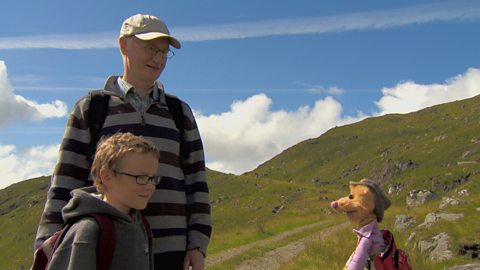
Mountains and electricity. video
William goes to Scotland to see his friend Euan and visit a power station deep inside a mountain.
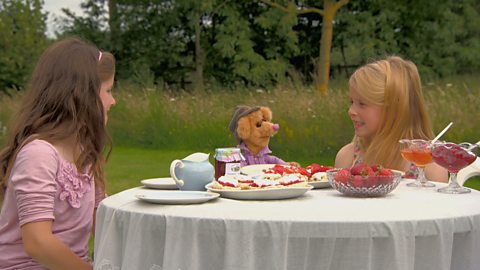
Growing and picking orchard fruit. video
William Whiskerson meets Lucy and Laura in an orchard. He learns about the different types of fruit that grow there including berries, cherries and apples.
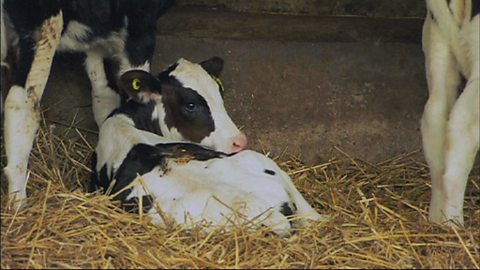
How our milk gets from the farm to the shop. video
William Whiskerson meets Theo on his family farm. He learns how female cows make milk and then takes a trip around the farm where he sees a calf being born.
Life on the Isles of Scilly. video
William Whiskerson travels to the Isles of Scilly, a group of islands lying off the Cornish peninsula of Great Britain.
Transport, travel and landmarks of London. video
William Whiskerson meets Kulala who lives in London, and visit some of the key landmarks.
Jobs and tourism in a seaside town. video
William Whiskerson visits the seaside town of Weymouth. He explores the beach and sees tourists on the esplanade.
How honey is made. video
William Whiskerson meets Sophie and Ben and they visit a bee farm.
Travelling on a canal boat. video
William Whiskerson meets Sophie and Harry on their narrow boat and they take a trip along the Birmingham and Worcester canal
Exploring a cave in Yorkshire. video
William Whiskerson meets Emily and together they explore a cave in Yorkshire.
Living in an eco-village. video
William Whiskerson meets his friend Ewan, who lives in an eco-village in Shropshire.
A visit to the Caledonian Forest. video
William Whiskerson travels to the Highlands of Scotland to meet his friends Lewis and Breya.