ERIN BROWNE:It's about five to seven, and I'm going to work.
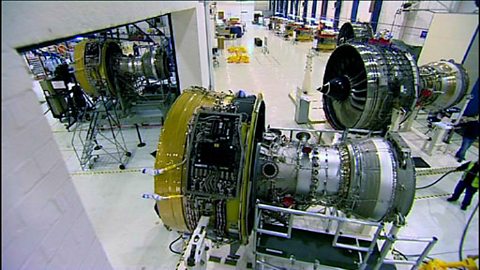
NIRAJ:I'm currently an apprentice at Derby, at Rolls-Royce, as a manufacture engineer in engine and maintenance.
ERIN BROWNE:'I'll be fully qualified in September of 2010, which is really daunting, being able to say, "I will be a qualified electrician".'
NARRATOR:'Erin Browne is a second-year apprentice electrician at BAE systems in Barrow.'
ERIN BROWNE:I'm just changing into my overalls.
ERIN BROWNE:I have to wear them obviously, so you don't cut yourself or hurt yourself. But they're not very flattering, to say the least.
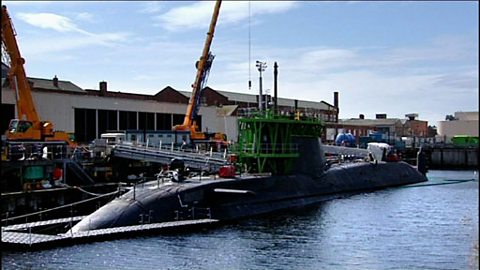
ERIN BROWNE:I work on that boat, boat two, Ambush. This one closer to us is boat three. We're going down there, to the toolbox talk.
ERIN BROWNE:That's Nige, team leader. Morning, Nige.
NARRATOR:'Erin will be trained in the electrical systems of the submarine. And as one of only 300 electricians on the build, when she qualifies, she'll be part of a very elite and highly-skilled club.'
NIGE:We'd better get cracking, eh?
ERIN BROWNE:'You can't imagine what it's like to work on submarines, you only get that image in your head once you've been on board and had a look around, and actually worked on one.
ERIN BROWNE:'When you first come in, it's so daunting how big the submarines are, how big the complexes that they're built in, and the yard itself. It's so… It is huge, but you walk past them every day and you don't even realise they're there after a while.
ERIN BROWNE:This is the Captain's cabin space. Ooh.
ERIN BROWNE:'I enjoy working here, definitely. It's just totally different. It fascinates me. Coming in, there's always someone new around, doing something different.
ERIN BROWNE:Everyone's friendly, everyone talks, and you ask questions, someone's going to give you an answer. You ask about, "Oh, what does that do?" Even if it's got nothing to do with your job, you ask, and someone will tell you.
ERIN BROWNE:So you learn all these different things about the boat that you wouldn't know otherwise.
UNKNOWN MALE:This is a call signal station. So if the power goes down on the boat, and you can't contact other areas, this will have a handset on it, and it's just like a wind-up phone.
ERIN BROWNE:I basically get a step by step guide through how to do something, until I've learnt, like, until I'm confident I can do it myself. And then I do them on my own. But I've never done one of these before so Carl will tell me what to do.
ERIN BROWNE:'I like the idea of learning while on the job. I'm a very hands-on person, I don't like being sat in a classroom just having all this theory battered into me, I like to be doing the hands-on side of it.'
ERIN BROWNE:Once you leave your apprenticeship and you end up being a tradesman yourself, if you're on a squad, and they get a new apprentice, then they might get put with you.
ERIN BROWNE:So it is important that you know what you're doing, and that you do listen when you're being told it to begin with.
UNKNOWN MALE:Three and four.
ERIN BROWNE:'You're gonna be teaching them, effectively. So the new set of apprentices that come in, you're gonna end up with your own apprentice at some point.'
UNKNOWN MALE:Alright. Sorted.
ERIN BROWNE:It's a skill that I've learnt that I can take around the world with me. And just do whatever I want, and always have something to fall back on.
NARRATOR:'It is essential to invest in people just as much as technology itself. Apprentice schemes like this are vital to British industry.'
NIRAJ:This is Rotatives, this is the business that I'm working in.
NIRAJ:They mainly, again, deal with discs, drums and shafts.
NARRATOR:'Niraj is a manufacturing engineer at Rolls-Royce in Derby.'
NIRAJ:Here, we've got main line shafts, so this is where they build the largest shafts which go through the main part of the engine. These are the coverings that go around them to make sure that the parts don't become damaged. We've got the various drilling machines down here.
NIRAJ:And then, as we walk through here, this is where I work. This is the shaft's support office.
NIRAJ:'From a young age I was always into building things and designing. And then the opportunity came round of me getting the apprenticeship and also my family, my Dad's an engineer, my grandad's an engineer, my uncle's an engineer. So I've had a little influence as well from them.'
NIRAJ:But generally I just like engineering, and I like the fact of designing and building.
NARRATOR:'Like every apprentice, Niraj can expect to spend three years or more learning the basic skills of his trade. So having a passion for it is really important.'
NIRAJ:Today I'm trying to make one of these control rods. Which, as you can see, is here. And basically it allows the pilot to control the amount of airflow that's going through the engine, and change various settings in the engine and the flaps and angles.
NIRAJ:You tell somebody you're 16 and working at Rolls-Royce, they see you in a different light suddenly. Like you're actually someone special, and someone a bit different. 'Cause it's not-- It's really quite prestigious to work in such a big company like this, certainly at the age that I am.
UNKNOWN MALE:So first data midge, blued out, one end to the other.
NIRAJ:OK.
UNKNOWN MALE:Second data midge, 90 degrees to it, check that with an engineer's square.
NIRAJ:Now I'm thinking, "Wow, what a change just a couple of years can make to a life." Because going from schoolboy to engineer, it's quite a radical change, and I'm quite pleased with that change.
NARRATOR:'Engineers use their imagination and analytical skills to invent, design and build things that matter.
NARRATOR:'They are team players with independent minds.
NARRATOR:'By dreaming up creative and practical solutions, engineers are changing the world all the time.'
Video summary
This short film, first published in 2011, is for teachers and review is recommended before use in class.
Two engineering apprentices describe their work on a nuclear submarine at BAE Systems in Barrow-in-Furness and at a Rolls Royce factory in Derby.
Industry is investing in engineering apprentices to create inventive designers, builders, problem solvers and team players.
Elite and highly skilled, the engineering apprentice is essential to industry in the UK today.
Teacher Notes
Could be used to introduce learners to a range of training, education and career pathways in engineering, including technician, incorporated and chartered grade.
They might look at engineering institution websites (such as the Institute of Engineers and Technologists) as part of information, advice and guidance within Design and Technology lessons.
This clip will be relevant for teaching KS3 and KS4/GCSE Design and Technology, materials.
This topic appears in OCR, Edexcel, AQA, WJEC in England and Wales, CCEA in Northern Ireland and SQA National 4/5 and Higher in Scotland.
Why CAD/CAM is an essential design tool. video
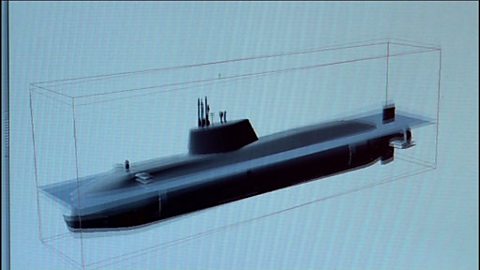
Find out why the Royal Navy use CAD/CAM to simulate design
Why is testing essential in design and build? video
A look at the process for testing the weapons system on a new submarine and an introduction to the vital role of testing and analysis.
How does planning help the production process? video
Rolls Royce use 'just in time' production planning for the Trent 700 jet engine.