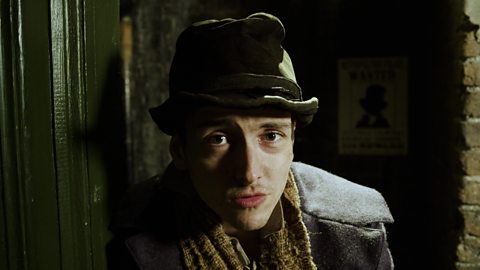
DODGER:
Victorian London from 1850 to 1900 is the biggest city in the world.
MORGAN:
And it's chaos.
CHARLEY:
There's the banging of new buildings.
TANG:
Railway tracks being built.
DODGER:
Street sellers yelling.
TOM:
People everywhere.
POLLY:
Most of those buildings, you know the famous ones, landmarks we call them. Victorians built them.
TANG:
Nelson's Column.
DODGER:
The Houses of Parliament.
MORGAN:
Victoria Station.
CHARLEY:
Britain is about to become the largest.
TANG:
Richest.
POLLY:
The most powerful empire in world history.
DODGER:
Ain’t trickled down to us though has it.
MORGAN:
People come here from every corner of the globe. Did the globe have corners?
CHARLEY:
You’ve got thousands of people of African heritage.
TOM:
Irish and Italian Catholics.
DODGER:
German and French Protestants.
POLLY:
Jewish people who've been here since the 17th century.
TANG:
Muslim sailors from the East India Company.
DODGER:
We've even had an Indian restaurant, the Hindoostane Coffee House. It opened in 1810. That was before I was born!
CHARLEY:
But one thing unites us all.
MORGAN:
None of us can read or write.
DODGER:
Well, apart from a lucky few.
MORGAN:
You've got the rich areas.
POLLY:
And the poor areas. Whole streets where it’s just people brawling.
TOM:
Babies crying.
MORGAN:
Terrible.
TANG:
London is smelly.
POLLY:
The streets pong. But most of all, the river really stinks. Everyone does their toilet and it flows right in, so it’s more like a toilet than a river.
MORGAN:
That's what caused the Big Stink in 1858.
TANG:
There was a heat wave.
DODGER:
Oh, imagine the smell of that.
POLLY:
It took just 18 days to agree to a whole new sewage system. Then the Thames stopped being so smelly.
DODGER:
Most days the air is dark and smoky, because of all the coal we burn. I can’t even see my hand!
CHARLEY:
It carried on right through to the 20th century and it's called smog.
MORGAN:
Or pea-souper, because it looks like pea soup.
TOM:
There are fogs.
CHARLEY:
Yellow fogs.
TANG:
And brown fogs.
POLLY:
And fogs so black they might be liquid soot.
TOM:
They fill your lungs and make you cough.
DODGER:
Even the grass is black in the royal parks.
CHARLEY:
And Buckingham Palace is crumbling because of the smog.
TOM:
Lots of people wear black clothes, because that hides the muck better.
DODGER:
The smog’s so bad, some people walk into the river Thames because they can’t see where they’re going.
POLLY:
But it ain’t all bad, we know how to have fun.
CHARLEY:
We go down the music hall.
TOM:
It’s like the theatre, but not as posh. For a penny you can get plays, comedy skits and music. It’s called the variety show.
POLLY:
If you're no good, you get pelted with rotten veg.
TANG:
Or dead animals.
MORGAN:
Some places had to put cages around the stage to protect the act.
TOM:
And there’s a geezer who stands at the edge of the stage with a big hook and he drags the weak performers off.
CHARLEY:
You're still singing some of our music hall songs today.
DODGER:
Daisy, Daisy, give me your answer do.
MORGAN:
I'm half crazy, all for the love of you. I’ve got a lovely set of pipes I have.
POLLY:
The writer Charles Dickens called the city his 'magic lantern', he loved all the madness.
TOM:
If you wanted to have a kick about or play a game of football during the Victorian era. It was a lot safer than it was before.
DODGER:
Before the 1800s, football was rough.
TANG:
There were no rules.
CHARLEY:
And no referees.
DODGER:
The Victorians brought all those in, so no more bone-crunching tackles.
TOM:
There were works teams for factory workers.
POLLY:
The geezers at the Royal Arsenal, in Woolwich formed the club in 1886.
MORGAN:
Arsenal!
CHARLEY:
The workers at Thames Ironworks formed the club in 1895.
DODGER:
West Ham!
TANG:
And outside London, the railway workers from Lancashire and Yorkshire Railway Company became…
CHARLEY:
Manchester United!
MORGAN:
Right, you’ve had your penny's worth, hop it. I’ve got to go and sweep a pile of dung bigger than Dodger’s top hat. Right, mind how you go, watch what you step in.
It won’t be a stylish marriage, I can’t afford a carriage, but you’ll look sweet upon the seat of a bicycle built for two.
Video summary
In this short film for primary schools Dodger and the gang provide an introduction to Victorian London which was, at that time, the biggest city in the world.
At the time Britain was the largest, richest and most powerful empire in history. But not much of that prosperity had reached the people of London and, as Dodger and the gang point out, pollution was a serious problem.
They also highlight the terrible smell, mentioning the Big Stink of 1858, and the thick fogs caused by the burning of coal.
This short film is from the BBC Teach series Dodger's Guide to Victorian Britain.
Teacher Notes
Before watching the film
This short film explores a number of themes which could provide fruitful follow-up work in the classroom. Although it does describe the conditions in London and the 1858 Big Stink, this guide does not reference this, as the issues were explored in the second video on poverty. One new theme is immigration, and although London may have been more cosmopolitan than other British cities, it makes sense to concentrate on a city closer to your pupils. Whether the classroom focus is say Belfast, Cardiff or Glasgow, there will be immigrant groups which have helped to shape the city.
As a teacher you will need to be sensitive to the topic of migration, as it may directly affect some of the children in your class. They should not feel they are the focus of the lesson or for there to be any expectation to discuss their own family circumstances, although they may choose to, as this will make the topic event more relevant to the class. Given the potentially emotive nature of the topic, there is guidance for teachers on how to approach this here. Please note that this PDF guide was created to support another BBC Teach resource for secondary schools, although the themes and advice is universal. By upper KS2, pupils will be more engaged in history if they find it challenging and there are rich rewards for both children and teacher, in addressing this issue.
Another theme to explore is leisure. Given that many of the films have focused on the hard lives of Victorians, it is important to provide a contrasting aspect of 19th century life. Pupils create mental pictures of the past and can have preconceived ideas of historical periods. With the Victorian era, it can be seen by the children as a hard and miserable period, yet there were also times of fun and enjoyment.
Questions to consider whilst watching the film
Depending on the focus of your lesson, you may wish to ask the following questions after the video or pause the short film at certain points to check for understanding.
- Which famous landmarks in London were built by the Victorians?
- What groups from other countries were living in London?
- What were the reasons for the Big Stink in 1858?
- What caused smog?
- What did you learn about music halls from the film?
- What changes to football happened during Victorian times?
After watching the film - activities to further explore learning
Concept of causation - One of the most important concepts in history is cause and consequence. The topic of migration provides an opportunity to explore causation by focusing on the reasons why different migrant groups came to Britain. This could help to reinforce the term push and pull factors.
This BBC Teach video provides a general overview to migration, explaining the terms push and pull factors, and from this depth studies could be explored.
The film mentions a number of migrant groups and these can exemplify both push and pull factors:Push: French Protestants fleeing religious persecution or escaping famine in the case of Irish Catholics.Pull: Job opportunities for Italian Catholics or Muslim sailors.
The pupils could work in groups with each one researching a different immigrant group with the task of identifying the main reasons why they came to Britain. Depending on your school context, you may wish to explore different migrant groups or extend the period of study to look at immigration in the 20th century. There are web resources to support this study; for example the BBC Teach Black British Stories films, which explore ‘the experiences and contributions of people from communities across the UK’.
Storytelling can be a very powerful approach in history, encouraging the pupils to listen to people recounting their stories of migration to Britain. If the school has community links, then it may be possible for someone to come and talk to your class about their experiences or those of their parents or grandparents. If not, the Making Histories website contains migrant stories, collated by young people and these cover many migrant groups.
Historical enquiry - The topic of Victorian leisure provides further opportunities for pupils to develop their skills of historical enquiry. The film highlights the Victorian origins of some famous football clubs. History is always more meaningful to children if it can be linked to the local area and so the pupils could research the origins of their local football club; many, but not all, have their roots in Victorian Britain. If football is not relevant to your school context, then other sports could be researched; most popular team sports, like cricket and rugby, can also trace their competitive origins to the Victorian period.
Historical enquiry also requires children to ask and answer questions based on a range of historical sources and this topic has a wide range of sources to explore, both written and visual. For example, the film mentions the music hall. There are obvious links here to music but the lyrics to songs can also be historical sources in their own right, revealing insights into life in Victorian times. This website has collated some of the more popular music hall songs, along with their words. Not all the songs can be treated as historical sources in this way, but there are some good examples such as Daisy Bell, sung by Dodger and the crossing sweeper in the video, and Any Old Iron, the cry of a rag and bone man.
There are other leisure pursuits to be studied through examining visual sources, such as advertisements and photographs. The British Library has produced a resource which links to its collection of visual sources on leisure in Victorian Britain. In addition, Historic England has a collection of images for classroom use and these can be searched by key word and then filtered to the Victorian period. This website also has a lesson plan and resources on seaside holidays and although the photograph is from 1907, it would not have been that much different in Victorian times.
Finally, a case study of Pablo Fanque can link the two topics of migration and leisure. He was famous as the first non-white British circus owner in Britain. He was born in Norwich as William Darby; the background of his parents is uncertain, with speculation that his father “was Indian-born and had been brought to Norwich and trained as a house servant.” This BBC Teach video provides an introduction to Pablo Fanque and his circus, as well as one of the posters he used to advertise his circus. The website provides suggestions to how you could follow-up the video in the classroom.
England
From the History national curriculum:Pupils should:
- understand historical concepts such as cause and consequence.
- understand the methods of historical enquiry, including how evidence is used rigorously to make historical claims.
Northern Ireland
From the statutory requirements for Key Stage 2: The World Around UsPupils should be enabled to explore:
- Change over time in places
To provide a balance of experiences in History pupils could study:
- Places then and now and how our identity, way of life and culture has been shaped by influences from the local and wider world.
- Some of the characteristics of past societies and distinctive features of life in the past.
- Reasons for and effects of historical events.
Teaching should provide opportunities for children as they move through Key Stages 1 and 2 to progress:_
- _from sequencing events and objects on a time line in chronological order to developing a sense of change over time and how the past has affected the present.
Scotland
From the Experiences and Outcomes for planning learning, teaching and assessment of Second Level Social Studies
- I can use primary and secondary sources selectively to research events in the past.
- I can interpret historical evidence from a range of periods to help build a picture of Scotland’s heritage and my sense of chronology.
- I can investigate a Scottish historical theme to discover how past events or the actions of individuals or groups have shaped Scottish society.
Wales
From the new Humanities Area of Learning and ExperienceSchool curriculum design for History should:
- develop historical … source-based skills.
- develop rich content across the time periods, through which learners can develop an understanding of chronology through exploring … cause and effect … the use of evidence.
- expose learners of all ages to a range of historical periods on a local, national and global scale.
Principles of progressionDescriptions of learning for Progression Step 2
Enquiry, exploration and investigation inspire curiosity about the world, its past, present and future:
- I have experienced a range of stimuli, and had opportunities to participate in enquiries, both collaboratively and with growing independence.
Human societies are complex and diverse, and shaped by human actions and beliefs:
- I have explored some causes and effects of events and changes in my community over time.
- I have explored and am aware of diversity in communities.
Dodger's guide to being a Victorian kid. video
In this short film for primary schools Dodger and the gang provide a brief guide to life for children in Victorian Britain, including some of the ways in which children were employed.
Dodger's guide to poverty and the workhouse. video
In this short film for primary schools Dodger and the gang provide a brief guide to the Victorian workhouse and the common diseases from the time, particularly cholera.
Dodger's guide to key inventions. video
In this short film for primary schools Dodger and the gang provide a guide to those inventions from the Victorian era which changed lives then and now.
Dodger's guide to crime and punishment. video
In this short film for primary schools Dodger and the gang provide a brief guide to crime and punishment in Victorian Britain.