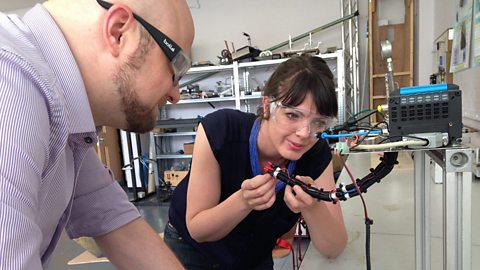
An explanation of the auxetic material found in the inner layer of a mussel shell and how it absorbs impact by becoming denser when stretched.
At Sheffield Hallam University, engineers are designing new materials with auxetic properties.
They have a lot of potential for protective sports equipment and in medicine, for example to protect someone with a hip injury.
Auxetic structures are also being tested to use in architecture, creating structures that can be installed in an instant in disaster relief areas.
Scientist and presenter Fran Scott shows how a card model can be created to illustrate the properties of the material.
Teacher Notes
This clip could be used with GCSE product design students to focus their idea development on specific user groups.
Prompt them to research widely when choosing materials and illustrate the testing of material properties.
Curriculum Notes
This clip is suitable for GCSE Design and Technology and touches upon topics that appear in AQA, OCR A, EDEXCEL, EDUQAS, WJEC GCSE in England and Wales, and CCEA GCSE in Northern Ireland and SQA National 5 in Scotland.
More from Biomimetics - Designed by Nature:
Introduction to Biomimetics - Inspiration from nature. video
An overview of biomimetics - the study of copying nature's mechanisms to solve design problems in a resource suitable for Key Stage 3/4 and GCSE.
Smart fabric inspired by pinecones. video
Scientist Veronika Kapsali presents her research into pinecones, and how it is helping her design a fabric that automatically cools the wearer if they get too hot.
Technology based on biology. video
Designer Amy Congdon is using living materials like bone tissue and bacteria to grow new products in this design and technology resource for Key Stage 3, 4 and GCSE.
The development of robot design inspired by nature. video
We see how by looking at worms, elephants' trunks and octopuses' tentacles, engineers are developing robots with softer, more natural limbs, rather than the traditional stiff skeletal ones.