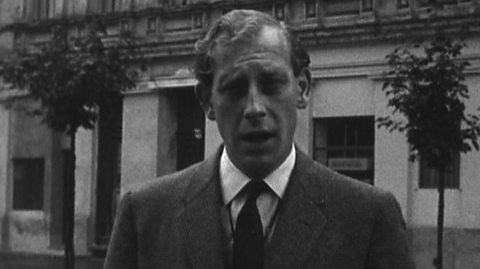
NEWS REPORTER VO [ARCHIVE]:
In the Departmental Auditorium at Washington on Monday, the North Atlantic Treaty was signed, a solemn pact by which 12 great freedom-loving countries of the world pledge common and immediate action in the event of armed attack upon any one of them. Foreign ministers of the countries concerned arrived. Here is Mr Dean Acheson, the United States Secretary of State.Monsieur Schuman of France.Monsieur Spaak of Belgium.
NEWS REPORTER VO [ARCHIVE]:
President Truman then arrived and greeted the ministers, shaking hands with each one in turn.
NEWS REPORTER VO [ARCHIVE]:
Then he spoke, firmly and unequivocally, upon the attitude of the United States.
TRUMAN [ARCHIVE]:
This treaty is a simple document. The nations which sign it agree to abide by the peaceful principles of the United Nations, to maintain friendly relations and economic cooperation with one another, to consult together whenever the territory or independence of any of them is threatened and to come to the aid of any one of them who may be attacked.For us, war is not inevitable. If there is anything certain today, if there is anything inevitable in the future, it is the will of the people of the world for freedom and for peace.
NEWS REPORTER VO [ARCHIVE]:
The ministers then signed the treaty.
So comes into being one of the most powerful instruments for peace mankind has ever forged. With the knowledge set thus clearly before them that never again will there be delay in facing the threat of force, aggressors will hesitate before launching another war upon the world.
Video summary
This clip from the BBC Archive is a newsreel about the signing of the Atlantic Pact, the establishment of the North Atlantic Treaty Organisation (NATO).
It contains footage of some of the foreign ministers of the countries involved. There are extracts from a speech by American President Harry Truman in which he outlined the principles behind the establishment of NATO: to uphold the peaceful principles of the United Nations, promote friendly relations and economic cooperation and to come to the aid of any country if attacked.
He concluded by stating that war was not inevitable while the countries of the world promote ‘freedom and peace’.
The clip ends with the signing of the treaty and the rhetorical flourish that this was a ‘powerful instrument of peace’; as a result, potential aggressors will hesitate from starting another war.
Teacher notes
This video could be shown as part of a series of lessons around this possible overarching enquiry question:
- How did NATO contribute to the division of Europe and increase tensions between East and West?
Before the video:
It is important to provide the historical context before playing the clip, by addressing questions such as:
- What does the abbreviation NATO stand for?
- When was NATO established?
- What was NATO?
- Which countries were founding members of NATO?
While watching the video:
Students could consider the following:
- What three principles of NATO does Truman outline in his speech?
- The clip ends with propaganda about NATO. What claims were made?
- What do you notice about all the politicians featured in the newsreel? Why might that be? Would it look similar today?
At the end of the video:
The students will need to study why NATO was established and consider why this happened in 1949. What may have been some of the short term catalysts for the establishment of a defensive military alliance? This revision guide also has a helpful map which clearly shows how Europe was divided between NATO countries and the Warsaw Pact, which will help in addressing the overarching enquiry question.
Once the students have studied NATO, it would be important to compare and contrast it with the Warsaw Pact, the Soviet response.
If there is time, it may be interesting to look at a current newsclip related to NATO and ask the students to reflect on what ways may have NATO changed, or stayed the same, since its creation in 1949.
The video could be interrogated as a historical source by answering a question like:
- How useful is this source to a historian studying the establishment of NATO?
Also, it could be compared with a contrasting source to explore different interpretations. Before being examined on this topic, the students could be directed to this set of revision podcasts.
Suitable for teaching the GCSE History units on The Cold War in England and for National 5 examinations in Scotland.
More from this series:
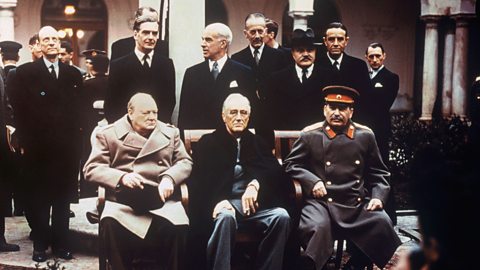
1945 Roosevelt speech at Yalta. video
An audio clip from the BBC archive taken from a speech made by the American President, Franklin D. Roosevelt at the Yalta Conference.
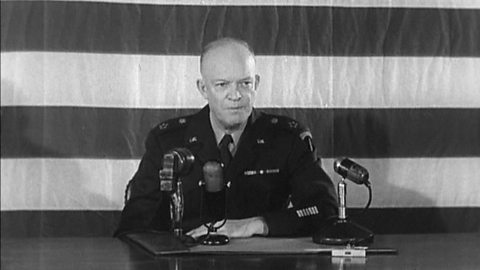
1948 Eisenhower on the Marshall Plan. video
An archive video clip of Dwight Eisenhower being asked questions about the European Recovery Programme, better known as the Marshall Plan.
1961 Building the Berlin Wall report. video
A short clip from the BBC Archive as journalist Peter Woods reports on the construction of the Berlin Wall.