ROOSEVELT:
We did, however, make it clear at the conference just what unconditional surrender does mean for Germany. It means the temporary control of Germany by Great Britain, Russia, France and the United States. Each of these nations will occupy and control a separate zone of Germany.
And the administration of the four zones will be coordinated – coordinated in Berlin by a control council composed of representatives of the four nations. Unconditional surrender means something else. It means the end of Nazism.
Video summary
This brief audio clip is from a speech made by the American President, Franklin D. Roosevelt at the Yalta Conference.
It focuses on just one of the key decisions taken at Yalta: to divide Germany into four zones - American, British, French and Russian and for these to be co-ordinating by a Control Council in Berlin, which became known as the Allied Control Council (ACC).
The clip concludes with Roosevelt stating that the unconditional surrender of Germany meant the ‘end of Nazism’.
Teacher Notes
This video could be shown as part of a series of lessons around these possible overarching enquiry questions:
- How did agreements at Yalta differ from those made at the Potsdam Conference?
- In what ways did the Yalta and Potsdam Conferences contribute to the development of the Cold War?
Before the audio:
It is important to provide the historical context before playing the clip, by addressing questions such as:
- When was the Yalta Conference held?
- Where is Yalta?
- Who were the ‘Big Three’ at Yalta?
- Why did the ‘Big Three’ meet at Yalta?
While listening to the audio:
Students could consider the following:
- What does ‘unconditional surrender’ mean for Germany?
- Which countries would occupy Germany?
- How will the four zones be coordinated?
At the end of the audio:
It is interesting to compare the impression created for the public, in speeches such as this and the famous photograph of the Big Three, with what may have been happening in private; the tensions between the allies did become more pronounced at Potsdam. The students could debate the reasons for these differences and relate to similar high profile conferences today.
The students will need to explore the other key decisions made at Yalta, which are outlined in this guide. It may be helpful for the students to create a table comparing the key facts of each of the three conferences, including Tehran in 1943. There is a possible structure to this table in the guide to Potsdam.
In the clip, Roosevelt stated the unconditional surrender of Germany meant the ‘end of Nazism’. The class could consider what he meant by this and what happened after the war to ensure this happened.
The video could be interrogated as a historical source by answering a question like:
- How useful is this source to a historian studying the Yalta Conference?
Also, it could be compared with a contrasting source to explore different interpretations. Before being examined on this topic, the students could be directed to this set of revision podcasts.
Suitable for teaching the GCSE History units on The Cold War in England and for National 5 examinations in Scotland.
More from this series:
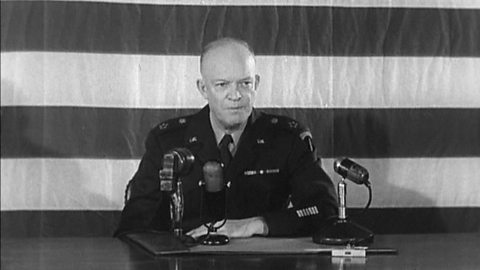
1948 Eisenhower on the Marshall Plan. video
An archive video clip of Dwight Eisenhower being asked questions about the European Recovery Programme, better known as the Marshall Plan.
1949 Signing of the Atlantic Pact. video
A BBC Archive newsreel clip of the signing of the Atlantic Pact, the establishment of the North Atlantic Treaty Organisation (NATO).
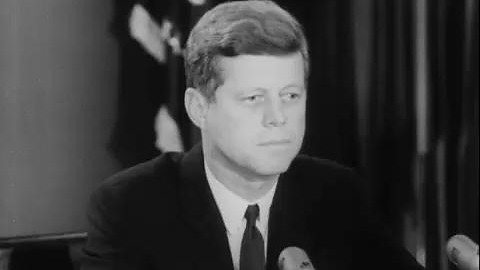
1962 President Kennedy's Cuban Missile speech. video
A clip from the BBC Archive from President John Kennedy’s television broadcast to the American people on the Cuban Missile Crisis.