About
This page was updated on Thursday 19 June 2025
The competition is organised by the BBC in partnership with Beano, HeadteacherChat, Libraries Connected, National Book Tokens, National Literacy Trust, Oxford University Press, Pobble, Publishers Association, The Reading Agency, EFL in the Community, Premier League Primary Stars, Crayola and World Book Day (the ‘Partners’).
The BBC's Code of Conduct for Competitions and Votes applies to this competition. You can read more about it here: BBC Competition Code of Conduct.
Eligibility
Entry to this competition is open to persons who will be aged between 5 and 11 years on Friday 7 November 2025 when the competition closes who are residents of the UK (including the Channel Islands and the Isle of Man), except anyone who is closely related to a member of BBC or BBC Group staff, or anyone connected to the competition (which includes our Partners and prize providers).
Entries must be submitted by an adult (parent/guardian, teacher, sports or community leader) on behalf of the child ('Responsible Adult’). When an entry is submitted by a third party (e.g. a teacher), prior to submitting the entry on behalf of an entrant, the party submitting the entry shall be responsible for (i) obtaining parental consent and (ii) providing a copy of the Rules to the parent/guardian to ensure the entrant’s compliance with the Rules. Evidence may be requested for consent, proof of age, identity, and eligibility.
Entry will be in two age categories:
- Category 1 - ages 5-7 years
- Category 2 – ages 8-11 years
How to enter
Entrants must write a fictional short story (no more than 500 words in length). Entry is via an online entry form available at www.bbc.co.uk/500words. The Responsible Adult submitting the story on behalf of the entrant will be asked to provide the entrant’s name, gender, region and their age and ensure that they have parental permission to do so. The Responsible Adult must enter the child’s story in the text box provided for submission.
All stories should be submitted in English.
We can only accept stories which are 500 words or fewer according to the word counter on the online submission form; the BBC cannot accept word counts from any other software. Please make sure you check the word count on our form if you are pasting from another piece of software, such as Microsoft Word.
Entries can only be accepted online; postal entries or entries sent over email will not be read or considered.
The Responsible Adult will be required to approve the entry and agree to these Rules (including the BBC’s use of the story submitted and the fictional nature of the story) on behalf of the entrant, by way of a checkbox in the online form. The Responsible Adult must provide their own contact and personal details (not the child’s) and must seek parental permission and, if requested by the BBC, provide evidence of permission in the event of an enquiry or complaint.
For the Top 50 shortlisted entries, if permission to enter was given by someone who is not a parent or guardian, the BBC will contact the Responsible Adult and ask for confirmation of permission from the entrant’s parent or guardian.
Entry opens at 08:00 on Tuesday 23 September 2025 and closes at 21:00 on Friday 7 November 2025. Submissions received outside of this time frame will not, under any circumstances, be considered. The BBC advises users not to wait until the last minute to submit entries. The 500 Words website receives a lot of entries in the last few hours of the competition. The BBC cannot be held responsible if the website runs slowly or for any technical failure or malfunction during the submission window.
If users have emailed the administrators and are awaiting a response, the competition deadline still stands. Unless the competition administrators have explicitly instructed otherwise, all stories must be submitted before the deadline in order to be considered in the competition.
Entrants can only enter individually. Only one entry per person is permitted and the story must be wholly written by the entrant only; stories cannot be written by more than one person. If more than one entry is submitted, only the entrant's first submission will be considered if they make it through to the final 50.
Entries must be an original piece of fiction and not an account of real events – either historical or current. However, stories can feature well known public figures from present day or from history (e.g. Leah Williamson or Charles Darwin), take place in historical eras (e.g. Roman Britain), or use real-life experiences as a creative springboard, as long as the story is FICTIONAL. If entrants are unclear on whether the content of a story contradicts these Rules, they may email the competition administrators at 500words@bbc.co.uk.
The entrant’s Responsible Adult warrants that they have not used material or depicted events that actually took place or used the personal details of any living persons in the story. As the stories will be published, it is important that entrants do not include any personal details about themselves. The entrant must not include their name in the title or body of the story; entries which do contain this information may be removed from the competition.
Entries cannot be returned so please remember to retain a copy. Unsuccessful entrants will be contacted in respect of their entry but no feedback on any entry will be provided.
All entries must be the original work of the entrant and the BBC will use third party software to check for plagiarism. Entries must not infringe the rights of any other party. In addition, the use of generative AI tools to create or develop any part of an entry is not permitted.
The BBC accepts no responsibility if entrants ignore these Rules and the entrant’s Responsible Adult agrees to indemnify the BBC against any claim by any third party from any breach of these Rules.
Entries must not contain defamatory, obscene, offensive, or any other unsuitable material; the BBC reserves the right to disqualify entries containing such matters. Entries must be suitable to be broadcast, published or used online by the BBC for audiences of all ages, but in particular for a child audience. Please see the following for further information: BBC Editorial Guidelines. If the story has troubling content the BBC may, if required, take advice from the NSPCC, and may refer the Troubling Content to the relevant authorities - BBC Child Protection Policy.
Entrants retain the copyright in their entries but their parent or guardian grants to the BBC a perpetual, non-exclusive, royalty-free, sublicensable licence to the entry for the following purposes; to administer the competition, to publish, broadcast (across all media), post the entry online and on any other platforms yet to be envisaged, and use or share the entry for research and teaching purposes. This licence will be deemed to include all the necessary rights and permissions to enable such use by the BBC, to fulfil the prizes, and to complete the administration of this competition.
By submitting a story, the entrant’s parent or guardian agrees that the BBC may at its sole discretion edit, adapt, abridge or translate the entry for the purposes listed in clause 21 above.
Entrants and their parent/guardian agree that the BBC may publish the stories on their website for the duration of 5 years, after which all names and attribution will be removed.
In the event that the entry is published online at www.bbc.co.uk/500words, for the avoidance of doubt, this will not be part of, or influence in any way, the judging process. Only the story title, entrant’s name and age will be published with an entry.
Judging criteria
- Entries will be judged on the following criteria:
- Originality
- Plot
- Characterisation
- Language
- Enjoyment
Round One
The first round will be judged by volunteer judges made up of teachers, teaching assistants and librarians across the UK. Each volunteer judge will receive a selection of anonymised stories, from entrants located in a different area of the UK, to read and score using the criteria above. Each judge will be allocated stories (via a secure login) along with details of the criteria and how to score the stories. Approximately 5000 of the highest scored entries from this round will be put through to the next round. This process will be overseen by a BBC Editorial figure. Parents or teachers of entrants may sign up to judge in the competition.
All volunteer judges taking part in the judging will be entered into a random draw once judging has finished in February 2026 and one volunteer judge will be randomly selected to receive a pair of tickets to attend the Grand Final (February 2026). The winners will be revealed in early March 2026 (dates may be subject to change).
Round Two
- The highest scored entries from Round One of judging (approximately 5000) will be collated and considered by a judging panel from The Reading Agency, in partnership with a BBC Editorial Figure. The Reading Agency panel will read and score these anonymised stories using the criteria above, to produce:
28.1. a shortlist of the Top 50 entries comprising the top 25 entries from each of the two age categories. The Top 50 stories will be verified by a BBC Editorial figure and the ages and identities of the writers confirmed (the ‘Top 50’); and
28.2. select up to an additional 50 entries to be named highly commended.
Round Three
- The Top 50 entries from Round Two will be read and judged by a guest panel chaired by a BBC Editorial figure. 3 finalists with 1 overall winner will be selected in each age category (gold, silver and bronze – gold being the overall winners). In the event of a tie, the chairperson will have the final casting vote.
Prizes
It's incredibly important to us that children of all abilities and backgrounds have fun writing their stories and take part in 500 Words, so will be offering to any schools with 50% free school meals (or higher) that submit entries a £75 National Book Token. This can be used to purchase books to reward individual children who enter 500 Words and/or for the school library. All schools need to do is submit their stories and once the competition closes in November we will be in touch if schools are eligible. We will be using the data of the Education Company - If schools have not heard from us by the beginning of January 2026 and believe they qualify, please email the 500 Words team.
50 entries from Round Two that were not selected to be shortlisted to the Top 50 will be named highly commended and receive a certificate and have their names published on the 500 Words website.
The Top 50 shortlisted entrants (25 in each age category) will be invited to attend the Final (location tbc).The Top 50 shortlisted entrants will receive a pair of tickets to the Final (for the entrant and a parent or guardian).Each of the top 50 finalists will receive a creative pack from Crayola to inspire imagination and support their storytelling.
The names of the overall 6 winners will be revealed on the BBC in early March 2026 (date tbc), subject to parental permission. We will request parental permission for pictures of the Top 50 children for use during the broadcast, and for permission to publish those images online for the 6 winners.
Prizes will be awarded to the 3 finalists in each age category:
- The 2 Gold winners will win the height of Sir Lenny Henry in books and 500 books for their school.
- 2 silver winners will win Her Majesty Queen Camilla’s height in books; and
- 2 bronze winners will receive the average height of a 7 year old or the average height of an 11 year old in books.
- All 6 finalists will receive an illustration of their story by one of the children’s illustrators and a 500 Words winners’ book. If the Gold winners are home-schooled, they will not receive the schoolbook bundle.
Following the confirmation of the winners (bronze, silver and gold) in February 2026, all other entrants will be entered into a random draw to attend the final (pair of tickets) and receive a bundle of books and 500 Books for their school and a literacy wall art. They will be notified by phone call by mid-February 2026. Unsuccessful entrants will not be notified. If the selected entrant is home-schooled, they will only receive their book bundle.
The entries from the 6 winners will be performed by an actor or well-known figure during the Final. Clips of the story performances may be broadcast on the BBC or published online. In addition, the entries of the 6 finalists may be published in a national newspaper. An anthology of the Top 50 entries (25 in each age category) may also be published, at the BBC’s discretion.
For editorial reasons, it may be necessary for the BBC to acquire ownership of all rights in the winning text(s). It is a condition of entry that the winner(‘s) parent/guardian will sign any additional documentation to assign all rights to the BBC and to waive all moral rights the winner(s) may have in the winning text(s). If you have any concerns about this requirement, we advise you not to enter.
General
The parents or guardians of the top 50 successful entrants will be contacted by a member of the production team in mid-January 2026; further proof of age, identity and eligibility may be requested at this stage.
The BBC will contribute a limited amount towards travel expenses and, where possible, to provide one twin hotel room to share for the child and a parent or guardian to attend the Grand Final. However, the BBC cannot cover any additional travel and accommodation that may be incurred by any other family or friends of the entrant.
If applicable, the BBC will obtain appropriate child licences for the children who will appear at the Grand Final and will be deemed to have agreed to be filmed during their time on location. The applicable parent/guardian(s) will be required to sign contributor consent forms on behalf of their child/ward and themselves to allow the BBC to use the contributions in all media for all purposes.
The BBC's decision as to each stage of this competition, the Top 50 (25 in each category), the 6 finalists and the choice of gold, silver and bronze in each category is final. No correspondence will be entered into.
The BBC reserves the right to disqualify any entry which breaches any of these Rules, brings the BBC into disrepute or to withhold a prize if, in its opinion, entries do not reach the required standard.
The BBC reserves the right to (i) amend these Rules or cancel this competition at any stage, if deemed necessary in its opinion, or if circumstances arise outside of its control, (ii) disqualify any entrant or winner who breaches these Rules, has acted fraudulently in any way or brings the BBC into disrepute (in its sole discretion).
The BBC, its sub-contractors, subsidiaries, agencies and/or any other organisation associated with this competition cannot accept any responsibility whatsoever for any technical failure or malfunction, nor for any other problem with any server, internet access, system or otherwise which may result in any entry being lost or not properly registered or recorded. Proof of sending is not proof of receipt.
To the extent permitted by law, the BBC will not be liable for any loss or damage (whether such damage or losses were foreseen, foreseeable, known or otherwise) including financial, reputational loss or disappointment.
The parent/guardian of an entrant is deemed to have accepted these Rules when giving permission to the entry of the relevant entrant.
If any of these clauses should be determined to be illegal, invalid, or otherwise unenforceable then it shall be severed and deleted from these Rules and the remaining clauses shall survive, remain in full force and effect.
The BBC reserves the right to terminate and revoke the prize if these Rules and the BBC Safeguarding Policy are not adhered to.
The competition is run by the BBC. These Rules are governed by the laws of England and Wales. This service is subject to the BBC’s Terms of Use and the Code of Conduct for competitions and voting.

Need more inspiration?
Back to 500 Words
Click here for more information on 500 Words.

The winning stories of 500 Words 2024/25
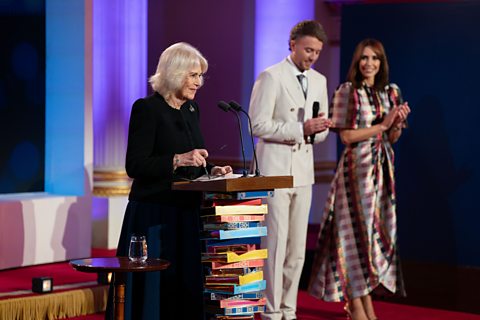
Watch Her Majesty The Queen present the winning stories at the 500 Words final 2024/25
FAQs
If you have any queries then we have the answers for you. Check out our list of frequently asked questions for 500 Words