 Image source, Oxford University Press
What does Taylor Swift and capybaras have in common? Well, they both feature heavily in 500 Words’ stories – according to the Oxford University Press’ report for this year’s competition.
One of our official partners, Oxford University Press, has compiled a report into the words and themes used in stories in the competition each year since 2014.
The analysis is studied by lexicographers, researchers and teachers. The data is incorporated into the Oxford Children’s Corpus – a large database of children’s written language in English.
Highlighting the importance of 500 Words, the report reveals a unique insight into the thoughts of children aged 5-11 across the UK. The competition received almost 44,000 submissions and each one is read and studied.
Watch three of our official judges, Sir Lenny Henry, Frank Cottrell-Boyce and Charlie Higson, break down last year’s report for children in the classroom.
500 Words judges Sir Lenny Henry, Frank Cottrell-Boyce and Charlie Higson break down the Oxford University Press report from the 2023/24 competition.
LennyDid you know, every single story entered into 500 Words changes the way reading and writing are learned around the world?
Each year, our friends at the Oxford University Press look at every one of your stories and create a special report on children's language.
It tells us a lot about you, what's important to you and the words and phrases that you use in your stories. Here's what we found out from last year's report.
FrankYou're thinking about the future of our planet. Climate change was chosen as the 2023 Oxford Children's Word of the Year (um, it's actually two words…) because so many of you chose to write about it in your stories.
What new ways could climate change and the environment feature in your stories this year?
CharlieYou're inspired by new technologies. Stories from the 500 Words 2023 competition used the word AI five times more often than in 2020.
What do you think the future will look like? Could your story take place in the distant future or could you take new technologies into the past?
LennyYou're influenced by world events like wars. Words related to Gaza, Ukraine, Israel and Palestine appear more often in stories from 2023 than from 2020. What world event could inspire your 500 Words story?
FrankYou like stories about heroes. The word Lioness appeared a lot in 2023 but not only in stories set in the zoo, over half of these mentions were about football.
Do you play any sports, have you been inspired by successes in the Euros, the Paralympics or the Olympics?
CharlieLots of your stories used creative similes to help describe a scene a simile compares two things by using the words like or as. Like these examples from last year's 500 Words stories.
"It was as dark as a raven flying across the misty night sky", "He is now as rich as a Victoria sponge", or "Mum sounded as angry as a bee whose hive was poked by a stick". What language could you use to paint pictures of the story in your reader's minds?
LennyWe can't wait to find out what you're going to write about this year. Your story will be part of something incredible! So get writing, go to bbc.co.uk/500words to send it to us! What are you waiting for?
Who are children writing about?
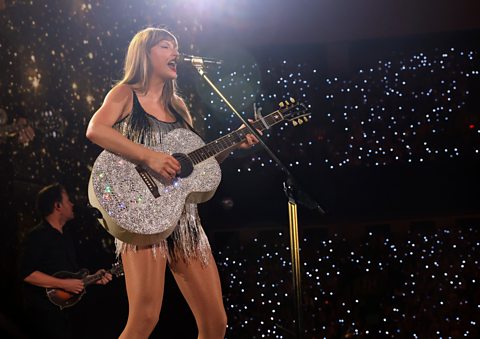 Image source, Getty Images
Pop superstar Taylor Swift was the most featured celebrity in children’s stories for this year’s competition – the singer had 219 mentions and an increase of 170% from the year before.
His Majesty The King was the second most mentioned famous person. Her Majesty The Queen was the seventh, often used in the context of inviting the story’s protagonist for tea at Buckingham Palace as a reward for good behaviour.
Other celebrities that ranked highly were Cristiano Ronaldo and Lionel Messi. They are the only footballers who have appeared in children’s top list of famous celebrities, both a decade ago and today.
Image source, Getty ImagesHow is social media influencing children’s vocabulary?
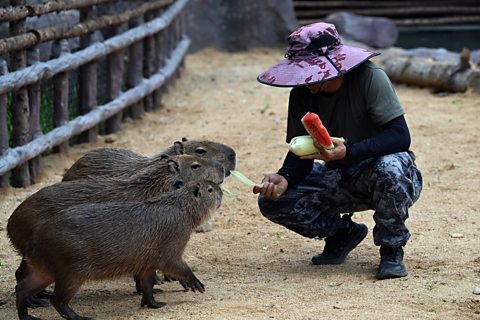 Image source, Getty Images
Fuelled by a viral TikTok trend, the South American giant rodent, capybara, had an increase of mentions by 11%.
Back in 2015, the report revealed that vlogger was a new word in children’s writing. In 2024, a new term has been revealed; fanum tax, which means stealing food between friends. The term has been inspired by content creator Fanum, who would jokingly steal food from friends during his live streams.
The usage of Facebook, FaceTime, WhatsApp, X, Snapchat and Spotify have all appeared in stories more frequently than they did in 2023. YouTube appears in the stories but is used mostly by boys, whereas the other platforms are used more by girls.
Image source, Getty ImagesOver a decade of study
Oxford University Press has published the findings of report since 2014. Children’s language has evolved since then and key trends and have been identified, but what has remained the same?
In 2014, Jack and Lily were the top character names in stories and remain so in this year’s competition.
Cinderella is the only fairytale character that appears in both 2014 and 2024’s list of top ten characters, alongside Harry Potter, Superman and Batman.
Gaming is still a popular trend in stories - Minecraft is the number one game written about both a decade ago and today.
Helen Foulkes, Head of BBC Education, said: “This report shows how children’s language is influenced by what they see and the media they consume whether that’s timeless favourites like Cinderella or trends on social media. We’re proud to celebrate the fantastic stories children have submitted from all across the UK to the BBC 500 Words competition and our ongoing collaboration with Oxford University Press provides crucial insights into how children’s language continually develops.”
Andrea Quincey, Director Early Years and Primary Publishing, Oxford University Press, said: “Every year it is a joy to analyse the fantastic stories submitted to the BBC 500 Words competition and produce our language research. The competition not only plays a vital role in supporting children’s creative writing but also contributes to one of the nation’s largest bodies of ongoing research into children’s language. Every story is added to our Oxford Children’s Corpus, one of the world’s largest databases of children’s written English, which allows us to research and track the evolution of children’s language over the years. Whether it’s identifying new words, or ongoing themes, this research is central to understanding how children use language to engage with the world around them.”
What are the 500 Words prizes?
There are many prizes to be handed out to the gold, silver and bronze recipients.