
Features: Growing a cutting garden

Ideas from Tatton 2010
Our horticultural researcher, Gilly Brennan, shares some of her favourite and inspiring finds at the 2010 Tatton Park Flower Show.
Mystic moss
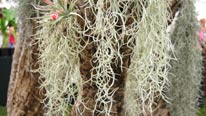
If you've got a tree in your garden with slightly bare lower branches, try draping them with pale grey strands of Spanish moss. It instantly adds a wonderful ethereal, almost mystical effect to your garden.
Spanish moss, Tillandsia usnoides, is an air plant, it has no roots and anchors itself by gently hooking on with its curved leaves. To keep it happy in dry weather mist it with water; airplant expert recommends adding a few drops of dilute liquid fertilizer to encourage it to grow – it can double in size in a year! In warmer parts of the country it can survive outside all winter.
Shiny shells
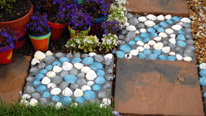
The children of St Oswald's Catholic Primary School have used cockle shells in lots of imaginative ways in their little front garden called 'Mary Mary…'
They've painted them blue and silver and pushed them into wet cement to decorate their path and ornamented the gate and walls as well. Finding ways to use up all those carefully collected shells could be a fun project for children once those beach holidays are over.
Double delight
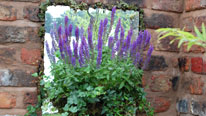
The atmospheric back to back garden, 'Lost Beauty' was designed and created by students from Holland and is about Mary Fitton who lived at Gawsworth Hall. On one of the old brick walls they have hung a mirror and in front of it, a pot of blue salvia.
It's such a simple idea but very effective – you double the size of the plant and add depth to the garden by giving the impression of a window.
Black beauty
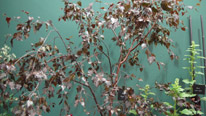
The Hardy Plant Society won a Gold medal for their stand 'A Modern Garden' in the Floral Marquee. The planting was beautiful and very sophisticated with a colour scheme of black, silver and purple/burgundy.
In pride of place was an excellent, very dark leaved birch called Betula refugia 'Royal Frost', it had coppery red bark which had been polished with almond oil and the leaves were an almost silvery black. It doesn't grow as big as regular birch and would be lovely in a smaller town garden.
Bird banquets
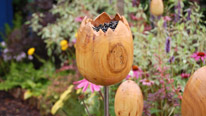
Birds were well catered for a Tatton this year. On 'A Banquet for Birds' back to back garden, Sue Beesley's seed holders were made by cutting the tops off wooden 'eggs', hollowing them out and filling with sunflower seeds.
They were on metal spikes that just pushed into the ground.
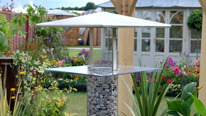
For urban, upwardly mobile birds there was a very chic perspex and metal birdtable with a support covered in chicken wire filled with pebbles. It looked great but the squirrels might find it easy pickings.
Plants with pulling power
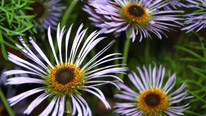
When you walk through the Floral Marquee some plants just shout out to be noticed. This year there were two that I couldn't pass by.
On Hall Farm Nursery stand I was lured by an aster of all things! It was Aster diplostephoides, an alpine type of aster, 30-50cms high with a basal rosette of leaves.
The flower has very fine petals of clear violet blue and a large golden centre. It's fully herbaceous and likes an open sunny site.
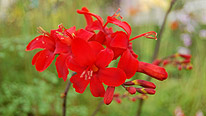
Across the way the large, rich red flowers of Crocosmia 'Hellfire' shone out from Cath's Garden Plants, they are almost velvety - larger than 'Lucifer' and new to Tatton this year. How can you resist?
Magic circle
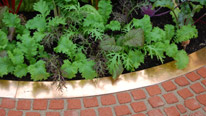
If slugs are the bane of your life and eating your veg before you can – take a tip from the back to back garden designed by Finchale Training College. Called 'What Grows Around', it includes a circular vegetable plot with various crops fanning out from a central display of peas and beans.
Around the edge is a 10cm copper band, this not only looks attractive but is a great deterrent to slugs and snails.
Summer sensation
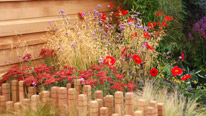
Once again it was the back to backs that came up with winning ideas. 'Shower Time', designed by Matthew Hardcastle won Gold and Best in show for his outdoor shower and plunge pool surrounded by gorgeous summery planting.
One combination that really caught the eye was the golden grass Deschampsia 'Goldschleier' with red Crocosmia 'Lucifer', Dahlia 'Bishop of Llandaff' and Achillea 'Red Velvet' contrasting beautifully with purple Verbena bonariensis.
With the sun shining it was reminiscent of a wheatfield and poppies.
Features
Take part
BBC iD
BBC iDBBC navigation
BBC links

BBC © 2014The BBC is not responsible for the content of external sites. Read more.
This page is best viewed in an up-to-date web browser with style sheets (CSS) enabled. While you will be able to view the content of this page in your current browser, you will not be able to get the full visual experience. Please consider upgrading your browser software or enabling style sheets (CSS) if you are able to do so.

