| 24 September 2014 |

| |
| BBC Homepage | | |
| |||
| Contact Us | | |
River OrwellYou are in: Suffolk > Places > River Orwell > Master of the Orwell 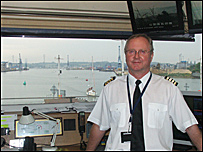 Captain John Woolley, Harbour Master Master of the OrwellBy Wendy Rose There is a balancing act taking place at the Ipswich Wet Dock, where it's the Harbour Master's job to make sure the Wet Dock stays wet. The River Orwell is 11 miles long and tidal, which used to cause problems for ships and boats because they would be left stranded in Ipswich at low tide. Harbour Master John Woolley said: "Without the water the yachts would sit on the bottom and some of the dock walls may collapse. "The volume of water is holding the walls up and the weight of the buildings on the quay would crumble the walls without the water, so it is a kind of balancing act." Captain Woolley is the Harbour Master for both the Port of Ipswich and the Port of Lowestoft, having worked in Ipswich since 2003 and Lowestoft since 1994. Once the largest wet docks in the UK, "Ipswich Wet Dock was constructed by dredging and cutting the meanders of the River Orwell. The river now runs down the New Cut, a channel that bypasses the wet dock." 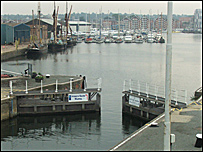 Lock gate closing as the tide goes out The Lock"The Ipswich Wet Dock is mainly for leisure vessels and is 10.60 hectares with berth for 385 vessels. The water level is kept at 6.40 metres and is controlled with a lock," said John. Once the tide starts to go out the lock gate is closed. There is a meter in the control tower that tells the controllers exactly how high the water level is and as soon as it hovers and then starts to go down they close the gate. The lock is manned 24 hours of the day! The lock master also logs each yacht coming in and out of the lock. The lock holds up to 20 32ft yachts at a time but usually it has between six and 12. Every time they open the gate they lose a little water but not enough to cause a problem. "The Ipswich Wet Dock took the shipping traffic from the eight hard areas around the estuary. When the boats became too big and heavy to enter the dock they developed three berths at Butterman's Bay, where the ships used to stop to unload their cargo onto barges. "Every property on the quay is responsible for the piece of wet dock in front of their buildings that includes maintaining it. They originally would use the berth for unloading and loading their own cargoes." DredgingAt low tide the river is mudflats and the silt builds up in the river and stops the ships delivering their cargo to the town. It is the Harbour Master's job to maintain the navigation channel in the River Orwell. "Once a year the river is dredged using a survey vessel with sonar to measure how deep the water is coming up the estuary. The depth is kept at 5.6 metres when the tide is out and at high tide there is usually between 3 to 4 metres more water in the river." It is John's job to know at any particular time how high the river level is and gauge whether or not to let a ship come up the river. This depends on how fast the ship is moving and how quickly the tide is going out or coming in. Ship sizeThe Port of Ipswich has 1640 metres of quay on the river below the Ipswich Wet Dock and 64,000 square metres of covered storage. "The port's cargo is generally raw materials such as timber, cement, grain, fertiliser, animal feeds, aggregates, liquid bulks, containers and roll on/roll off container traffic." 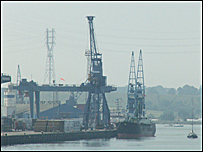 Cargo ship on River Orwell The size of a ship's depth (draft), height and length will dictate as to whether it can get up the river to the dock or not. As a ship sails through the water it actually bounces up and down (squat) and needs 10 per cent on top of its draft (under keel clearance) to clear the water safely without grounding. An oil tanker needs even greater clearance owing to the nature of its cargo. The ships keep between the green and red buoys, which is the area that has been dredged and varies as the river widens. The river's turning area at the top of the Orwell is 190 metres. The largest vessel the Ipswich Port will take is 155 metres long, and such a vessel would have difficulty turning around and would need a tug to help it manoeuvre. The clearance height for the Orwell Bridge is 43 metres at low tide. RadarIn the control tower there are radar screens that track each ship or yacht going up and down the river and the vessels' speed is measured with the help of the buoys. Each ship or yacht when fitted with an Automatic Information System (AIS) can be tracked. This sends the vessel's name and position to the control tower via satellite navigator system and this is logged on to the radar positioning system. The names of the ships on the river are displayed on screen so that it is easy to track their progress up or down the Orwell. 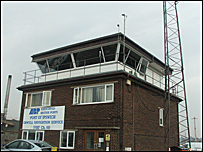 Harbour Master's control tower There are also screens monitoring different areas of the river, the Orwell Bridge for example. It is also possible to track even the very small boats as their wash leaves a trail which shows up on the screen. So nothing enters the estuary without the Harbour Master's knowledge. last updated: 08/08/2008 at 15:32 Have Your SayHave you any interesting story to tell us about the River Orwell? So the "Ipswich Wet Dock is mainly for leisure vessels and is 10.60 hectares with berth for 385 vessels. The water level is kept at 6.40 metres.The depth is kept at 5.6 metres when the tide is out and at high tide there is usually between 3 to 4 metres more water in the river.The Port of Ipswich has 1640 metres of quay on the river below the Ipswich Wet Dock and 64,000 square metres of covered storage.The river's turning area at the top of the Orwell is 190 metres. The largest vessel the Ipswich Port will take is 155 metres long.The clearance height for the Orwell Bridge is 43 metres at low tide."And yet "The River Orwell is 11 miles long. The lock holds up to 20 32ft yachts"Come on BBC. Stop this metric/Imperial schizophrenia. I really don't care if it's all metric or all imperial - but why this hopeless muddle of both? SEE ALSO
You are in: Suffolk > Places > River Orwell > Master of the Orwell |
| | About the BBC | Help | Terms of Use | Privacy & Cookies Policy |