| 24 September 2014 |

| |
| BBC Homepage | | |
| |||
| Contact Us | | |
River OrwellYou are in: Suffolk > Places > River Orwell > Bombarded birds 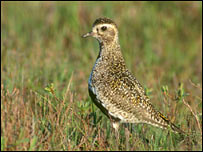 Golden plover (photo: RSPB) Bombarded birdsBy Wendy Rose "The River Orwell estuary is the worst performing estuary in Britain when it comes to birds" - that's according to the British Trust for Ornithology. Mick Wright is estate manager for Suffolk Wildlife Trust and he works at the nature reserves at Trimley Marshes, Levington Lagoon and Orwell Country Park. He is also regional representative for British Trust for Ornithology (BTO): "There is a decline of 12 species out of the 17 that inhabit the estuary on alert status, which means that there numbers have declined significantly. The Orwell has been designated as a Special Protection Area (SPA) and a Ramsar site, reflecting the international importance of the estuary for wildfowl and wading birds. 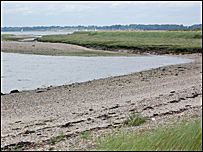 River Orwell next to Trimley Marshes "A wetland is considered internationally important if it regularly holds at least 1 per cent of the population of one species of water bird. Help playing audio/video "The Orwell has lost international importance for dunlin and golden plover because the wetlands no longer attract 1 per cent of the bird population there. National status has also been lost for wigeon, ringed plover, lapwing, curlew, shelduck, grey plover and dunlin for the same reason. "The other species in decline are great crested grebe, cormorant, pintail, black-tailed godwit and redshank. My main job is to organise all the national surveys at county level. "At the moment we have a huge survey over the next five years. The surveys are carried out by rangers and volunteers from Suffolk Wildlife Trust (SWT), BTO and RSPB who count the birds in different places around the estuary." Reasons for the declineMick Wright outlined some of the reasons, he said: "The statistics show that it is disturbance that is causing the birds to evade the area particularly on the mudflats on the Orwell at low tide. "Sailing boats are pretty good but we are getting more and more motorboats on the estuary. The water authorities have just brought in a speed limit of 6 knots (7 mph). "Throughout the three year research programme that we've just had, we have discovered that motorboats can disturb birds at the low water mark. "Another reason for the decline is global warming. We are into our 16th year in succession of mild winters and birds are reacting to that. Instead of coming right down here to see the winter out they are moving east. 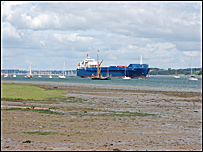 River Orwell mudflats and container ship "Recreation is also a problem. There is no other estuary with the amount of recreation the Orwell's got. "The Orwell doesn't help itself. It is a beautiful estuary close to the sea with lots of bird habitats along its shore and this encourages tourism. "Walkers particularly with dogs cause a lot of problems. Keeping dogs on their leads in nature reserves is important because dogs have a tendency to run into the undergrowth and disturb birds who are roosting or sitting their eggs." Added threatsBill Parker, Suffolk Estuaries Officer and acting manager of Suffolk Coast and Heaths Areas of Outstanding Natural Beauty unit said: "We needed the statistics so that we have proof of the decline and we can now act on them. "There is a tension between man and bird on the estuary and finding a balance between the two isn't easy. "What could have an even greater impact on the bird population is a coastal access bill in the House of Commons that is designed to give walkers a path around all coastal areas. This would include filling in the gaps where there isn't a path on the Orwell." Andrew Smith is a communications officer for Natural England, which is part of the DEFRA (the government Department of Environment, Food and Rural Affairs): "Natural England financed the research report. We see it very much as a first step in trying to identify recreational and other impacts on bird populations in the Stour and Orwell estuaries. "This research will lead to more detailed discussions with local users about managing any possible disturbance to birds in the area. As a general principle Natural England promotes access to wildlife. "We cope with any impacts on wildlife through the way we manage access." Another added threat to the birds is even more people coming to live in the area. Bill said: "The possibility of new housing being built in Felixstowe and the areas surrounding the Orwell could also impact on the bird population." What we can do to help the birdsBill Parker said: "We intend to put up signs on paths asking walkers to keep their dogs on leads and to explain why this is important. "On the places where boats and ships sail from or land we are putting up signs reminding them of the new speed limit of 6 knots (7 mph) and explaining why. It is going to take a while to educate the public about conserving nature. "We hope to work with SWT and Ipswich Borough Council, who own the nature reserves, on specific solutions for specific parts of the estuary but this could take time to develop." Mick said: "Solitary noises like guns going off also scare birds. The constant drone of the traffic on the Orwell Bridge or the cranes at the Port of Felixstowe doesn't seem to affect them."  Peregrines on the Orwell Bridge I suppose it's what you get used to! Good newsIn 2008, Peregrine Falcons have hatched chicks under the Orwell Bridge for the first time in Suffolk for 200 years. Paul Davey at the Port of Felixstowe said: "We have had Peregrine Falcons nesting in the cranes here." There is a shortage of cliff faces in Suffolk and so the peregrines have had to make do with the next best thing! Help playing audio/video last updated: 01/08/2008 at 14:10 Have Your SayWhat can be done to stop the decline in birds on the River Orwell estuary? SEE ALSOYou are in: Suffolk > Places > River Orwell > Bombarded birds |
| | About the BBC | Help | Terms of Use | Privacy & Cookies Policy |