| 29 October 2014 |

| |
| BBC Homepage | | |
| |||
| Contact Us | | |
ReviewsYou are in: Suffolk > Entertainment > Theatre and Dance > Reviews > Morris Offspring: sticks, hankies and a unicorn 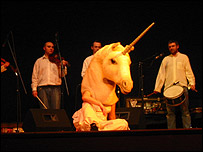 Morris Offspring: sticks, hankies and a unicornBy Rachel Alexander, April 2006 The English Acoustic Collective brought their updating of the morris dancing tradition to the Angel Theatre in Rendlesham. The troupe claim Billy Bragg as a fan. My only experience with morris had been at the Aldeburgh Carnival so I was therefore surprised to learn that there was not only a theatre at Rendlesham but that a group of more alternative morris dancers was touring the country. 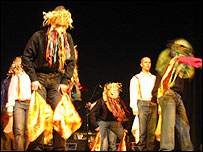 What is Morris Dancing? Well briefly it is a form of folk dancing. There are English records mentioning the Morris Dance dating back to 1448 and dances with similar features are mentioned in Renaissance documents in France, Italy and Spain. One of the commonest explanations for the name ‘Morris’ is that it is derived from ‘Moorish’. Some Morris men dance with blackened faces which may represent the Arab foes from the time of the Crusades. Another is that it comes from the Romanian ‘Morisca’ which means ‘little mill’ or another simpler explanation is that ‘Morris’ is the Latin word ‘mores’ meaning ‘a custom’. The origins have been lost in history but prevalent opinion is that Morris is based on pre-Christian fertility or luck-bringing ceremonies. Over time these pagan dances were absorbed into the church and by the 1500s Morris was being performed for Easter, May Day and other parish feasts to help raise funds for the local church. 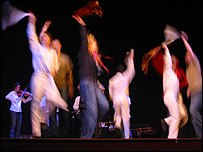 A blur of hankies The MorrisOffspring began their evening performance with a traditional dance. Their costumes were white, rather like a village cricket team, and they created a great social and lively scene within minutes by dancing an alternative Cotswold dance ‘face to face’. Every dance told a different story, costumes were changed and an assortment of props used. Elaborate head pieces were sometimes worn and large handkerchiefs waved. A number of dancers held wooden sticks or metal poles and whilst weaving in and out of each other managed to hit them above their heads before then striking the floor creating a very energetic and noisy display. 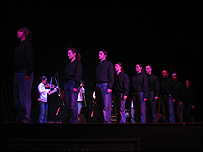 All the young dancers demonstrated amazing suppleness and strength as they performed more and more challenging manoeuvres. There was one particular dance where two of the performers tried to ‘out dance’ one another and this brought comedy and fun into the show as the saying ‘anything you can do I can do better’ came into its own. The lively folk music being played during these high-impact dances was on the violin, guitar, concertina and drum and therefore very reminiscent of traditional English folk dancing and village fairs. This complemented the stories that were being woven into the dances, one such ‘jig’ was Beauty & the Beast where one of the girls wore a beautiful unicorn head piece while another had on a large boar's head with tusks and they told the story of how every individual can celebrate the fact that they are different from one another. 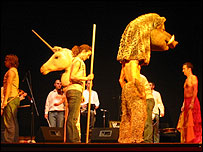 Beauty & The Beast The morrisOffspring may not be everyone’s kind of dance but they certainly performed a very professional and spectacular exhibition of strenuous leaps, exhausting step routines and dangerous stick-wielding clashes that I wouldn’t be surprised to see a revival of Morris Dancing catching on in clubs and even being taught in schools. last updated: 16/07/2008 at 11:33 SEE ALSOYou are in: Suffolk > Entertainment > Theatre and Dance > Reviews > Morris Offspring: sticks, hankies and a unicorn   |
| | About the BBC | Help | Terms of Use | Privacy & Cookies Policy |