| 13 November 2014 |

| |
| BBC Homepage | | |
| |||
| Contact Us | | |
FeaturesYou are in: Suffolk > Don't Miss > Features > RAF Felixstowe 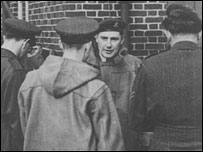 Felixstowe Floods 1953 RAF FelixstoweTrevor Purling At the time of the floods, on the night of 31 January 1953, I was doing my National Service as a Pilot Officer, Fighter Controller, at the radar station RAF Trimley Heath, which was a few miles inland from Felixstowe.
Help playing audio/video RAF Felixstowe was our “domestic site” i.e. that was where we lived. RAF Felixstowe was also home to the Marine Aircraft Experimental Establishment (MAEE), a RAF marine air-sea rescue unit with two high speed launches operating from the then Felixstowe Dock, and a RN detachment who looked after a number of motor torpedo boats which were laid up in one of the hangars. A mobile radar convoy was stored on the camp. The equipment for the naval boom defence of the estuary was stored near the dock. 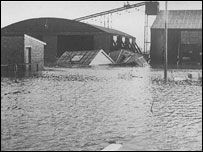 East Coast Floods 1953 The weather that day was very cold, with high winds and the odd shower of sleet or snow. About 8.30 pm I was having an after dinner drink in the mess when the Duty Officer came in. He said that the Orderly Officer at Trimley Heath was not too happy because the Bessaneau hanger - which housed an Auster aircraft - was at risk of blowing away. This was not surprising as that type of hangar is a rather flimsy structure of scaffold tubes and tarpaulin (dating I believe from the first world war). Although I was off duty he asked me to take a party of men up there to try to secure it. Equipped with ropes, corkscrew pickets and ladders we managed to tie down the hangar. By then we were all very cold and wet through and had just about had enough, so I telephoned the cook house at Felixstowe to lay on some hot supper. Returning to Felixstowe at about 10.30 pm we had just finished our meal when the Tannoy announced tersely “Anyone who can drive report to the MT section”. The MT section was at the south end of the station and very low lying. I think everyone realised what had happened and some one remarked “The sea has broken in”. I set off down the road to the MT section but was soon met by two strange sights. First was a large expanse of water the edge of which was approaching rapidly. The second was the Station Commander sitting in his Vanguard staff car up to his waist in water. The car was being towed by a fire tender and water was pouring from around the doors. Somebody immediately coined the phrase “Boudecia in her chariot”. It should be said here that the CO, Wing Commander “Charlie” Winn, was a bit of a character and a typical leader of men. He had arrived at the MT section to find several feet of water. In his inimitable style he decided that a high wheel base truck would be more useful than his car, and had charged at the water to try to reach one. The result - he and his car were inundated. On a more serious note, the CO spotted me and shouted “Take a crash tender and cut the crash gates open. We may need to get out that way.” This I did. As we went along the road outside the camp fence we had to drive with the nearside wheels on the kerb to keep the engine out of the water. 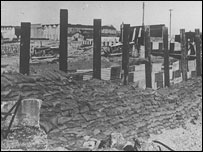 East Coast Floods 1953 As we cut the chains on one gate one of the fire crew spotted a baby floating past in the water and grabbed it. I think it was a little girl. We set off towards the town and eventually met a taxi. The driver volunteered to take the baby to the hospital. The road where we found the baby also went on to Landguard Fort past some Army married quarters. The story at the time was that an Army sergeant left his quarters with his wife, and holding his baby. It seems his wife took fright and turned back to the house. He was unaware of this and continued, holding on to the fence of the RAF station. A surge of water as a piece of fencing collapsed swept him away and he lost his hold on the baby. I believe he was drowned. On returning towards the camp we drove round the pre-fab estate ringing the bell on the tender and shouting to get to higher ground at the sea front. Unfortunately nobody took much notice, apparently because they were used to water coming on to the sea front and running down to Langer Road. When we reached our camp the water level made us abandon the crash tender. We stood rather disconsolately on the veranda of the guardroom, being joined by the CO. Somehow a message arrived saying that the telephone exchange was on fire. The CO, myself and a corporal (fireman or RAF police?) set off for the exchange with fire extinguishers. The rest of the men were told to stay in the guardroom. At the exchange we found no fire. The water lapping under the grate of a coal fire had caused sparks to go up the chimney. The airman on duty as telephone operator had, rather gallantly, remained at his post. It was now obvious that the situation was untenable so I cut off the batteries and we made to leave. We were only in there a matter of a few minutes. There were three steps up to the door of the exchange. As we went in the water level in the road was about up to our knees. On leaving it was also up to our knees, but now while on the top step! It was about midnight and the sudden rise in water level was when the main breaches occurred in the river wall of Languard marshes. 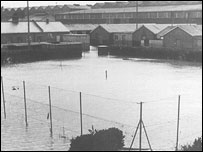 East Coast Floods 1953 Little more could be done for the moment. An onlooker would have enjoyed an odd sight. That of one CO, me, the corporal and the operator holding hands while wading through the waist deep water. There was good sense in this. There was a chance of one of us being swept away by the strong current. Also there was no way of telling what lay under the water. The CO had already gone down a sewer manhole where the lid had been blown off by water pressure. We went across the road, and into the upper floor of the NAAFI block. We were very cold and soaking wet. Someone had got a load of blankets up there and we all curled up together to keep warm and try to get some sleep. We were better off than some. The RAF police and firemen who had stayed at the guardroom spent the night on the roof. To get there they had had to climb over the large spikes which turned downward around the yard to prevent escape of prisoners. The following morning the tide had receded somewhat but there was still several feet of water in parts of the camp. There were things to be done and that meant wading into the water again. I always remember how icy cold that water felt. This had not been so noticeable during the excitement of the previous night. The situation was that an operational unit, concerned with the air defence of the UK, was completely isolated, both physically and in terms of communications. The first priority was a check on personnel. Service men are fit and active and tend to be able to look after themselves, and most had been able to take refuge somewhere. It was in some ways fortunate that, being a Saturday, many were on weekend leave. Unfortunately one airman was swept out on to the marsh and drowned. A member of the WAAF developed pneumonia, apparently due to shock. Two Pilot Officers, Messrs Graham and Greenwood got to the hospital in town by half swimming, half crawling, along the railway embankment. They returned the same way with penicillin and the girl was successfully treated. There were also concern for the people in the married quarters alongside Langer Road. The other objective was to get up to the town to send a message about the position at the camp. This journey was a bit ambitious. Fortunately we met up with two officers who had come from town in a boat with oars and they took the message. Some men managed to get into the control tower on the apron and rescue an emergency VHF radio set. Our first contact with the outside world was with an aircraft flown by, I think, the Wing Cmdr Ops from RAF Wattisham. He was circling overhead to see if any of us were still around. 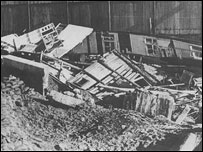 East Coast Floods 1953 Later we were able to set up a make-shift communications centre. Most of the mobile radar vehicles were ruined but we managed to salvage a VHF radio truck and a diesel generator truck. The Army gave us a field telephone exchange which was connected to the exchange in town via a field telephone line. These arrangements served for two or three weeks. Meanwhile the Army got to us through the water using their large, high, Matador trucks. Most of the personnel were evacuated to other RAF stations, and the families were also moved out. A group of about fourteen of us, mainly RAF police and firemen, stayed on the camp to keep an eye on things. Soon the revival of the camp started with working parties being bussed in each day for two or three weeks. A RAF Airfield Construction Squadron moved in to make emergency repairs to the sea wall. Large mobile pumps, I think from the Metropolitan Water Board, began pumping water off the marsh. A tremendous amount of damage had been caused. Water levels varied considerably with the ground height, but were on average about 4 to 5 feet. In the low lying MT section a depth of 17 ft 10 inches was later recorded with a brass plate. My recollection is that 76 vehicles were lost, including the radar convoy. Petrol bowsers floated across the MT yard and one crashed through the front of a hangar. A number of buildings suffered damage. Much of the workshop equipment and records of MAEE was ruined. An example was the Officer’s Mess, a unique and charming building which, I believe, dated back to the 1914 war. A lot of oak panelling and other features were ruined. I recall sensing the sadness of the civilian mess staff, many of whom had spent most of their lives caring for that Mess. 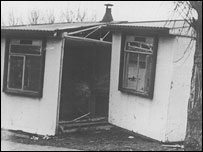 East Coast Floods 1953 I recall the view along Langer Road, with smashed pre-fabs in the middle of the road and one of them jammed between two houses on the other side. There was also one of the large bouys of the boom defence between the upper floors of two houses. The officer in charge of the boom had always been quite obsessive about the security of his equipment. He must have been distraught when he saw it spread all over the marsh. The services had not been totally unprepared for flooding. There was a national plan called King Canute in which certain stations held equipment such as sandbags. In the event of flooding the men and equipment from these sites could render assistance to the community. One such site was RAF Felixstowe, as things turned out not too wise a choice. When the cry went up “Where is King Canute” the answer was “Under water, with all his equipment”. A couple of days after the floods happened I was walking past the rear of the station HQ when I saw the Orderly Room Sergeant. He was leaning out of the window holding a file and carefully dipping each page in the water. I asked the obvious question. The reply: “This file holds all the problems I have not been able to deal with in three years, I’m making damn sure they have been lost in the flood”. I was talking to a senior officer on the steps of the officer’s mess when another officer approached, obviously wishing to make an impression. Now this SO liked his drink in the bar and tended to have a sizeable mess bill. The other officer proudly stated that he had recovered the mess books. The response from SO was predictable. “Well throw them back, you bloody idiot!”. I always suspected that the next report on that officer contained the phrase “lacks initiative”. About two weeks after the flooding there was another period of high tides. Due to the temporary nature of the repairs to the river wall a patrol was mounted to keep a check on the situation. Communication was by walkie-talkie radios which the Army had provided. All went well until a log got caught in one of the drain flaps on the marsh, and water began to flow in again. Sorting this out involved messages which included rather robust military language. We were then informed that all this could be heard on TV sets as far away as Ipswich, so more formal communications had to be used. last updated: 17/11/2008 at 15:12 Have Your SayAnthea Youens (nee Waterston) PETER C EASTHAM Sheila Colbran SEE ALSOYou are in: Suffolk > Don't Miss > Features > RAF Felixstowe
|
| | About the BBC | Help | Terms of Use | Privacy & Cookies Policy |