| You are in: Stoke & Staffordshire Features » |
September 2002
The day the Burslem Clock stopped | |
| 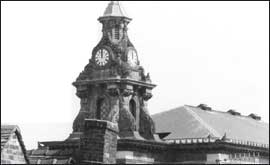 | | Burslem Town Hall |
| | The North Staffordshire History Detective, Fred Hughes, goes high and low to get his stories.
In this investigation, he gets up into the belfry high over the Mother-Town of the Potteries... |
|
:: Have your say » | What do you think of this story?
Do you have a story for Fred?
Send us your thoughts -
Have your say |
:: Pass it on!» | | E-mail this story to a friend - click here |
:: And there's more» | Click here to return to main Local History Index for more history stories
Main History Pages |
:: Seen a mistake?» | We're only human - we make errors.. if you see one, or there's a broken link...
Please tell us |
:: Do you photo?» | We always need pictures. Do you have any relevant pictures you can let us use?
We'd be soooo grateful | |
| |
Probably Burslem's most famous landmark is the Italian-styled old town hall.
It was opened in 1857 to enormous acclaim as some 14,000 notables gathered for a public dinner comprising of 124 choice courses prepared and served by Mrs Lees of the Leopard Hotel across the way.
As well as being Burslem's first concert venue, the town hall came to provide offices for the new Town Council in 1878 when Thomas Hulme, a partner in MacIntyre Pottery, became the first mayor.
The famous coat of arms bearing the legend 'Ready' was incorporated at the same time.
Arnold Bennett
It was here that Arnold Bennett set his prestigious Countess of Chell's ball in the Five Towns novel 'The Card', made into a film starring Sir Alec Guinness with many locations filmed in Burslem.
In Bennett's greatest novel 'The Old Wives' Tale', the author had the head of the Baines family checking out his own watch each day by setting it to the town hall clock's chimes.
On one occasion it was once pointed out to him that his watch and town hall clock bell told different times. Baines reasoned that it was impossible that his watch was wrong - there must be another cause: - 'Then th' Town Hall's wrong', he blustered.
This famous Bennettism set me on my case to find out exactly what made the Town Hall clock work.
Inside the belfry
I knew that the gubbins had been originally located in the bell tower with a weighted pulley-and-hammer mechanism that struck a single tenor bell. The mechanism had been designed and constructed by J. Smith, a Derby clockmaker, who - as rumour had it at the time - was asked by the miserly benefactors to make a 'cheap clock for as little money as possible'.
Over the decades the clock kept reasonably efficient time until the late 1960s when it stopped altogether. Repairs were made but - to put it as one local clock engineer did in 1970..... 'It's pretty much buggered'.
During the development of the Ceramica project in 1999, the pulleys and weights, fastened in the racks that held them, were removed and a simple electric gadget was installed. This I needed to see for myself.
Evidence of the past
High above Burslem, among the old 1857 rafters, I found that Smith's original clock workings, consisting of a couple of brass geared cogs connected to a thin pulley and an offset axle rod, were all that remained of the 'cheap little clock'. 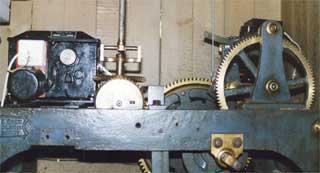 |
The old wind-up clockwork box was still in place but modern engineers had now connected it to a small computer and, of course, powered it by electric.
Case solved, I returned to the pavement of Market Place in time to hear the noon bell chime. I checked my own watch to make sure. One of them was ten seconds out.... It couldn't be the town hall clock, could it?
Fred Hughes
More Fred Investigations
Discovering Wades Whimseys | | | |
|
| |  | BBC Stoke and Staffordshire
Cheapside
Hanley
Stoke-on-Trent
Staffordshire
ST1 1JJ
tel: (+44) 01782 221281
e-mail: stoke@bbc.co.uk |
| |
|
|