| You are in: Stoke & Staffordshire Features » |
Summer 2002
A handful of history | |
| 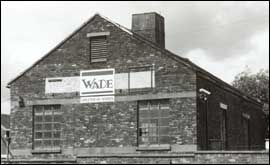 | | The old Wades works in Burslem - now demolished |
| | The Stoke on Trent historian, Fred Hughes, believes in getting his hands dirty! - so he's been to the demolition site where once stood the famous Wades factory (left).
So starts the story of the Hallens, van Hallen, and the Wades' "whimseys". |
|
:: Have your say » | What do you think of this story?
Do you have a story for Fred?
Send us your thoughts -
Have your say |
| | Very soon there will be a new housing estate in Stoke on Trent on the former Wades' factory site in Green Head Street in Burslem town centre.
I have been a bit disappointed that the former Shaftesbury school has been demolished - but I am reconciled to progress and of course what Burslem needs is new residents.
Whimsey pickers!
So I went to have a look after the demolition was completed and, on a sunny Sunday, I gazed over a flattened piece of land that once hosted one of the most important pot works in the town. Among the rubble was an army of people clustered together in small groups rummaging around among the debris.
I asked a couple of chaps what they were looking for. 'Whimseys' was the abrupt reply. And then I realised, of course this is what Wades' had been famous for in recent times!
The "whimseys" were a line of very collectable small ceramic character-figures made by Wades.
It was quite interesting to watch all these people searching for some intact piece of memorabilia that might fetch them a bob or two.
Just then I bent down and lifted from the clay an odd-shaped piece of porcelain. I cleaned it and showed it to my ferreting companions who scoffed and resumed their digging.
200 year old find
What I had found was far more interesting to me than the animal characters that my friends prized.
What I had lifted was a broken ceramic bobbin that had probably last seen the light of day 200 years before, during the height of the Industrial Revolution.
Hallen pottery on the site
Between 1790 and 1850 a large family named Hallen had worked at a number of pottery outlets throughout the North Staffordshire district. One of these scattered members was Samuel Hallen who lived and worked at Chesterton in nearby Newcastle.
Samuel married Elizabeth Riles who belonged to an early Burslem printing family.
In the 1830's, a later Samuel Hallen acquired a potbank from the Mitchell potters at the top of an area known as the Sytch, overlooking Oxley Fields and Brownhills.
It was here that the Hallens concentrated on the lucrative market of supplying ceramic 'pickers', shuttles and creels to the textile mills throughout Lancashire. Hallen's trade grew so large that the east side of the Sytch became known as 'Little Lancashire'.
And so to wades...
At the beginning of the 19th century, an enterprising furniture maker, John Wade from Crewe, came to set up business in Burslem. His sons, in their turn, became admired for their reputation in business as they diversified into the manufacture of pottery.
In 1867 a potbank established by Joseph Wade and his partner, Thomas Myatt, opened in Hall Street opposite to Hallen's.
It wasn't to be a success; and almost drifted into obscurity until it was rescued by an Uncle George Wade.
The Wades were another large family in which there had been bitter internecine warfare due to drunkenness and waste.
But a better business under the name of Wade & Co began to make a profit. Wade & Co went into direct competition with the well-established Hallens.
Wades take over Hallens
In 1890 a second famous George Wade took over the running of the firm and progressed the business from textile ceramics into the manufacture of gas lamp fittings and later electric fittings.
He bought out the Hallens in 1905 and virtually cornered the industrial ceramics market.
With some irony, he called the Hallens potbank the 'Manchester Works' to reflect the glory days of the Hallen's own 'Lancashire Works'.
In the 1950's the potbank was renamed 'Greenhead Works', the name that most people know it by. The company further diversified and became specialists in tableware production.
In 1952, almost by accident, Wades designed and developed their 'Whimsey' range of ornamental figures which became the world's first popular ceramic collectable gift ware.
Jessie appears
One of Wade's most famous modelers, more so since her death, is Jessie Van Hallen (coincidentally related to the Hallen family through marriage).
Since she died in 1983, Jessie has become most respected and her work as a modeler/designer is most sought-after.
Her art deco pieces, such as 'Ginger', 'Lupino Lane' and 'Lotus' are collector's icons.
Jessie's most noticeable and recognisable local design is the red-brick wall sculpture that faced the office walls outside the Manchester Works.
This mural has now been removed prior to demolition. Maybe my friends searching the Manchester Works site managed to find a bit of broken pottery made by Jessie Van Hallen.
But I was more than happy with my valueless piece of early memorabilia taking me back to where it all began.
Fred Hughes | | | |
|
| |  | BBC Stoke and Staffordshire
Cheapside
Hanley
Stoke-on-Trent
Staffordshire
ST1 1JJ
tel: (+44) 01782 221281
e-mail: stoke@bbc.co.uk |
| |
|
|