:: Have your say | What do you think of Ska music, or of this article? Give us your opinion...
Have your say |
:: Lost? | Can't find something on this website? Find it ... Click here |
:: Do you photo?» | We always need pictures. Do you have any pictures that you can let us use? | |
| | Ska emerged on the British music scene in 1964, when Prince Buster, the greatest of the Jamaican Blue Beat artists - who later inspired Madness - appeared on the British music TV programme "Ready Steady Go".
In that year he also recorded Al Capone, the most definitive of ska songs.
However, it was other artists like Desmond Dekker and The Upsetters who were to gain more success in Britain than the Prince, through labels like Trojan.
They became working-class heroes, especially to a new 'tribe', the Skinheads, who emerged in the late sixties.
The skinheads wore Doc Marten boots, Ben Sherman shirts, and turned-up jeans.
Partly because the music got classed as just for skinheads, and because a more subtle form of the sound, reggae, had emerged, ska lost its mainstream popularity in the early seventies.
Not bothered about the past?
Want to know about ska today? Click here to skip the history... |
Two Tone
Ska only came back in the very last year of the seventies, at a time when punk was dying a slow death and the shimmering, party sound of disco sat all too uneasily with the depressing political climate.
This new sound took the energy and the politics of punk, but replaced buzzsaw guitars with choppy rhythms and horn sections to create a distinctive style.
With the skinhead movement and increasing National Front activity in the late 1970's, ska was instrumental in bringing tolerance and understanding to the music scene, as black, white and Asian youths shared dancefloors and stages across the country to the 2-Tone scene.
Why is it called Two-Tone?
Like all the best youth movements, ska was as much about fashion as it was the music - and the snappy music was reiterated in the dress too.
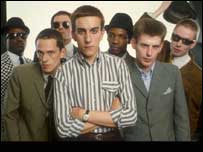
Ska-boys (and girls) adopted a very 'modish' slant on fashion, with Levi Sta-prest trousers and shirts, three-button suits and brogues, Fred Perrys, Doc Martens and pork-pie hats very much the deal for boys.
Girls would also adopt a mod look with minis, skinny cut blouses and cool 60's haircuts.
Some even had skin/suedehead haircuts and nicked the boys gear!
The 'Two-Tone' bit comes from the look, black and white sharp colours were adopted in imagery used by bands like The Beat and The Specials on record sleeves, pin badges and posters etc.
Message to you Rudi!
The beauty of the new sound was that each band had a different take on the genre, and friendships were formed between the bands which often resulted in joint tours.
Coventry's The Specials and The Selecter made three-minute anthems their own, with tracks like 'Rat Race', 'Message to You Rudi' and the unforgettable 'Ghost Town' from the former and 'Three Minute Hero' and 'On My Radio' for the latter.
The Beat always sounded more intense, possibly angrier with their taut rhythms and staccato guitars - 'Mirror in the Bathroom' and 'Hands Off, She's Mine' are prime examples of their tough sound.
 | | Suggs went onto become a TV personality after Madness |
'The Nutty Boys'
Madness and Bad Manners took the lively vibe of ska and added a dose of humour to it, and both bands enjoyed chart success and fame, using the movement as a springboard to bigger things.
Characters like Suggs (from Madness) and Buster Bloodvessel (from Bad Manners) became household names, and ska records are as likely to be heard on television adverts these days as they are on the radio.
Where are they now?
Like many punk bands of the era, ska bands from the original time still remain today.
The Beat, The Specials AKA and The Selecter can all be seen doing the circuit, so you can get a flavour of the old-school ska vibe. Punk bites back
But as punk had helped break down the barriers for D.I.Y. bands to make headway, punk bands influenced as much by Big Youth as they were The Clash's more reggae-type vibe poured out to create a new sound.
The seeds were sown for the next big ska revival in the nineties, when Americans were to take the lead and Brits were for once in second place.
However... a new breed of ska bands have been continuing the traditions of the scene and adding a twist of their own...
So who's pushing the sound of ska in the 21st Century?
Bands like Rancid and the Rough Kutz that's who!
|