:: NZ Features » | Introduction
A description of the tour about New Zealand that Nic undertook
History of New Zealand
A brief look at the history of New Zealand
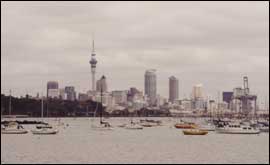
Auckland
Nic takes a look at New Zealand's largest city
Rotorua
Nic visits the distinctly whiffy Rotorua in the Bay of Plenty region |
| | The early New Zealand developed a unique ecosystem because of a lack of predators. This meant several species of bird became flightless through natural evolution - one of which is the nocturnal Kiwi, a national symbol of the country. Another fabled creature was the Moa - this was a large flightless bird that closely resembled an ostrich. Coincidentally, a life-size statue of the Moa can be seen in Queenstown - and it's a very big bird. Sadly, this is all modern day visitors will get to see of the big bird as it was hunted into extinction. Maori heritage
About a 1000 years ago, Maori navigators discovered a land they named Aotearoa - this would become the New Zealand we know today. The Maori way of life - or Maoritanga - developed on the two islands that make up New Zealand. If you ever visit New Zealand, one thing you'll certainly see is something the Maori call Pounamu but we know it better as jade. This distinctive green stone was a highly prized item amongst the various Maori tribes who made ornamental pieces like combs and necklaces as well as utilitarian items like clubs, axes and fish hooks. The Maori are also famed for the haka, which is a 'posture' dance designed to display a warrior's prowess - its modern form can be seen performed by the New Zealand rugby team the All Blacks. The fleeing Dutchman
The first explorer from the Northern Hemisphere to visit New Zealand was a Dutchman. He was called Abel Tasman, and in 1642 he landed in Golden Bay, which can be found at the northern tip of the south island. However, his welcome wasn't very warm as his landing resulted in the death of several of his crewmen at the hands of local Maori in the area. Still, Tasman is credited with giving New Zealand its modern name - he called it Niuew Zeeland after a Dutch province. After his unfriendly introduction, Tasman decided to leave this new land well alone. British exploration
It was over a century later in 1769 that British explorer James Cook came to New Zealand. He extensively mapped the coastline, giving many of the geographical features their names (which they still hold today). Cook was impressed with the country and eventually made friends with the Maori. He went on to claim the entire land for Britain. Environmental decline
In the nineteenth century Europeans, or pakeha (non-Maori) as the Maori called them, descended on New Zealand and pretty much wreaked havoc. Firearms were introduced to the Maori, who set about killing each other on an unprecedented scale. At the same time, the unique environment was also put under threat as the seal and whale populations were decimated. The delicate ecology of New Zealand was also affected by the introduction of several species of animal that weren't native to the country - one of the worst is the opossum from Australia. They were originally introduced for their fur coats but multiplied rapidly to become a modern menace - annually, they get through about seven million tonnes of vegetation, and are believed to be solely responsible for the decline of several native varieties of flora. There are so many opossums in New Zealand that you'll see literally hundreds of the creatures on the roads that have been squashed by traffic. I was told that the nocturnal opossums become transfixed by the glare of headlights and don't move, and I guess because they're considered a national menace that no quarter is given by the driver. It certainly seems that way when you see the astonishing number of flattened brown pelts you see on the roads! The infamous Treaty of Waitangi
Lawlessness and exploitation of the Maori as well as rumours of French colonisation lead the British to draw up the Treaty of Waitangi. The treaty was signed in 1840 by the Maori and it guaranteed Maori rights in return for ceding their sovereignty to the British Crown - it effectively meant that Great Britain was officially running the country from that point on. The Treaty of Waitangi, which can be seen in the Te Papa museum in Wellington, was highly controversial (and still is) because the Maori definition of sovereignty was not the same as the British one. Nevertheless, the treaty paved the way for more settlers to enter the country. Although the concept of the treaty was an admirable idea, the reality was much less so. Under the terms of the treaty, the Maori could only sell their land to the Crown who would, in turn, sell it on to the settlers. Relations began to break down when the government refused to pay the Maori for the land. The ill feeling over the land disputes finally reached boiling point with the Land Wars throughout the middle of the nineteenth century. There were several bitterly fought battles, particularly across the North Island, before Maori resistance was subdued. After that, Maori rights were less importance in the eyes of the ruling government. Recently, there has been a great drive to redress the wrongs of the past Modern New Zealand
In fact, there's been much to admire about the modern New Zealand. For a start, it's a non-nuclear country - much of their power comes from natural means like geothermal energy, hydro-electrical plants and wind farms. I also found out that they were the first country in the world to give women the vote, and that was twenty-five years before Britain or the United States did. And, of course, they're home to the All Blacks - one of the best rugby teams to grace the game (although England are right up there too, in my humble opinion). For more information on the heritage of New Zealand, check out the Te Papa National Museum web site
The BBC is not responsible for the content of external websites
Click here to return to the
main New Zealand tour page
Your holiday online...
Have you been somewhere you really want to talk about? Do you have pictures? Or have you seen a foreign town with the same name as a Staffordshire town? Send us words and pictures, and we'll put your story online! Send your tales by e-mail to us at: stoke@bbc.co.uk |