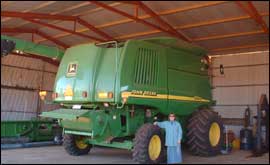
| Carrying on from talking about the history of Michael and Chris Brennans farm, I thought Id ask about how the farming differs from back in the UK and what methods are used. The Brennans' grow wheat, barley, canola and lupins on 8500 acres of their land. They run 4500 merino sheep and at any one time have around 7000 growing pigs. As the summer season is so hot here in Australia seeding and cropping occur in seasons that are different to back home. The practice of dry seeding takes place which means that the land isnt ploughed first. The crop seeds are literally drilled directly into the ground, with a gap of 10 inches between each row. Herbicides are applied with a boom sprayer (which is 80ft wide) to the fields, then a few days later a huge piece of equipment called an Ausplow which is 46ft wide, drills the seeds and fertilizer into the soil at the same time. An Ausplow can farm 400-500 acres in just one day! This is done by having 24 hour operation with 2 people doing 12 hours shifts. In the Wheatbelt a lot of farms use the practice of dry land farming as there are no irrigation facilities and the crops are totally reliant on the rain. As the land is so expansive and water is so scarce, dry land farming is the only option if you want to farm this soil. Seeding starts on 20th April and finishes around 20th May (the Australian Autumn) during this time, some 8500 acres of land will be seeded. The farmers then hope for the rains to come so their crops will flourish over the winter period. All being well the harvest will be ready for cropping in the last week of October. A huge 36ft wide harvesting machine will harvest the crops until Christmas time (Spring/Summer time). The Brennans employ two permanent staff and around three extra staff will be employed seasonally for cropping and harvesting. After the harvest takes place the chafe is collected into long piles. The chafe is the stubble that is left after the crops have been harvested. This chafe is then set alight and the burning takes place to kill any weed seeds. Seeing the rows of chafe alight at night is quite a thing to see, especially as the fields go on for miles and miles. The crops that the Brennans grow provide food that is milled for their piggery(lupins and barley), noodle wheat(which is used for making Udon noodles and is exported to Japan and Korea), canola(which is crushed locally and the majority is then exported to Japan) and the hard and white wheats which are used for bread making. The hard wheat has very high protein content. A minimum sized farming property would be around 5000 acres (2000 hectares) and the cost of land is around AUS$1200 per hectare of agricultural land so you are looking at about £1,000,000 to purchase 5000 acres of land to cultivate. As you can tell, farming practices are quite different from back home as the scale here is so much larger.
Article by Sarah Watts
|