Error-strewn England flunk oldest Test at Murrayfield
- Published
You could pinpoint the moment Scotland had England's streak stopped.
After 56 minutes the Murrayfield crowd, still euphoric after Huw Jones' second try, were halfway through a rendition of Flower of Scotland, when Rory Darge pilfered a turnover inside his own 22m.
A cheer went up, but the anthem rolled on unchecked. It was another battle in the bag, but the war was already won.
England's winning run had ended short of 13 and there was not much unlucky about it.
At half-time, however you measured it, the hole was deep for the visitors.
Fourteen points down on the scoreboard. A man down on the pitch. Several hundred decibels down on support in a bouncing Murrayfield.
But, at that point, it did not feel insurmountable.
Scotland had done much of the spadework, with Finn Russell, who brilliantly shovelled the ball on to Jones for a try in a hectic opening, showing the nimble feet, sharp hands and the game smarts that can make him irresistible.
His team, so ineffective in defeat by Italy a week before, were ruthless. Four visits to England's 22m in the first 40 minutes yielded 24 points.
But England had also contributed to their own predicament.
Henry Arundell was the most notable. The Bath wing copped a first unfortunate yellow card for not releasing the tackled man and then a clumsy second, blundering into an airborne Kyle Steyn.
Those infringements had England down to 14 for a total of 30 minutes. His absence only encouraged a willing Scotland to spin wide.
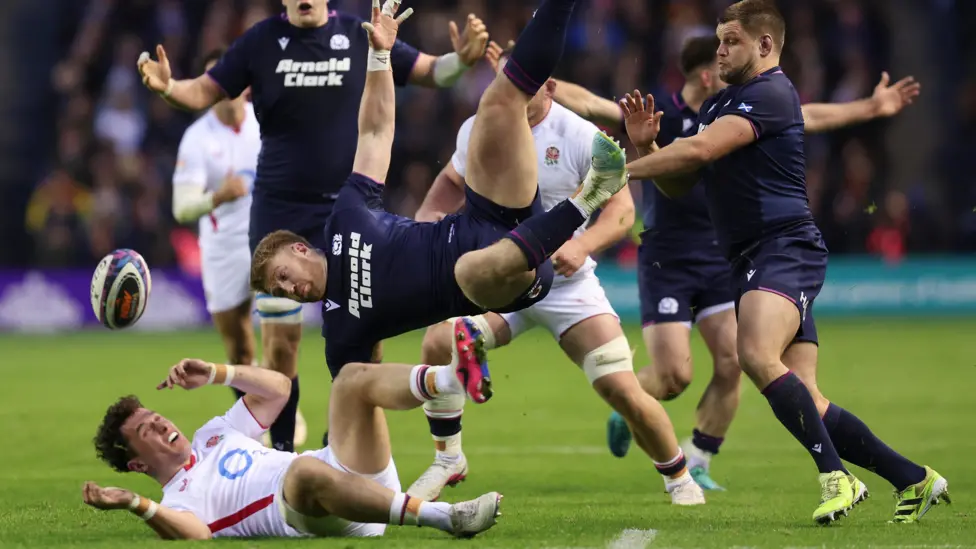
Arundell was shown a second yellow card after failing to get off the ground as early as Kyle Steyn in a first-half aerial contest
Arundell's were not the only individual errors though.
Luke Cowan-Dickie's no-arms tackle had given Scotland the field position from which Jamie Ritchie scored the hosts' second try.
Ellis Genge, being asked to do a job that is not really his, fluffed a loose backfield ball to hand over a third try.
Collectively, the team's defence, which has kept opposition shuttling sideways for the past year, was suddenly full of creaks and creases for Scotland to exploit.
Despite all that, all was not lost.
Cut out those individual errors, shape up without the ball, see out Arundell's sin-bin period and turn the screw in the scrum and there was a narrow, theoretical route back into the game.
Taking it would be the greatest validation yet of an upwardly mobile team.
Scotland had shown vulnerabilities only in the autumn, coughing up a 21-point lead against Argentina. England's bench could bring their strength in depth to bear.
The theory was there.
All too briefly, it looked as though it could play out in reality.
Scotland players 'showed up' for Townsend - Borthwick
Genge ground another penalty out of Zander Fagerson two minutes after the restart. George Ford clipped it over for 24-13.
The Scotland front row were backed up once more. Another penalty and Murrayfield sat a little less easy.
As Ford dropped back into the pocket to line up a drop-goal on 53 minutes, it felt like the drip-drip scoreboard pressure was set to grow.
But Ford, who 15 months ago missed a late drop-goal to beat the All Blacks, had not given himself enough space.
Matt Fagerson, fresh off the bench, was too quick. Charge-down, try, England's Grand Slam dreams in the dust and Scots dancing in the stands.
England's bomb squad came on, but didn't really go off. Scotland held them at bay and finished in comfort.
Borthwick said Ford's charged-down drop-goal was influential in the outcome, but far from the only cause of England's defeat.
"This is a team that has reeled in a lot of opponents over a long period of time," he said of his side.
"It's 24-13, you get that drop-goal, 24-16 and with 24 minutes left, that's a different complexion.
"That 10-point swing was clearly a big point in the game, but there's plenty of other smaller moments in the game that added up to that result."
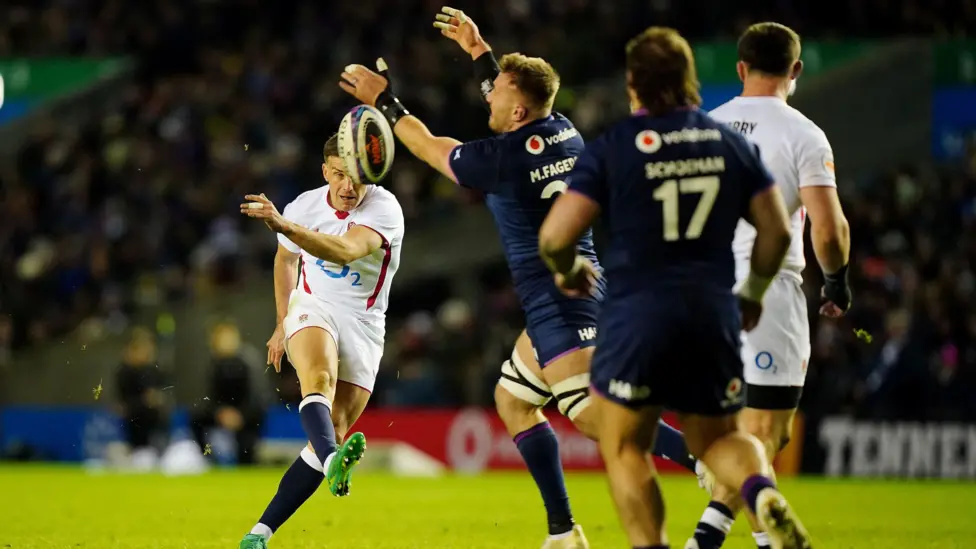
Matt Fagerson's charge-down of Ford's drop-goal attempt set up a second try for Huw Jones
In the build-up to the tournament, Borthwick's right-hand man Richard Wigglesworth had suggested that, just as England did not deserve every bit of criticism they got during a rotten run in 2024, the praise they received in a far more successful 2025 might be overblown.
These words look wise now.
"We have to learn our lesson and move forward," said captain Maro Itoje.
"We didn't start well, we were not as accurate and precise as we wanted to be, in the scrum especially - all those areas need to be better.
"I think over the last 12 months we have been good at riding the wave and finding a way, but today we were not good at that."
The lessons need to stick quick. Defeat by Ireland next weekend would surely wreck any Six Nations title hopes.
Away days against Italy, France and world champions South Africa follow shortly after.
If England aren't riding the wave, several more will be on them before they know it.
Arundell 'out of his depth' in England loss to Scotland - Rugby Union Weekly
