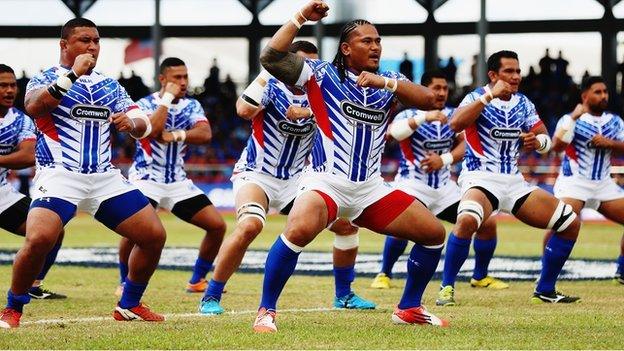
Samoa play Scotland at Murrayfield on Saturday and England at Twickenham on 25 November
Autumn Test: Scotland v Samoa |
|---|
Venue: Murrayfield Stadium, Edinburgh Date: Saturday 11 November Kick-off: 14:30 GMT |
Coverage: BBC One, Connected TV, online & the BBC Sport app & Radio Scotland 810MW |
The mental health issues suffered by players who come to Europe from the Pacific Islands can only be resolved by the players themselves, says former Wasps and Samoa lock Dan Leo.
Some who moved from Samoa, Fiji and Tonga have fought alcohol addiction and depression, while others struggle to support extended families left behind.
In France, three killed themselves.
"We need to be more open with each other and it's got to come from within our communities," Leo told the BBC.
"No one can do this for us, the only ones who can do it for us are ourselves."
Leo and other former internationals have founded Pacific Rugby Players Welfare (PRPW), a non-profit organisation that bring Pacific Islanders together to bond around their love of food.
There are an estimated 200 players of Pacific Island descent currently playing in Britain. Most came over to earn money that is not available at home and send it back to their families.
Just this week, the Samoan Rugby Union were declared bankrupt by chairman Tuila'epa Sailele Malielegaoi, who is also the country's Prime Minister.
'It can get really bad, very quickly'
Tuilagi opens up about moving from Samoa
England and Leicester Tigers centre Manu Tuilagi was born in the tiny settlement of Fatausi-Fogapoa and travelled to Britain aged 12 with his mother to join his brother Freddie, who was playing for Cardiff. He soon showed his own rugby ability and joined the Leicester Tigers academy. He is among six of seven brothers to have been on the club's books.
In 2010 it was found he had remained in England for six years on an expired holiday visa but he avoided deportation as Leicester supported him and helped him carve out a successful stint in England.
"On the island you have to play internationally to be able to get a working visa," said Tuilagi, now a player representative for PRPW. "It could have gone really bad and I could have gone back home.
"For most of us boys that have come straight from the islands, it's the change of lifestyle. Here there's little things like paperwork and tax. If you don't know about it, it can get really bad, very quickly.
"It's all about helping your family back home - and when you say 'family' in Samoa it's about 100 to 200 people."
'You feel terrible if you don't send money home'
England's team to play Argentina at Twickenham on Saturday features Fiji native Nathan Hughes, with another Fiji-born player Semesa Rokoduguni on the bench.
Wales will include Tonga-born Taulupe Faletau against, while Bundee Aki, who is of Samoan descent, will make his debut for Ireland who play South Africa.
But while those men have forged successful careers to support their families, those playing lower down the league often struggle.
"You feel terrible if you don't send money back home after a month," Tongan Viliami Hakalo, who plays for Nottingham in the second-tier English Championship, told the BBC.
"The one reason we came here was to look after our parents but it's sometimes hard budgeting what you earn for the month.
"When they call you can't say no, but obviously they have no idea how hard it is dealing with bills every month and putting the food on the table for the kids. It is really tough."
Broken promises and tales of woe
Anthony Matoto plays for Coventry in National League One - the division below Hakalo's Nottingham.
He has represented Tonga in sevens and played in Spain before moving to the Midlands and knows some of the pitfalls that his fellow Pacific Islanders can face.
"I've had friends who have been cut short on many deals," he said. "Some were supposed to be on a three-year deal but it's cut to one year.
"The majority are from agents who are unregistered in France. Some were promised a house and when they got there but they ended up living with other people.
"It just pulls you back from taking that leap and that's what made me worry about moving and pursuing this career."
- Published8 November 2017
- Published7 November 2017

- Published15 September 2015