Is VAR any better in the rest of Europe's top leagues?
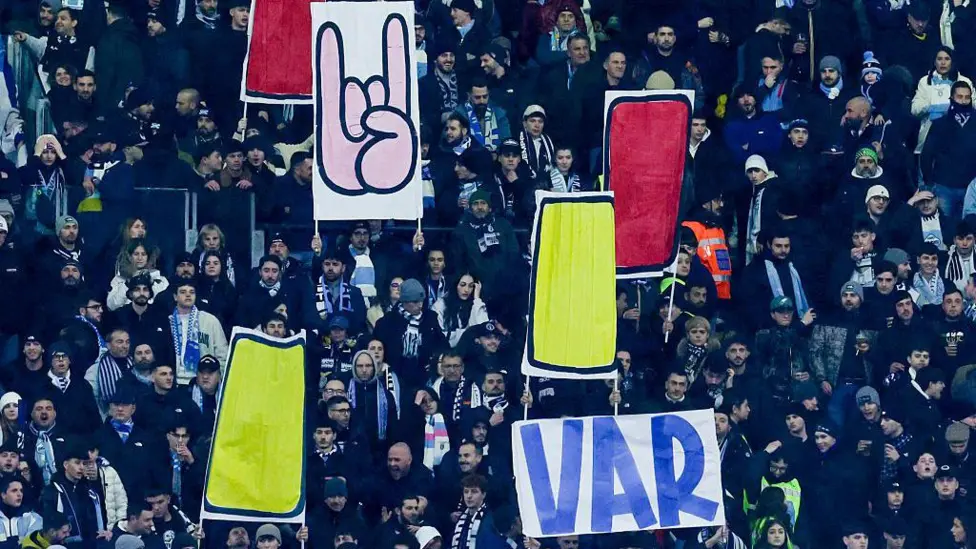
Lazio fans made their feelings about VAR clear during matches in January
- Published
"I believe we forgot the reason why VAR was introduced," Uefa referees' chief Roberto Rosetti said last week.
His choice of words was important. This was not a criticism of the Premier League.
It was aimed across Europe. And it was about the rise of "microscopic" video assistant referee interventions.
In England the media coverage of refereeing is savage. Any perceived mistake is pounced upon.
Social media is full of people saying VAR works fine elsewhere, that the standard of refereeing is better in other top divisions.
In the Premier League, are we largely cocooned from much of the controversy in the other top European leagues? BBC Sport spoke to people across the leagues to find out.
Bundesliga - 'like horse racing with donkeys'

There have been regular and visible anti-VAR messages at games in Germany, as shown by the major protest by Augsburg fans at the weekend
Bundesliga fans have been relentlessly against VAR from day one.
Many terraces have 'Videobeweis abschaffen' (Eliminate VAR) banners held up in the ultras section for the duration of each review.
For all the controversy of VAR in the Premier League, it is rare to see this type of big public display. Chants yes, but not banners.
In Germany it is different. Take Augsburg fans before their fixture against Heidenheim on Sunday.
Behind the goal there was a sea of messages against VAR.
"Football with VAR is like horse racing with donkeys," read one banner, following a penalty they had conceded against Mainz which VAR did not cancel.
BBC Sport has been provided with the most up to date official data from the German top flight.
It showed that the rate of interventions is higher in Germany, but the frequency of mistakes virtually identical. That is one every 16 games in England, and 15.66 in Germany.
The numbers are collated internally, with only the Premier League having an independent body to judge performance.
VAR swamps the media coverage in Germany too, with the nation's football association (DFB) trying several tactics.
Only last weekend the head of referees, Knut Kircher, sat in the TV studio throughout Saturday's matches to try to offer perspective.
It was the equivalent of Howard Webb, referees' boss at Professional Game Match Officials (PGMO), appearing on Final Score.
The DFB felt it was positive but Munich-based newspaper Suddeutsche wrote that Kircher should "focus on improving referee performance".

Supporters of VfB Stuttgart hold up a sign which reads 'Eliminate VAR' during a VAR review
"VAR has caused a lot of unrest here," NTV journalist Stephan Uersfeld told BBC Sport.
"It continues to be what we call 'Schuldverschiebung' - passing on the blame - to the VAR instead of the on-field decisions.
"While it brings some fairness to the game, it has become a bureaucrat's dream."
The Bundesliga introduced semi-automated offside this season but its microscopic decisions and unreliability have only increased the controversy.
In January, broadcaster ZDF polled coaches, external in the top two divisions. Of the 27 respondents, 16 said they were unsatisfied by VAR.
Another survey carried out by NTV, external found that 80% of coaches felt VAR delays were excessively long. The opinion was that VAR has not improved.
If Premier League fans thought VAR had a better reputation in Germany, that clearly is not the case.
La Liga - 'Technology feels distant from emotion of sport'
In Spain you won't see any great public displays of dissatisfaction in the stands. The league has plenty of other problems with officiating.
Last summer, the Spanish FA replaced its entire refereeing committee and became the first major league to separate the roles completely.
A team of 15 dedicated VARs work only as a video assistant.
Yet it didn't take long for the first error to happen, and again the semi-automated technology was at fault.
It failed to identify a goalscorer was offside, the officials did not realise and the goal counted. The VAR team was stood down from its next appointments.
Specialist VARs have long since been suggested as the big fix.
But BBC Sport columnist Guillem Balague says it has made no difference.
"There is no agreement of what VAR should do or how referees should act," Balague said. "The suggestion was to use VAR less. Less than what?
"Why less if it is necessary? But when is it necessary?"
It is the question that nobody appears able to answer, in any league.
Real Madrid's TV channel produces videos criticising referees on a weekly basis.
At the weekend, Barcelona issued a statement, external highlighting "repeated refereeing decisions it considers damaging to the game".
It followed an incredible eight-minute VAR review to disallow a goal for offside against Atletico Madrid. Again, the semi-automated technology was faulty.
Marca analysed, external incidents covered in the league's version of 'Match Officials Mic'd Up'.
It found 10 errors in the first 18 rounds of games - higher than the Bundesliga or the Premier League. The paper said that there would further errors not covered by the programme.
"The feeling is that VAR has complicated the game, instead of purifying it," Balague added. "What was meant to simplify decisions, scientific, transparent, logical has instead made them more obscure, interpretative, anything but clear.
"Supporters in Spain often leave stadiums not just disagreeing with decisions, but also confused by them.
"The technology feels distant from the emotion of the sport."
Does that sound familiar?
Serie A - 'Many would prefer more intervention'

Lazio fans have been on the end of a series of decisions leading to fan protests throughout January
Serie A is in a unique position.
Players, coaches and the media complain just as fiercely as their Premier League counterparts.
Davide Chinellato, the UK correspondent for La Gazzetta dello Sport, says there is one subtle difference. Serie A not only wants VAR, it "would prefer more intervention rather than less".
"Unlike in England, the average Italian fan cannot imagine modern football without it," Chinellato told BBC Sport.
The league is backing reviewing corners and second yellow cards, which is set to be approved by the International Football Association Board on 28 February.
"What is changing is the level of frustration," Chinellato said. "The expectation in Italy is that every clear mistake should be corrected.
"When that does not happen, the reaction is not to question VAR itself, but to question the rules governing its use."
Take Lazio supporters last month after the club suffered from a couple of errors.
"Transparency on VAR, audio justifications without logic or sense," a banner read.
"They invent everything to ruin old-fashioned football."
There are similar opinions from players.
Veteran Napoli defender Juan Jesus hit out at current VAR standards., external
He said: "There's nothing but controversy. It becomes hard for everyone to remain passionate about football."
Italy might like VAR, but difficult and technical decisions are problematic.
"Fans and media are increasingly impatient with what they see as excessive complexity," Chinellato added. "They want broader, clearer, more straightforward guidelines.
"A system that aligns more closely with the basic expectation that obvious mistakes should be corrected."
No one has been able to define an obvious error.
Ligue 1 - 'There are mistakes every weekend'
In France, the story is different.
Ligue 1 has the highest intervention rate, pretty much every other game.
Across the first 198 matches there were 83 VAR interventions. The referee has stuck with his decision nine times, far more than any other league.
France suffers more errors, 17. That is one every 11.65 games compared to 16 in England.
There is frustration for supporters, but most of the noise comes from the boardroom.
It is compounded by the collapse of TV rights. It means budgets have been squeezed.
"The referee system, including VAR, is costing 25m euros by season," L'Equipe journalist Pierre-Etienne Minonzio told BBC Sport.
"So in a time when all the clubs need money, they think it's too expensive."
Luc Hagege, who writes about refereeing for L'Equipe, says there is a "misunderstanding between the objective of VAR and the perception of some players, coaches, but mostly presidents".
One of the most outspoken critics has been Lille president Olivier Letang, who says there is a "a breakdown of trust" with referees.
"The perception is that coaches feel a kind of arrogance from referees," Hagege added.
"Most people, and especially the directors, feel that a gap is growing."
Many other figures within clubs have been critical.
Lyon captain Corentin Tolisso said in November: "There are mistakes every weekend. We're paying a very high price for the level of refereeing."
Hagege said errors are magnified by the clubs and the media.
"We speak much more of the mistakes than of all the things that have been corrected," he added.
"A few even said that they are fed up with the VAR, we should withdraw it."
Perhaps there is one factor which binds all five leagues.
As Rosetti said, fans and pundits asking "where is VAR?"
It appears to have created a gradual creep into more areas of the game. It will be hard to stop.
- Published13 February
- Published15 February
- Published14 February
- Published8 June
- Published8 June