Trump and Infantino - too close for comfort?
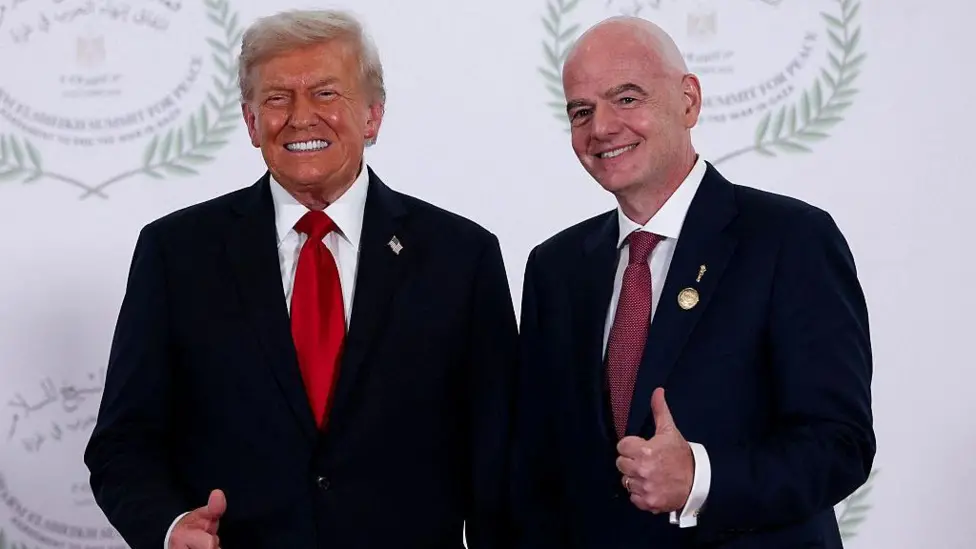
Donald Trump and Gianni Infantino attended the World Cup draw
- Published
With US President Donald Trump at the centre of proceedings, Friday's lengthy and extravagant World Cup draw had a distinctly political feel.
The glittering ceremony took place at the Kennedy Center, the famous Washington arts venue now chaired by Trump after he overhauled its board this year.
And the event seemed planned with him very much in mind.
By the end Trump was dancing along to his favourite song YMCA, a track regularly heard at his campaign rallies. Little wonder after he had become the recipient of a new Fifa Peace Prize, as widely expected.
These gestures underlined the close alliance forged between the US president and his Fifa counterpart Gianni Infantino, who announced the award last month after claiming that Trump deserved to win the Nobel Peace Prize for his contribution to the Israel-Gaza ceasefire, and has enthusiastically praised his policies.
But for the critics, the draw was an unedifying spectacle, threatening Fifa's commitment to political neutrality, and overshadowing the actual football it was meant to be about.
They believe it showed that Infantino and Trump are effectively too close for comfort, sending a message that world football's governing body is aligning with the Make America Great Again (Maga) movement, and endorsing what many feel is a divisive administration. Is it wise, they ask, that Fifa associates so closely with a man who recently made disparaging comments about Somali immigrants for instance, describing them as "garbage"?
Football Supporters Europe for instance, insisted the prize "was not awarded on behalf of millions of fans around the world, as Fifa claims. It's nothing more than an ego-stroking stunt. This is a deeply troubling day for football and Fifa."
Asked about the controversial new award, amid reports that the Fifa Council was not consulted, one senior official at the governing body told BBC Sport: "Why can't this be bigger than the Nobel Peace Prize? Football has huge global support, so it's right that it recognises extraordinary efforts to bring about peace every year."
They pointed to the fact that in 2019 there was no such controversy when Fifa gave the president of Argentina an award to honour his contribution to football, and said the organisation deserves praise for endorsing peace in a divided world.
Dan Roan reports from Washington before the 2026 World Cup draw
A special relationship
President Bill Clinton opted not to attend the draw for the World Cup in 1994, when the US last hosted the event. But it is no surprise that Trump chose to play a prominent role, given the global platform the World Cup offers him.
In a sign of the kind of scenes that may lie in store at next year's event, Trump appeared at the Club World Cup final this year, when he chose to remain on the podium as Chelsea celebrated winning the tournament, clearly enjoying remaining at the centre of attention after handing them the trophy.
More recently he greeted Cristiano Ronaldo at a White House dinner held in honour of the Saudi Crown Prince. Just days later, the forward was handed a surprise reprieve by Fifa when it suspended two matches of a three match ban after he was sent off for elbowing during a defeat to the Republic of Ireland, ensuring his availability for Portugal's opening matches at the World Cup.
There is also the regularity with which Trump and Infantino have appeared together in recent years, including at events outside the sporting realm.
Since first visiting the Oval Office in 2018 during Trump's first term, Infantino has been spotted with Trump at the Davos Economic Forum, the signing in Washington of the Abraham Accords - an agreement between Israel and some Arab nations in the Middle East in 2020 - and even as a guest at Trump's second inauguration in January.
Fifa formally hailed the pair's close friendship after that event, with Infantino himself insisting that it made practical sense given the importance of the US hosting both the expanded Club World Cup and the World Cup.
Fifa also claimed Infantino had a duty to develop and promote the game globally, and that he also held regular meetings with other world leaders.
While Infantino seemed to have much less of a rapport with US President Joe Biden during his time in the White House, that has indeed been the case with other heads of state.
Since replacing predecessor Sepp Blatter almost a decade ago after promising to restore Fifa's reputation and finances following a huge corruption scandal, Infantino has appeared close to Russian President Vladimir Putin - who awarded Infantino a Russian Order of Friendship medal in 2019 - along with the rulers of two other World Cup hosts in Qatar and Saudi Arabia.
Infantino's proximity to such leaders has inevitably sparked controversy and criticism, but it is the relationship with Trump that has caused the biggest backlash within the game.
Earlier this year, delegates from Europe's governing body Uefa staged a walkout from the Fifa Congress in Paraguay when Infantino arrived hours late after joining Trump on a tour of the Middle East, accusing him of prioritising "private political interests" which "does the game no service".
In 2018 Infantino himself said "it is very clear that politics should stay out of football and football should stay out of politics".
But he defended the trip with Trump, insisting it had been crucial as it allowed him "to represent football" in "important discussions" with "world leaders in politics and economy".
But the episode only intensified scrutiny on the relationship, as did Fifa's decision to set up a new office in New York's Trump Tower. Infantino also made a surprise appearance at a summit in Egypt in October as Trump and other world leaders signed a declaration for bringing peace to Gaza.
The only sports leader present, Infantino claimed football could contribute to peace efforts, and said Fifa would help rebuild facilities in Gaza - but his presence again raised eyebrows.
Iran to attend World Cup draw after boycott threat
- Published4 December 2025
Ferdinand to conduct World Cup draw with sporting greats
- Published3 December 2025
Fifa to keep top seeds apart in World Cup draw
- Published25 November 2025

A welcoming World Cup?
Amid such football diplomacy, there have also been concerns about the impact that some of Trump's policies and statements could have on the World Cup, and uncertainty over how welcome visitors from some countries will be.
In June the White House listed 19 countries, predominantly in Africa, the Middle East and the Caribbean, which would face full or partial immigration restrictions, referencing a need to manage security threats.
Amid suggestions that the list could be expanded to as many as 30 countries after an Afghan man was identified as the suspect in the recent shooting of two National Guard soldiers near the White House, Fifa has vowed to have a welcoming and unifying tournament.
But Iran and Haiti, whose teams have qualified for the World Cup, are among the countries affected by the ban. Iran had said they would boycott the draw because of the limited number of visas issued for their delegation.
The June executive order exempts athletes and coaching staff from travelling for the World Cup, but fans could face a ban.
"We want to make sure that we're as welcoming as possible," Andrew Giuliani, the executive director of the White House's World Cup Task Force, said before the draw.
Giuliani hailed a programme designed to shorten wait times for interviews for visitor visas for those with tickets, but he did not rule out Immigration and Customs Enforcement (ICE) raids targeting undocumented immigrants at World Cup venues. Giuliani insisted that authorities wanted to ensure visitors came into the US legally to prioritise the safety of US citizens.
Such a stance worries civil liberties campaigners, with Human Rights Watch (HRW) citing "a backdrop of violent detentions of immigrants, National Guard deployments in US cities, and the obsequious cancellation of Fifa's own anti-racism and anti-discrimination campaigns". They are among a group of organisations claiming the World Cup is at increasing danger of being "weaponised for authoritarian aims."
"There is still time to honour Fifa's promises for a World Cup not tainted by human rights abuses, but the clock is ticking," HRW said.
Having praised Infantino as "one of the greatest men of sport" during a meeting at the Oval Office last month, Trump suggested he might even take matches away from Democratic-run host cities if he had concerns over safety and security.
While it is unclear whether the president will - or even could - follow through with a move that would cause major logistical and legal disruption, his words added to the uncertainty surrounding the tournament.
At the same meeting Trump suggested he could launch "strikes" against Mexico if it would stop drugs from being trafficked into the US. Coming after Trump's trade policies had already caused friction with both Mexico and Canada, it only reinforced concerns about the level of co-operation between the three World Cup co-hosts over issues such as security at the tournament.
Infantino could claim that, given the unpredictability of some of Trump's statements, having a close relationship with him is even more crucial.
But others would argue it also risks impeding his ability to stand up to the US president.
Image, elections and revenue
The true strength of Trump and Infantino's relationship could well be tested in the coming months as preparations for this vast tournament reach crunch point, and issues - from extreme heat and ticket prices, to security and logistics - have to be addressed. But both men clearly view their alliance is mutually beneficial.
For Trump, the World Cup has been a focus of his second presidency. It gives him an ideal chance to project his image internationally, along with the celebrations marking the 250th anniversary of US independence next year.
With the president hailing the event as an "incredibly significant economic opportunity" for the US, there are hopes that it provides a welcome tourism boost after a sluggish year, with Fifa claiming it will generate £22bn for the economy and create almost 200,000 jobs. The tournament is also a chance for the country to show it can deliver a successful mega-event, before Los Angeles hosts the Olympics and Paralympics in 2028.
For Infantino, the most lucrative sports event ever staged will enable him to honour his pledge to grow the game in the US, boost Fifa's revenues, and then increase payments to national football associations - doing no harm to his chances of a third re-election as president in 2027.
A deregulated ticket market in the US has enabled Fifa to run an official resale platform for the tournament that will earn it an unprecedented 30% commission on every transaction. Fan representatives have condemned the move, claiming that supporters are at risk of being exploited by a pricing model that fails to reflect the spirit of the World Cup. But it also helps explain why Fifa expects to bring in a record £10bn in its 2023 to 2026 cycle.
This all comes at a time when Infantino has faced plenty of criticism; from players' unions and environmental sustainability campaigners over the impact of his expansion of Fifa competitions, to human rights groups concerned about the treatment of migrant workers in Qatar and Saudi Arabia.
And the scrutiny on him is only likely to intensify after a World Cup draw that risks being remembered more for the feting of Trump than the fixtures it produced.
