






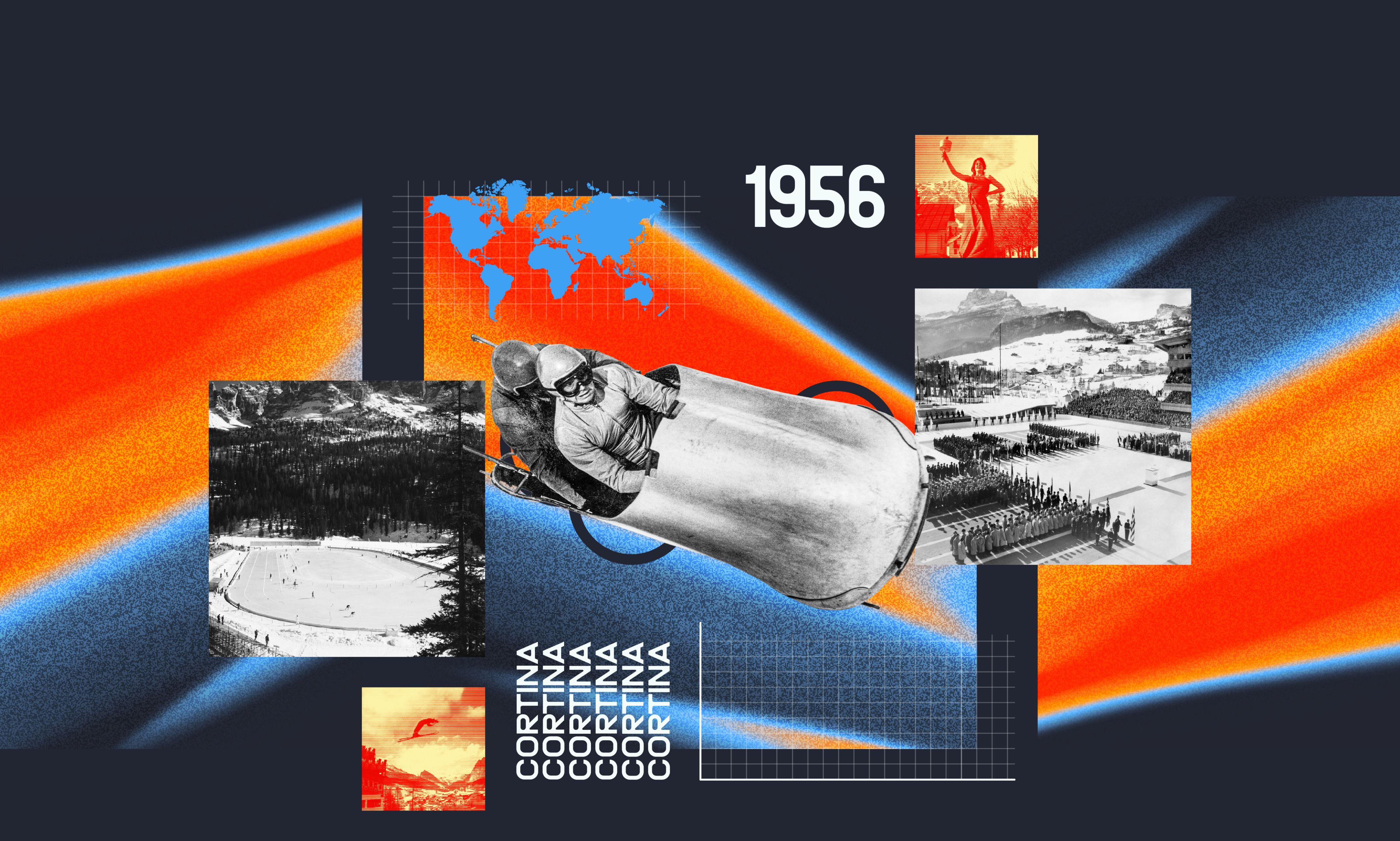

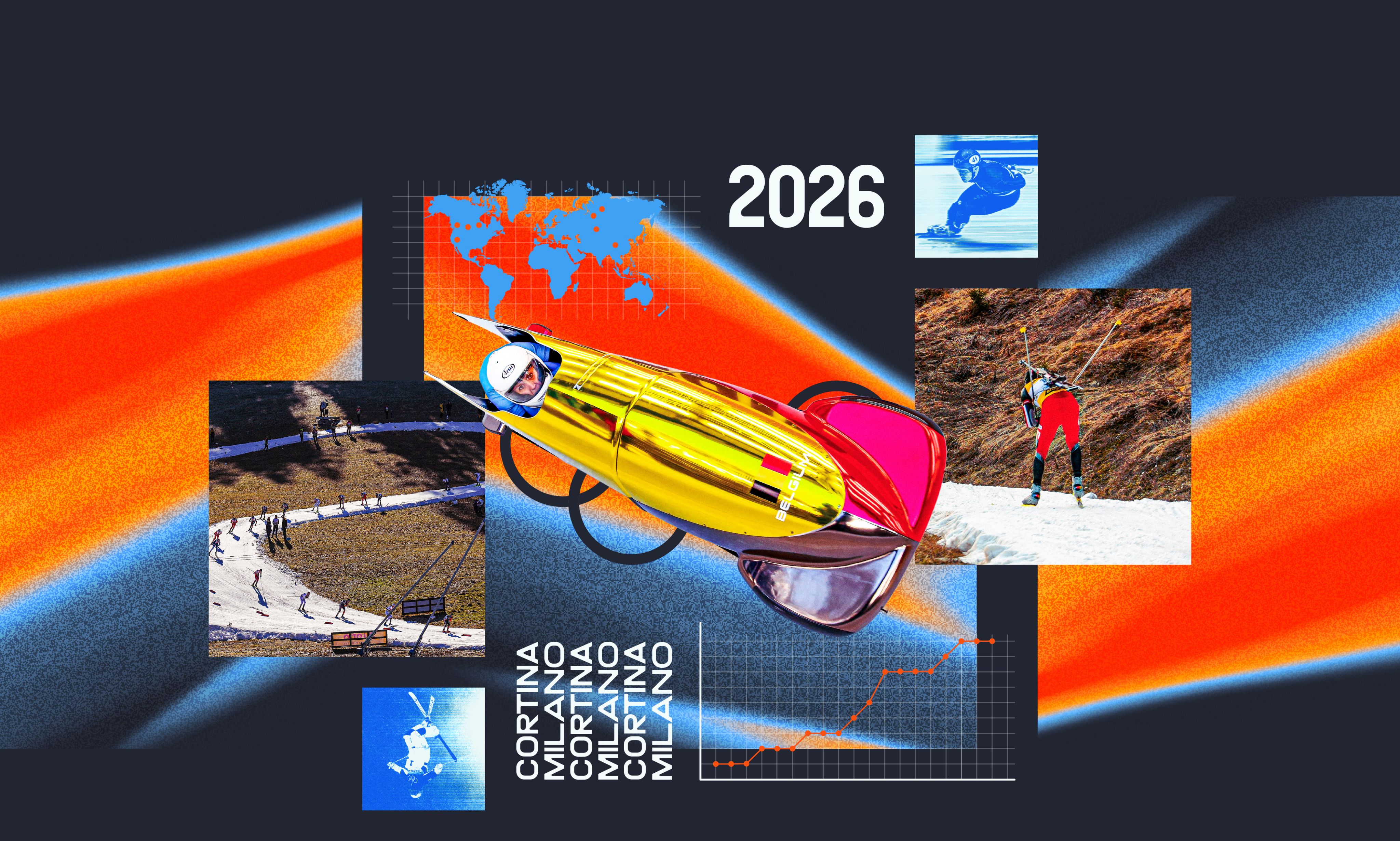




With mesmerising mountainous landscapes, pristine white slopes and snow-covered peaks, the Winter Olympics provide a sporting setting like no other.
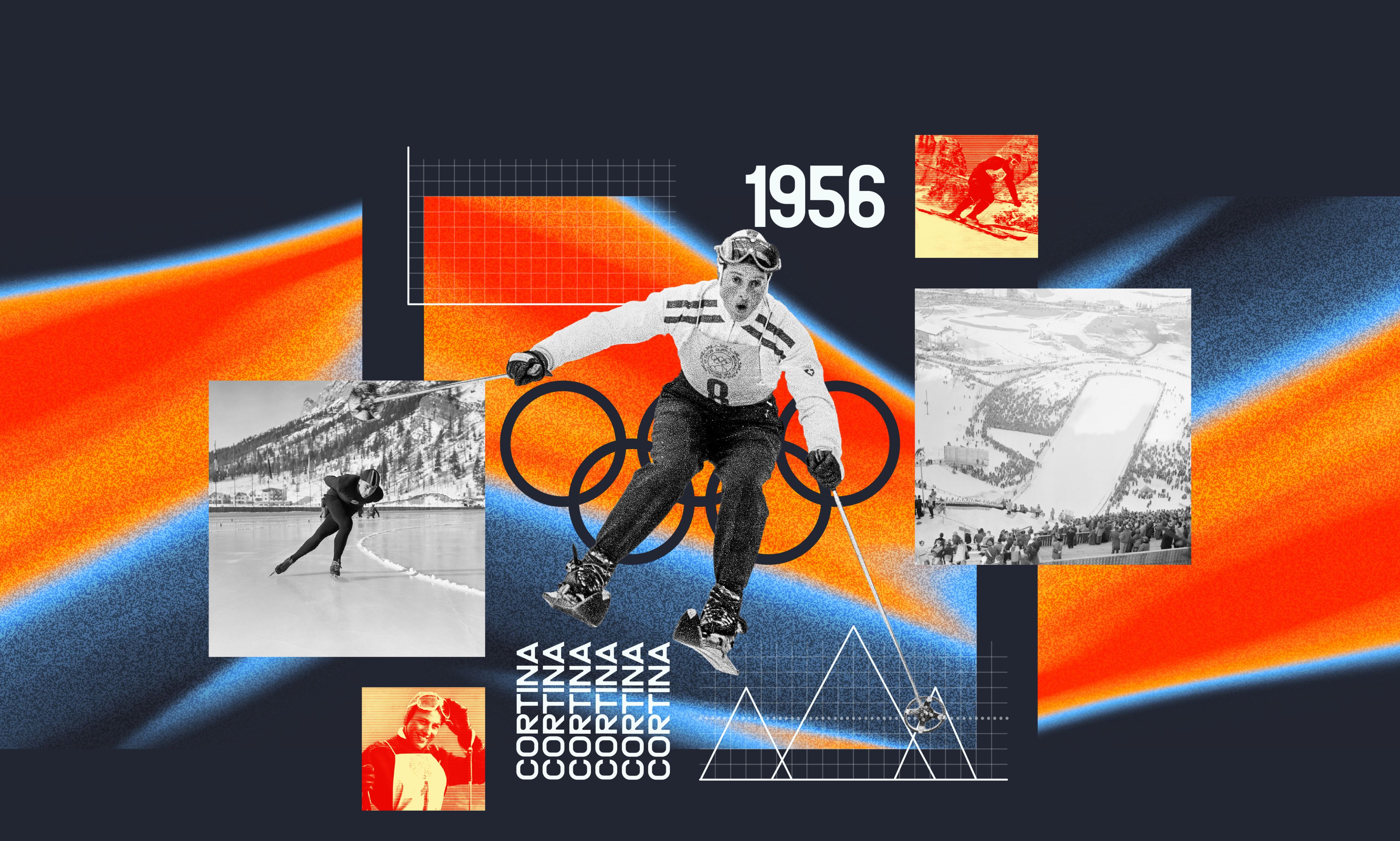
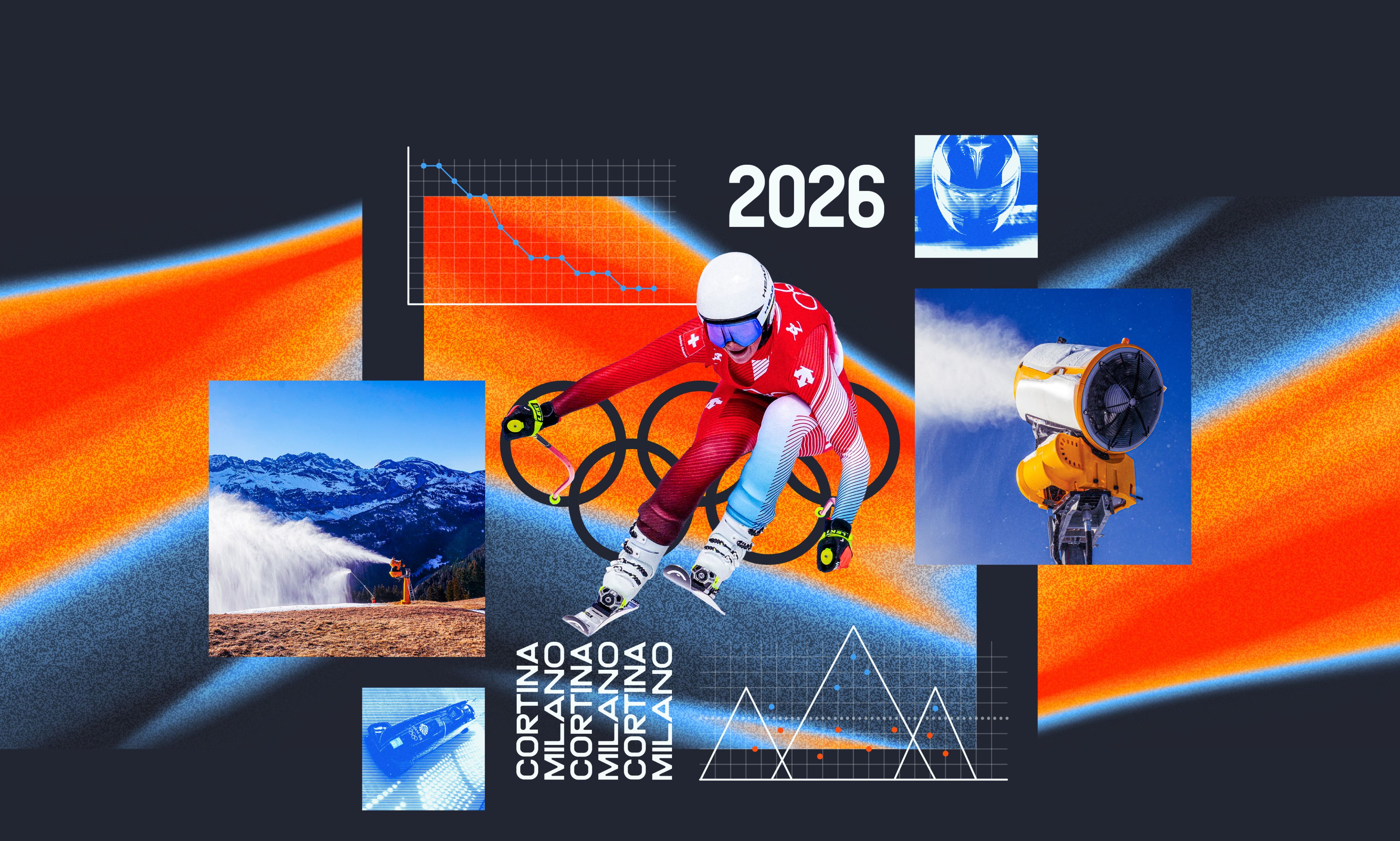
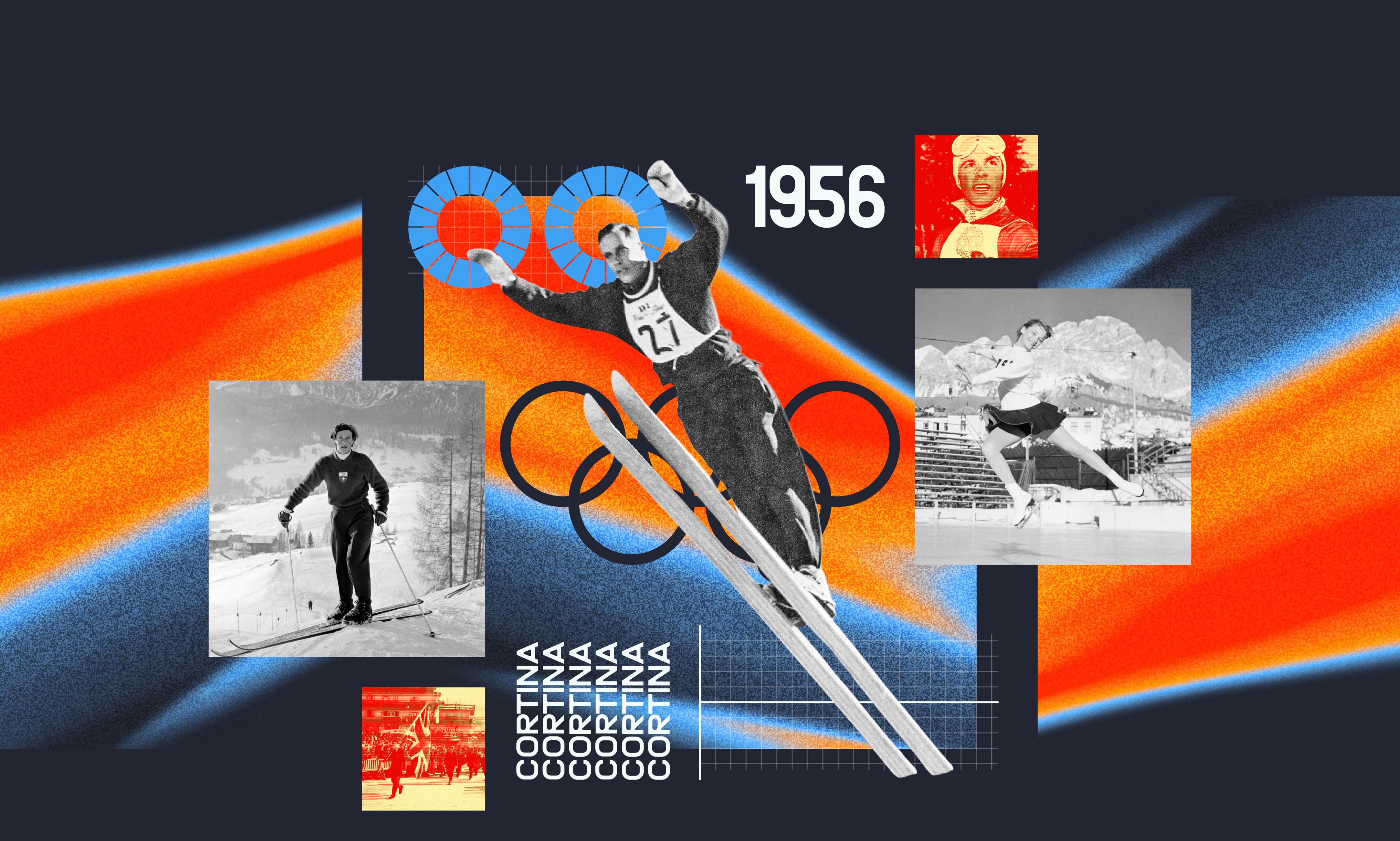
Milan-Cortina 2026 will be the 25thedition of the Games, and marks a return to this part of the Alps after it first hosted in 1956.
Back then, every event took place outside, there was not a fleck of artificial snow in sight, and the threat of climate change was not yet realised.
Seventy years on, that threat has become a genuine problem.
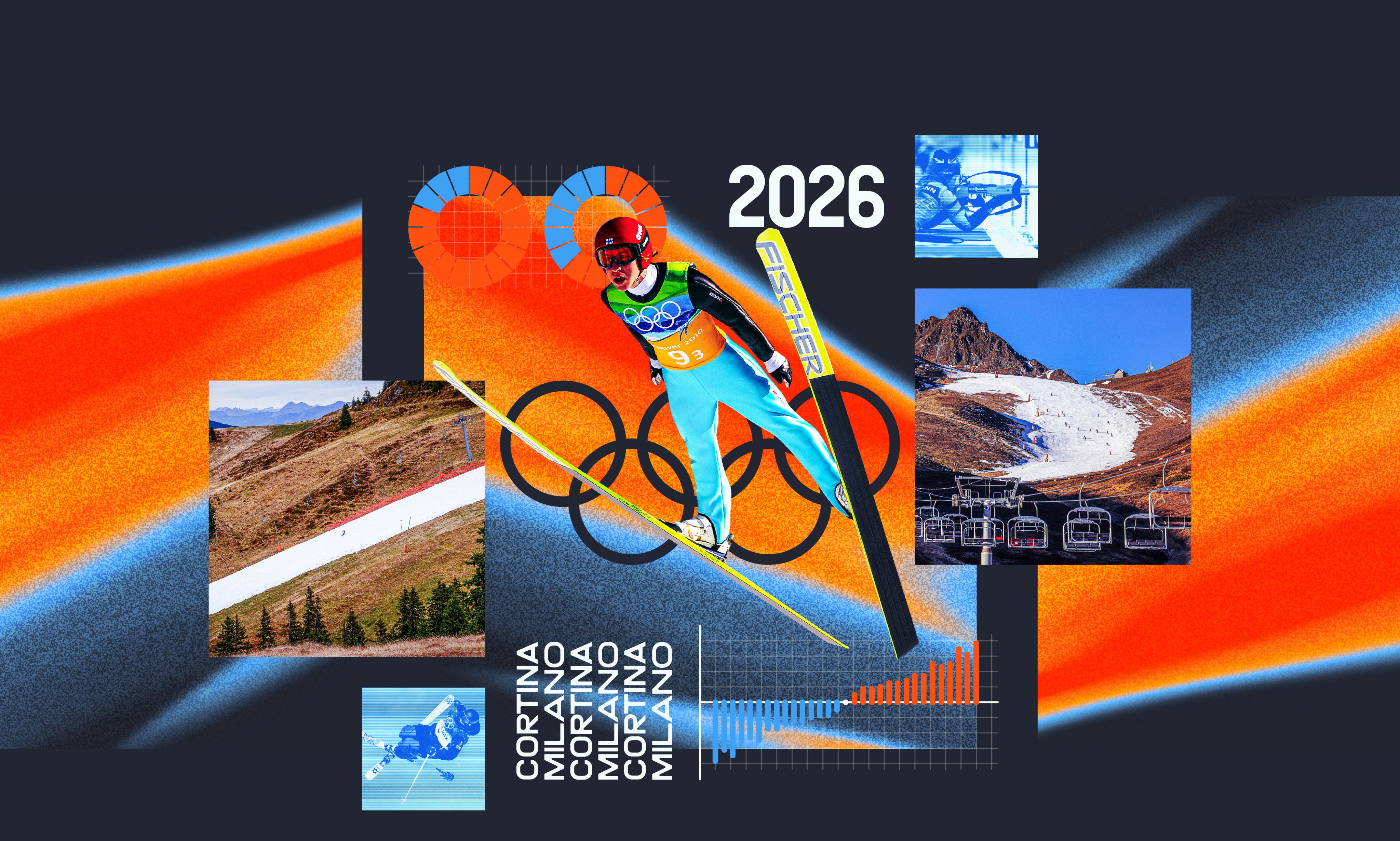
Rising temperatures have led to insufficient snow levels, with more snowsport competitions cancelled year on year, skiing holidays curtailed or cancelled altogether, and more artificial snow than ever pumped on to mountains once blanketed in real snow.
The International Olympic Committee (IOC) recognises the need to find solutions to the changing landscapes that could have a huge impact on how the Winter Olympics is hosted, watched and competed in.
Research has suggested failing to meet targets set out in the Paris Climate Agreement could leave fewer cities able to host the Winter Games. The production of artificial snow, meanwhile, requires a significant amount of water and therefore comes with its own environmental issues.
So what does that mean for the future of an event first hosted 102 years ago?
"It won't be around in another 100 years," says British former skier Chemmy Alcott. "Will it be around in another 20 years? I don't know."
From practical ideas such as creating artificial snow in an energy-efficient way to more drastic ones including rotating between a selection of host locations - or even hosting the Games entirely indoors - the future of the Winter Olympics depends on innovative solutions to combat the challenges of climate change.












To look forward, sometimes it is necessary to look back.
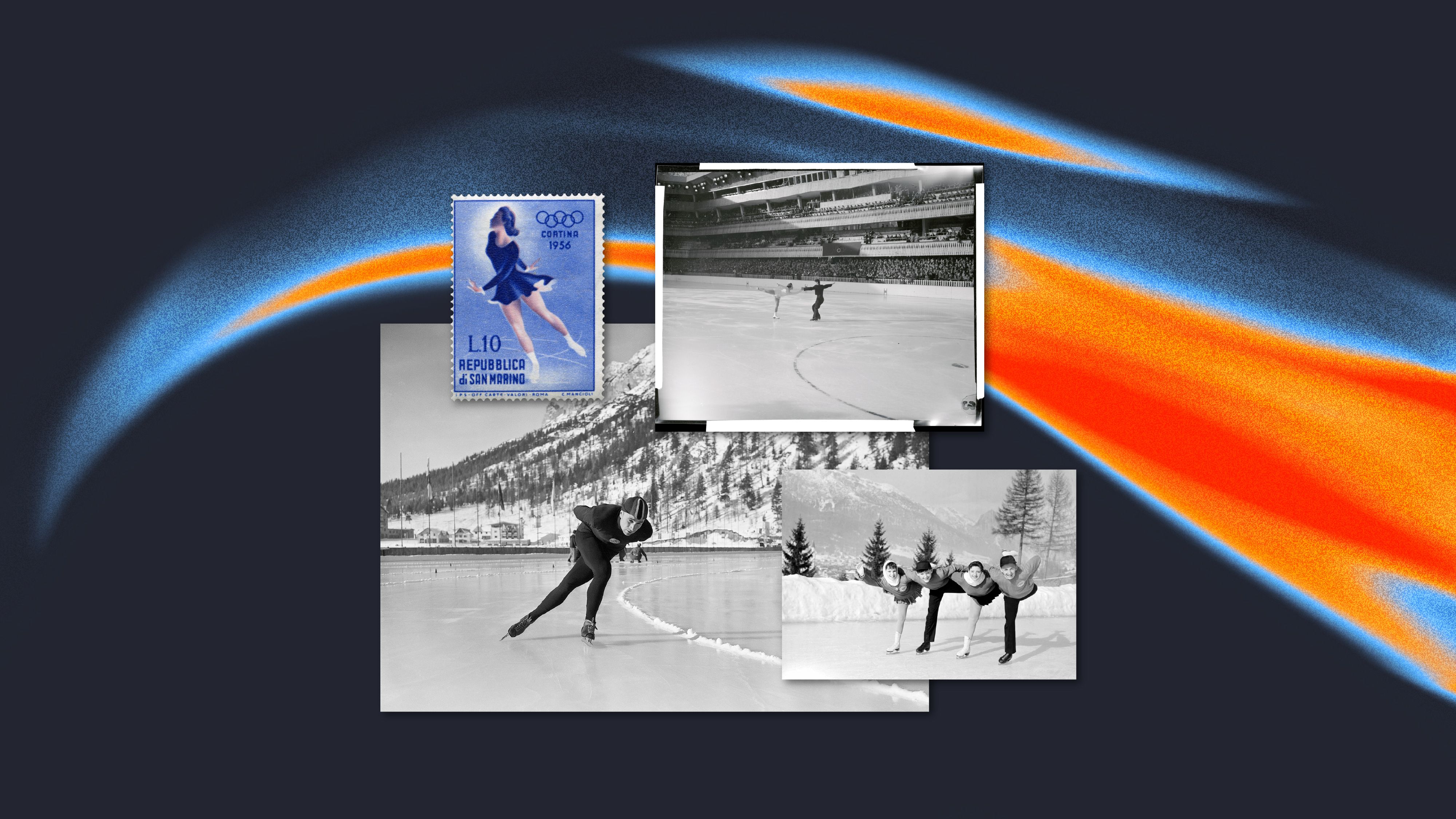
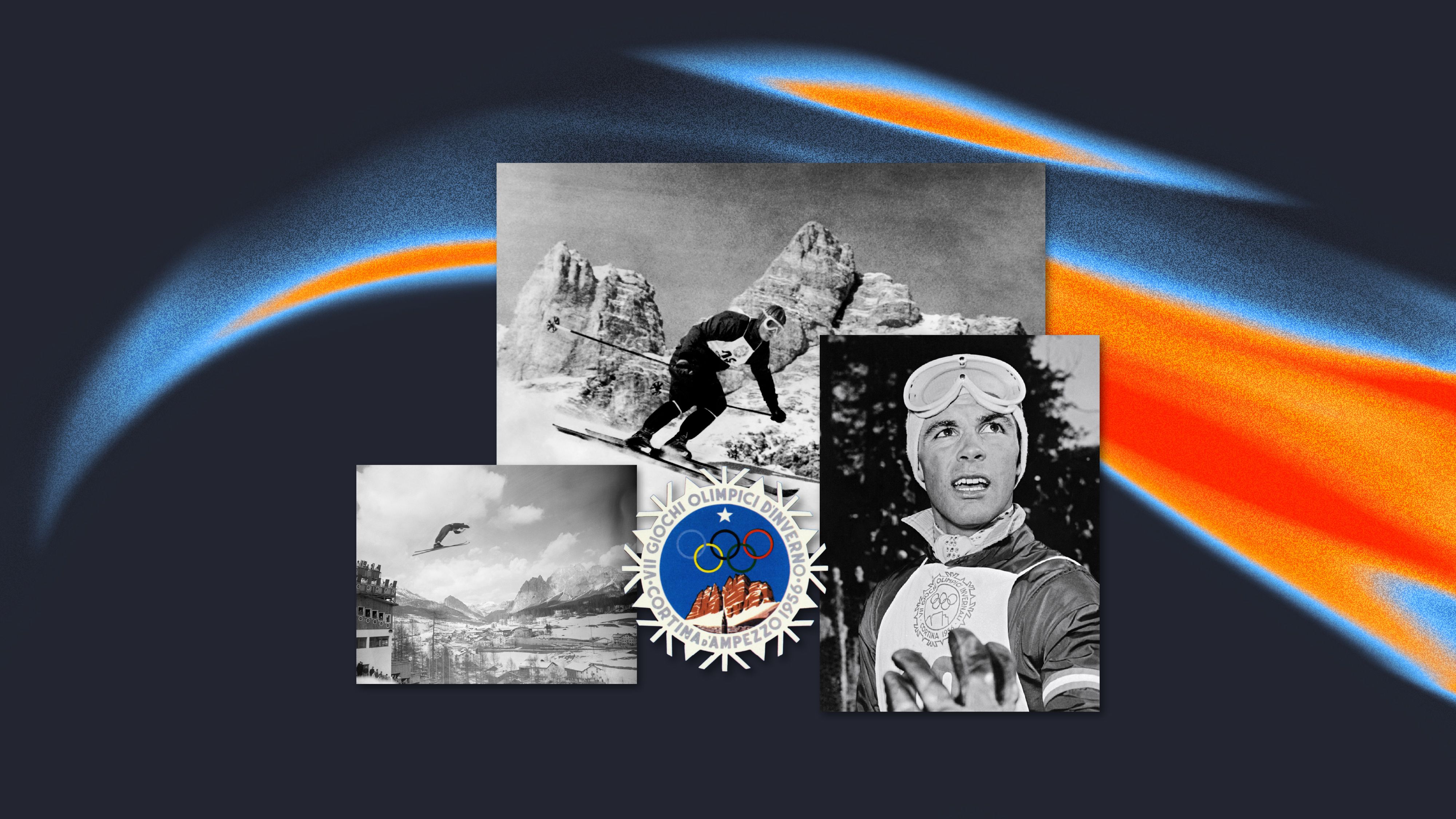
In 1956, Cortina d'Ampezzo hosted a Winter Olympics at which every event was held outdoors.
This year, Cortina will host the curling, women's alpine skiing and sliding, while Milan will be the home of the indoor events - ice hockey, figure skating and speed skating.
Livigno and Bormio will stage freestyle skiing, snowboarding and men's Alpine skiing, while cross country skiing and ski jumping will take place in Val di Fiemme.
Milan-Cortina 2026 will feature eight sports and 16 disciplines - double the number from 1956. It means 116 medals are on offer, with 2,900 athletes set to compete. Seventy years ago, 825 athletes vied for 72 medals.
The scale of the Games has grown significantly - and more events mean more snow and more infrastructure.
A lack of snow in the build-up to the 1956 Games was considered inconvenient. The Italian military transported snow from other areas of the Alps to Cortina, but a blizzard in the two days prior to the start meant the issue was resolved naturally.
The threat of climate change and its repercussions for the Winter Olympics were a long way off.


Statistics about the rate of global warming appear regularly in the news, but it is perhaps not until you see the stark visual changes to mountains that the real effects hit home.
That was certainly the case for four-time Olympian Alcott, who said she was ignorant to climate change during her racing career.
Since retiring from the sport, she says it is something she can no longer ignore.
Alcott recalls, at the age of 10, skiing the iconic Vallee Blanche - an off-piste glacial ski run above Chamonix. She remembers the pristine white slope and the danger of the surrounding crevasses.
Returning 25 years later, she said: "It just didn't live up to it.
"It was a monumental memory for me going there when I was so young. For those 25 years, I genuinely would think about this run multiple times every winter.
"When we went back there it had lost 100 metres of volume, so larger than Big Ben from its base.
"When I finished it in 1992, we had five steps that we walked up, and then you got this lift out that then took you to the train down to Chamonix. When I went back there, there were 285 steps. It was such a visual and physical loss of glacier that once I saw, I couldn't unsee it."

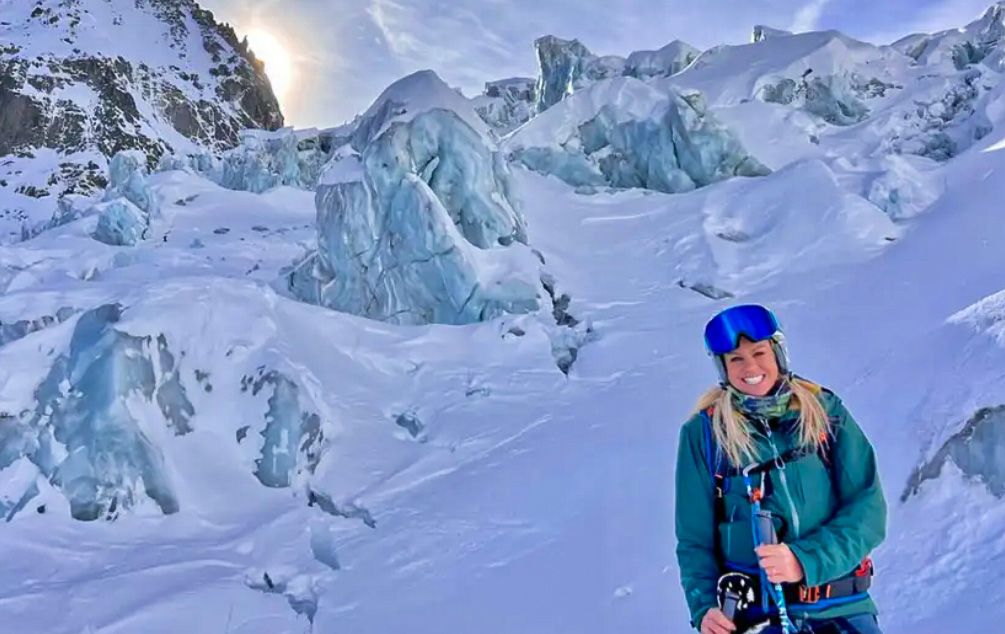
Chemmy Alcott competed at four Winter Olympics

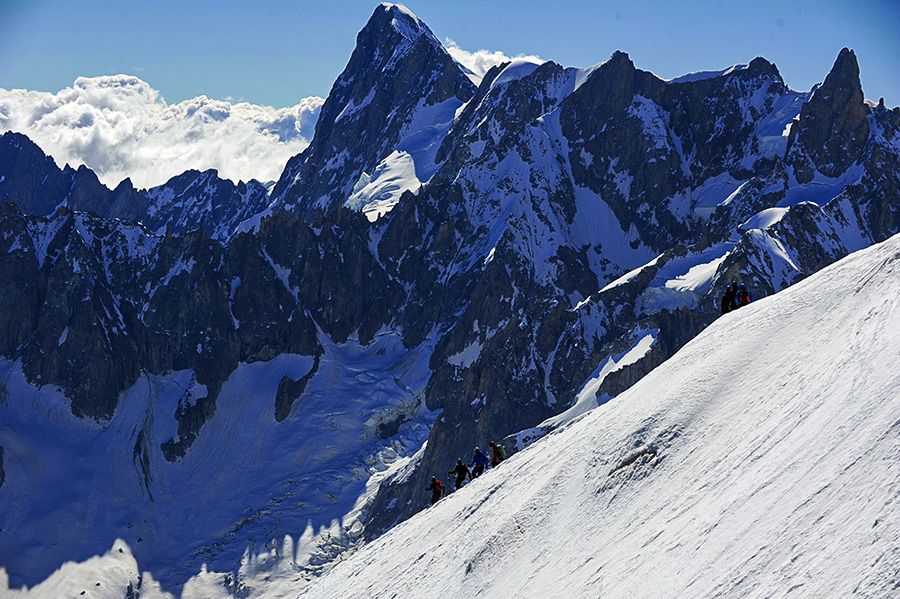
Tackling the issue of rising temperatures is the primary aim of the Paris Agreement. World leaders agreed the global rise in average temperature needed to be kept below 2C above pre-industrial levels, but with an optimum target of 1.5C.
Following a record warming rate in 2024, temperatures dipped slightly in 2025, but continue to approach the 1.5C marker.
The success - or otherwise - of meeting the goals set in the Paris Agreement could have huge implications for winter sport and the future of the Winter Olympics.
Research shows glaciers are melting at an unprecedented rate, snowfall is decreasing and what snowfall there is often melts quickly.
According to a recent report by the World Meteorological Organisation, glaciers outside the giant ice sheets of Greenland and Antarctica lost 450 billion tonnes of ice in 2024.
In the Alps, ice is melting at an alarming rate, with experts predicting that if warming continues on this trajectory, 90-95% of glaciers will be gone by the end of the century.


According to a study by Eurac Research, the amount of fresh snow in the Alps has decreased by 34% over the past century, with a significant acceleration since 1980.
In the 2023-24 season, 26 World Cup events were cancelled across five disciplines, all due to lack of snow.
Elite athletes are forced to adapt training schedules and locations to account for the weather.

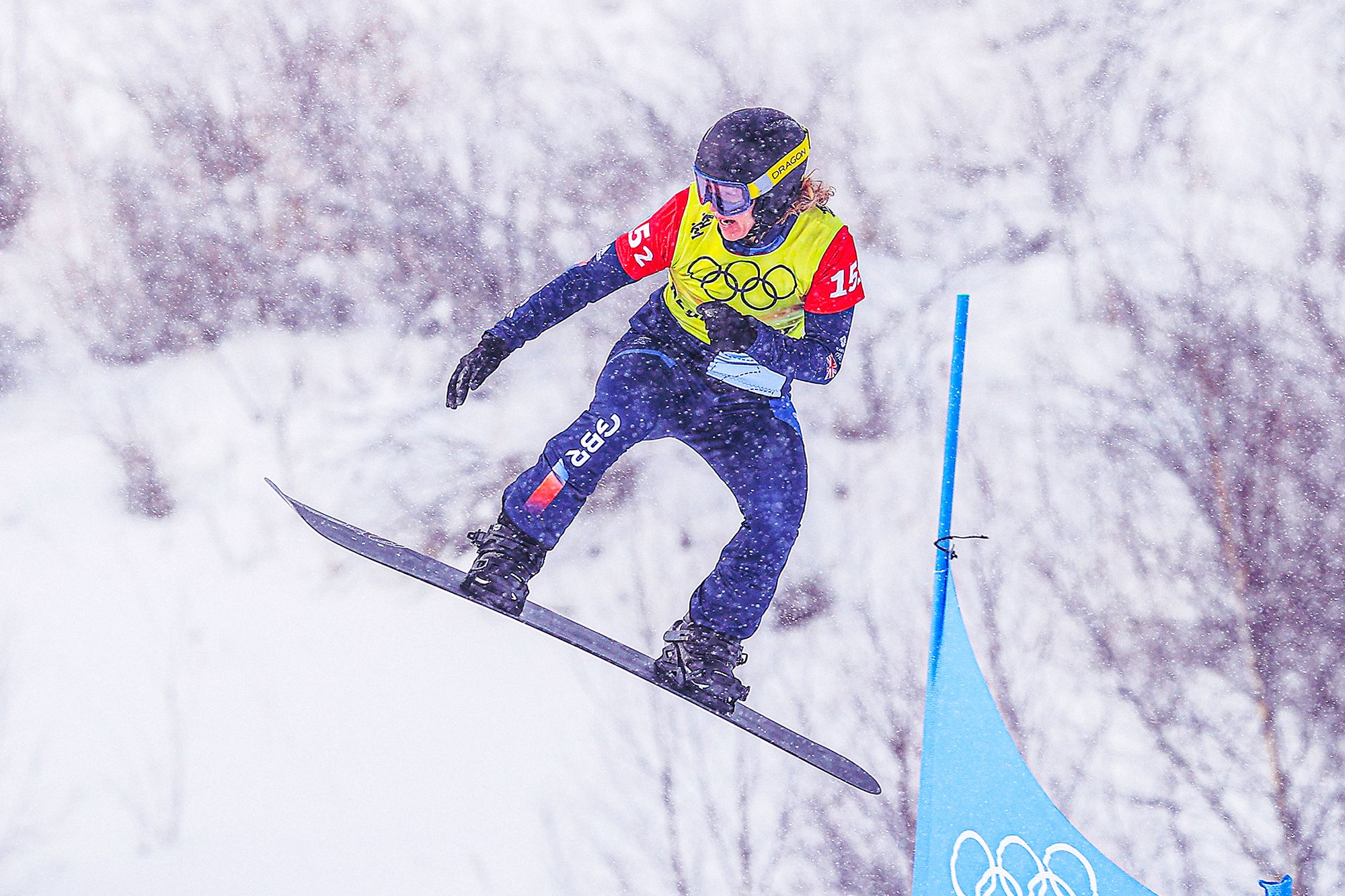
Charlotte Bankes (above) and Katie Ormerod (below) competing at the Beijing Winter Olympics in 2022
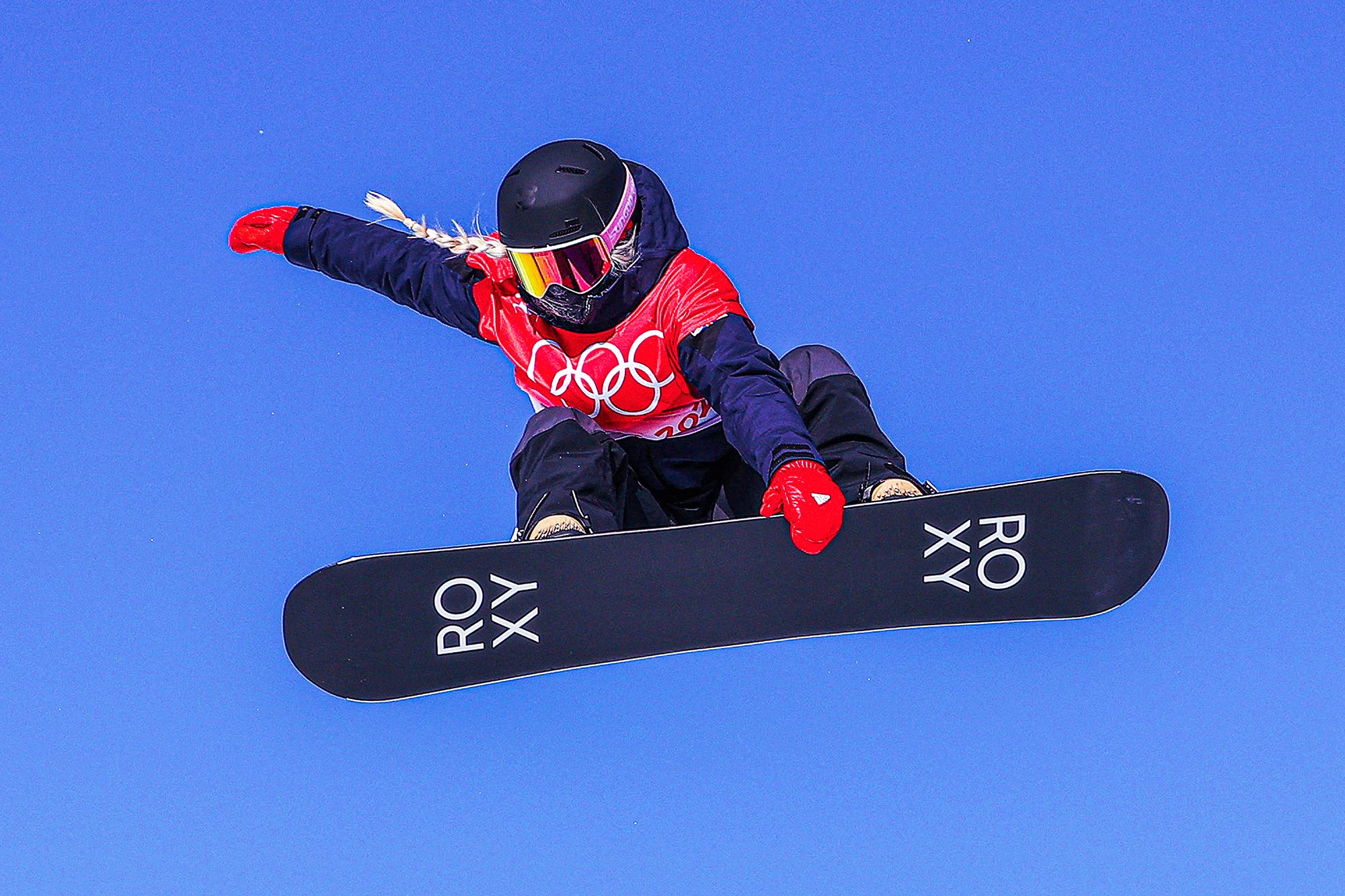
British snowboarder Charlotte Bankes said more of her training camps now took place in the southern hemisphere because "the glaciers in Europe are struggling".
"To preserve them, it's better for us to not be on them in the summer so we have to do a big camp in Argentina in September to get time on snow," she said.
Compatriot - and fellow snowboarder - Katie Ormerod said she was "very concerned" about climate change and worried what the landscape would look like for her future children.
"Every year there are changes. Some of the places we used to train at, for example Stubai in Austria... it's really hard to train there at the same time [of year] now because there is no snow at the start of the season," she said.
"I fear for the future of skiing and snowboarding. If things keep going the way they're going, my children might not be able to go snowboarding on natural snow in the mountains, and that makes me really sad because that has been my entire life."
Of course, it's not all about the elite level.
As snowfall decreases, ski resorts are impacted heavily, with ski seasons curtailed or cancelled as skiiers arrive to find green slopes and rain.
In France, about 113 ski lifts have been abandoned after resorts were forced to close because of a lack of snow. The Mountain Wilderness association estimates there are more than 3,000 abandoned structures dotted around the French mountains.
"Once I saw [Vallee Blanche] I feel like I started looking up for the first time in my life and everywhere I went I noticed differences," said Alcott.
"I noticed resorts that I grew up skiing in in France now didn't exist. They couldn't exist. This whole local economy that had put their lives and souls into having this ski area there... and you could see all the lift lines there, all the infrastructure, but it just doesn't have snow any more."

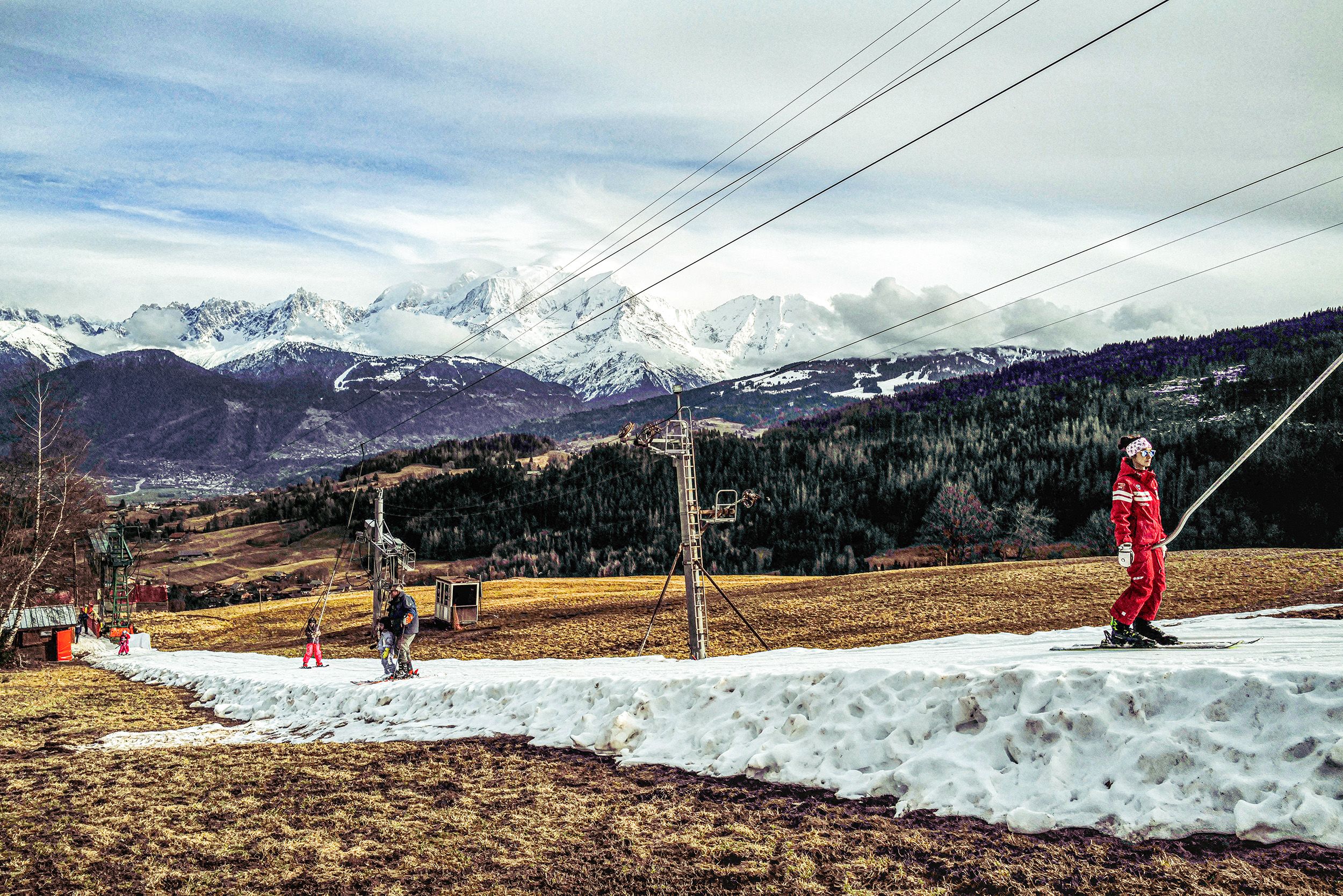
According to research, resorts in Europe face the most significant risk from climate change.
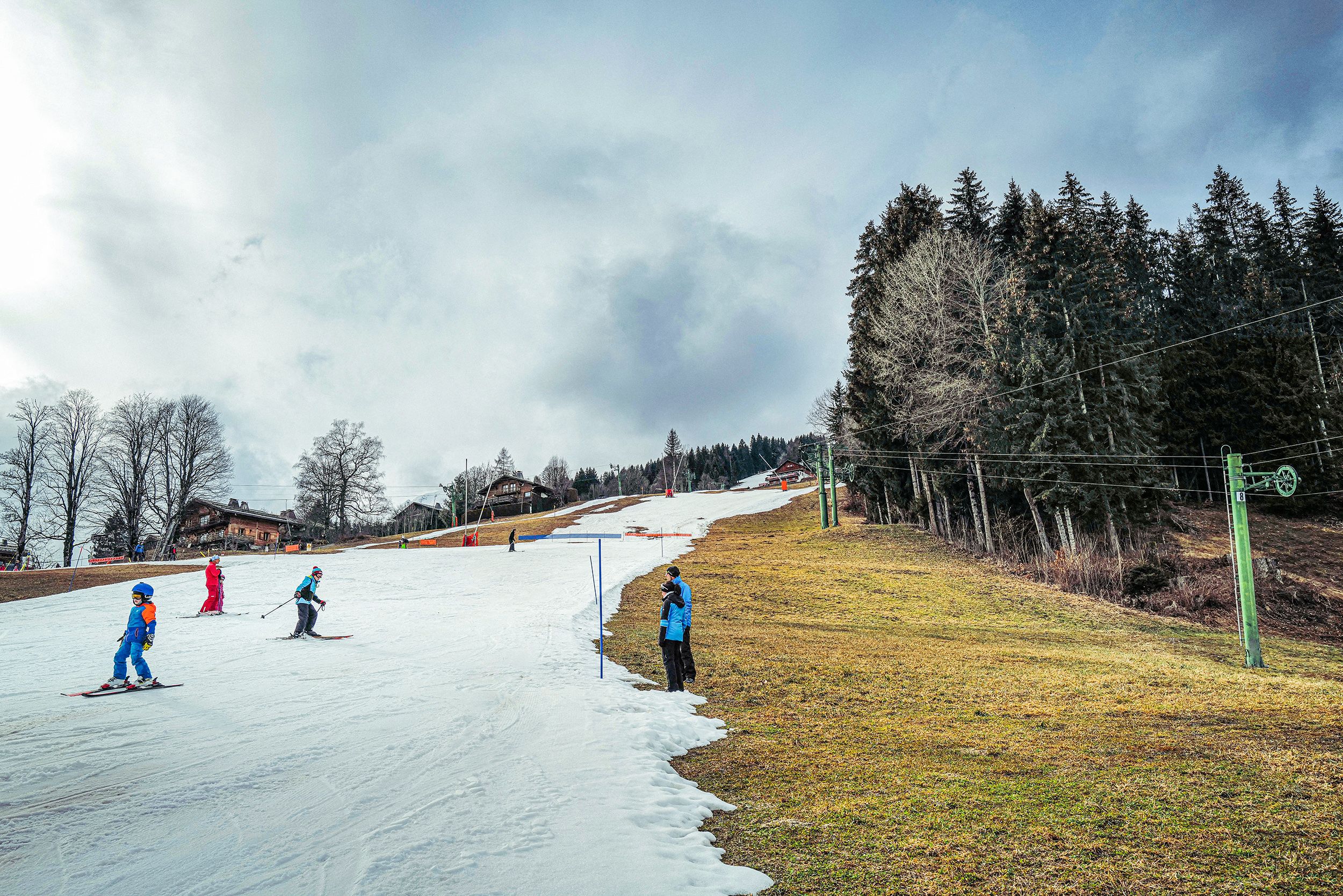
These slopes at well-known ski resort Megeve in France show the stark reality of how warmer weather affects resorts.
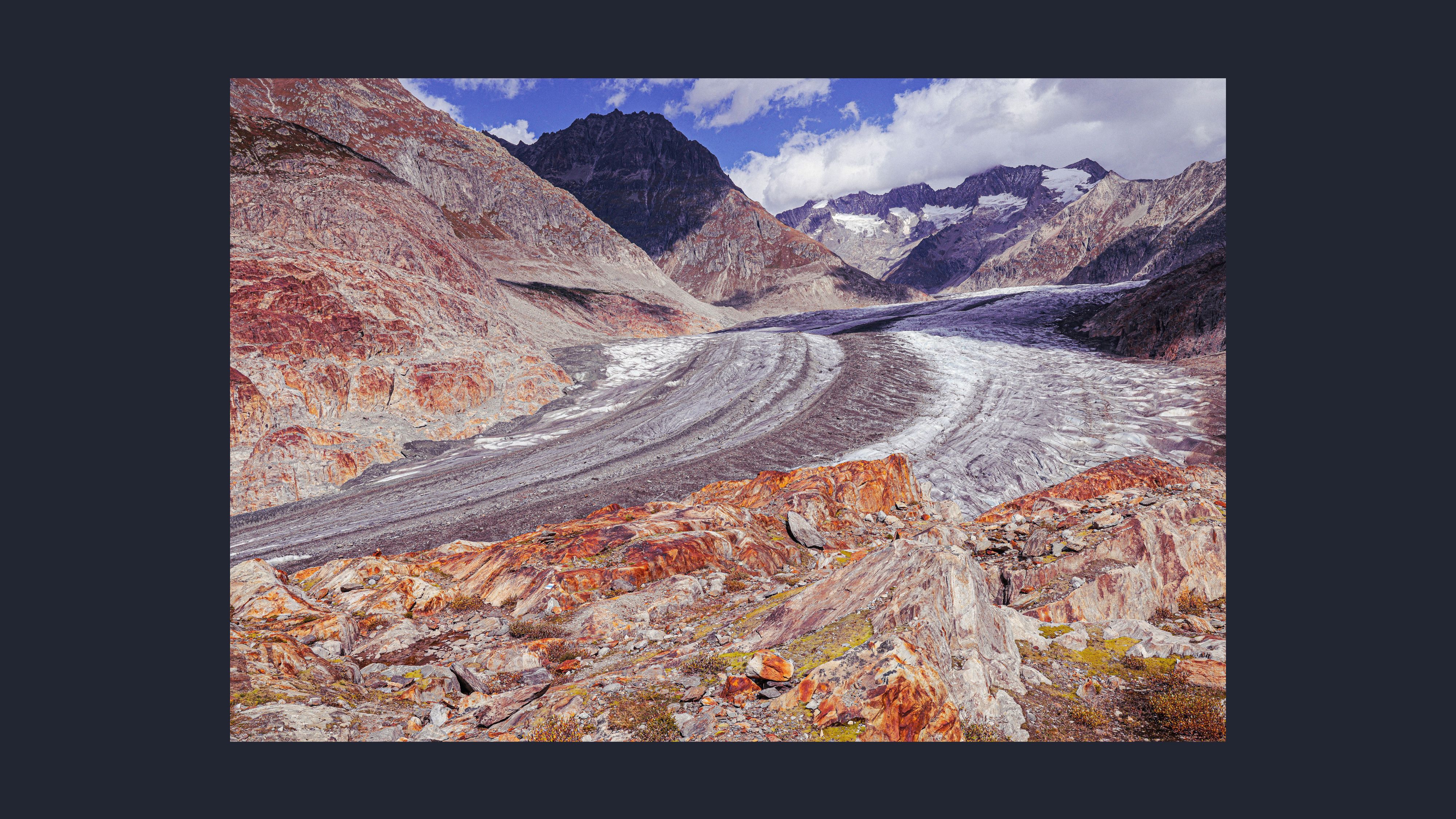
Aletsch Glacier, Switzerland
How the Aletsch Glacier has changed over the past decade

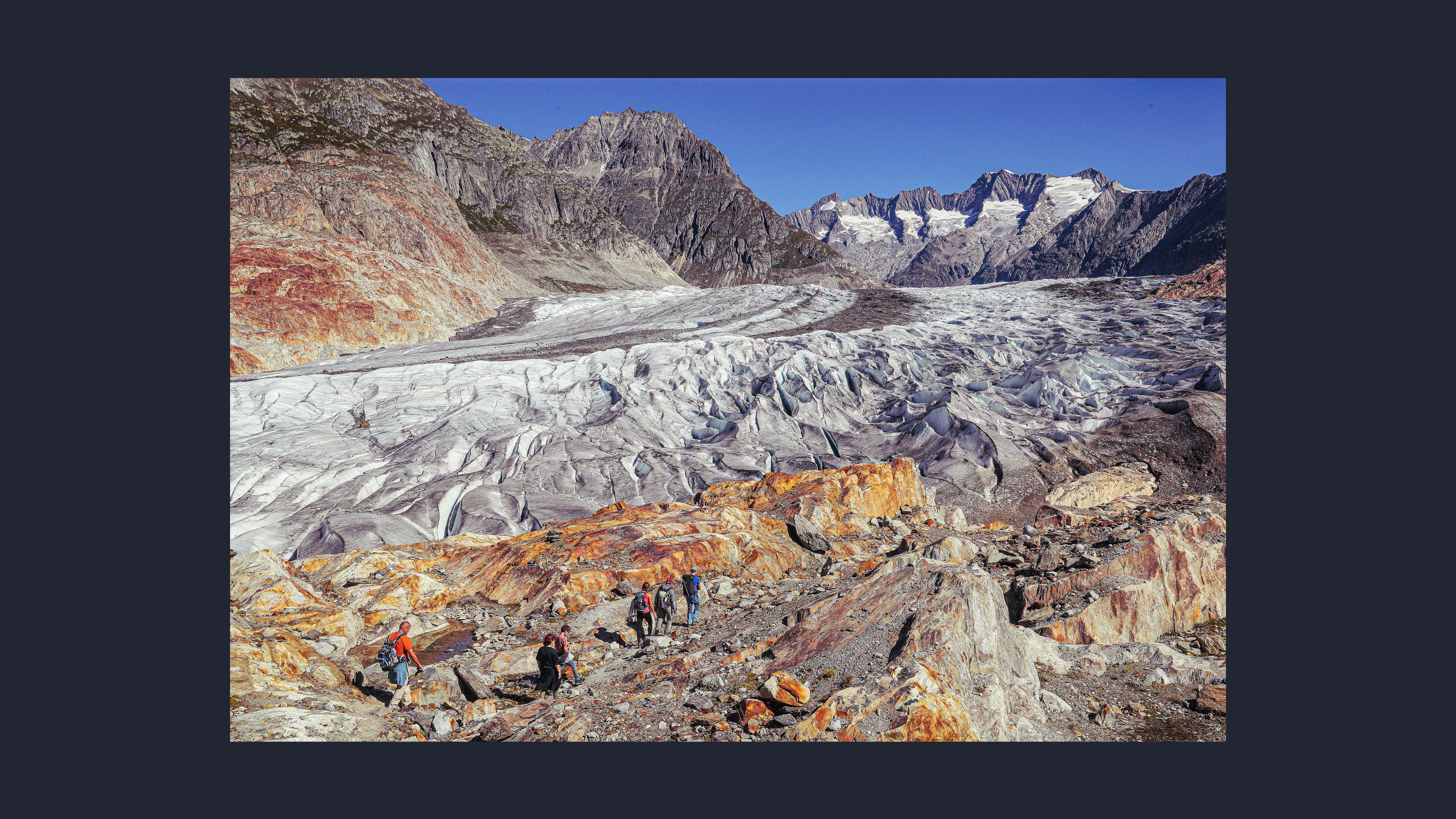

August 2016
September 2025
The issue is even starker at lower altitudes, where - according to the Intergovernmental Panel on Climate Change (IPCC) - warming is more pronounced, and snow cover has declined by about five snow-cover days per decade since the middle of the 20th century.
Almost half of the 186 ski resorts to have closed in France alone since 1951 did so because of a lack of snow. By the end of the century, the Snow and Avalanche Research Institute warns that only resorts above 2,500 metres will have enough natural snow to stay open.
"We have to keep going higher and higher and higher so then we have less and less places for people to ski because everyone's got to go higher," said Alcott.
"Then what happens is the slopes become more like the M25 and then more dangerous. Nowadays... the traffic comes up from lower resorts, and then higher ones become massively congested and it becomes more dangerous."
The ski industry generates $30bn (£25.57bn) a year for Europe. In France alone, 250 ski resorts employ about 120,000 workers.


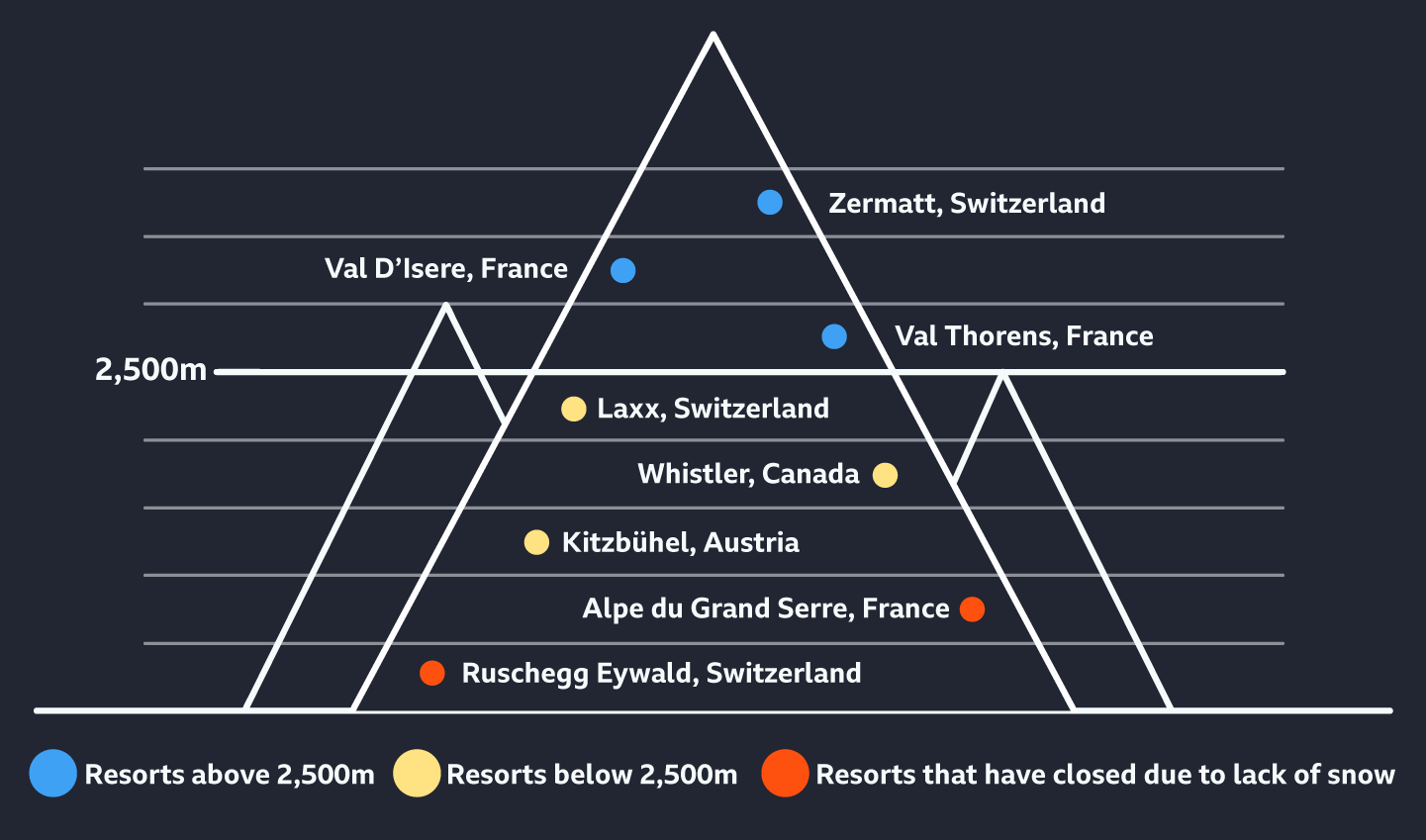
Altitudes of well-known ski resorts
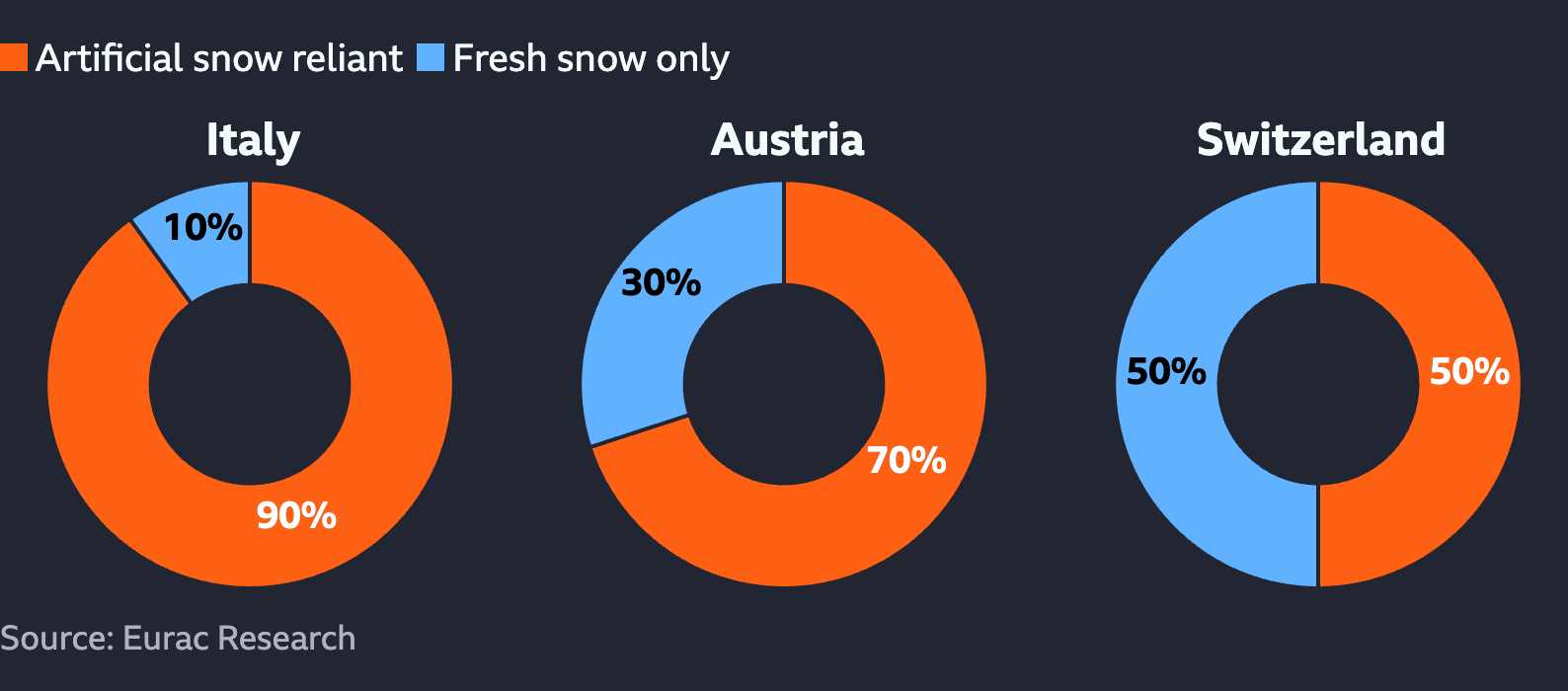
To combat the problem, resorts rely on the production of artificial snow.
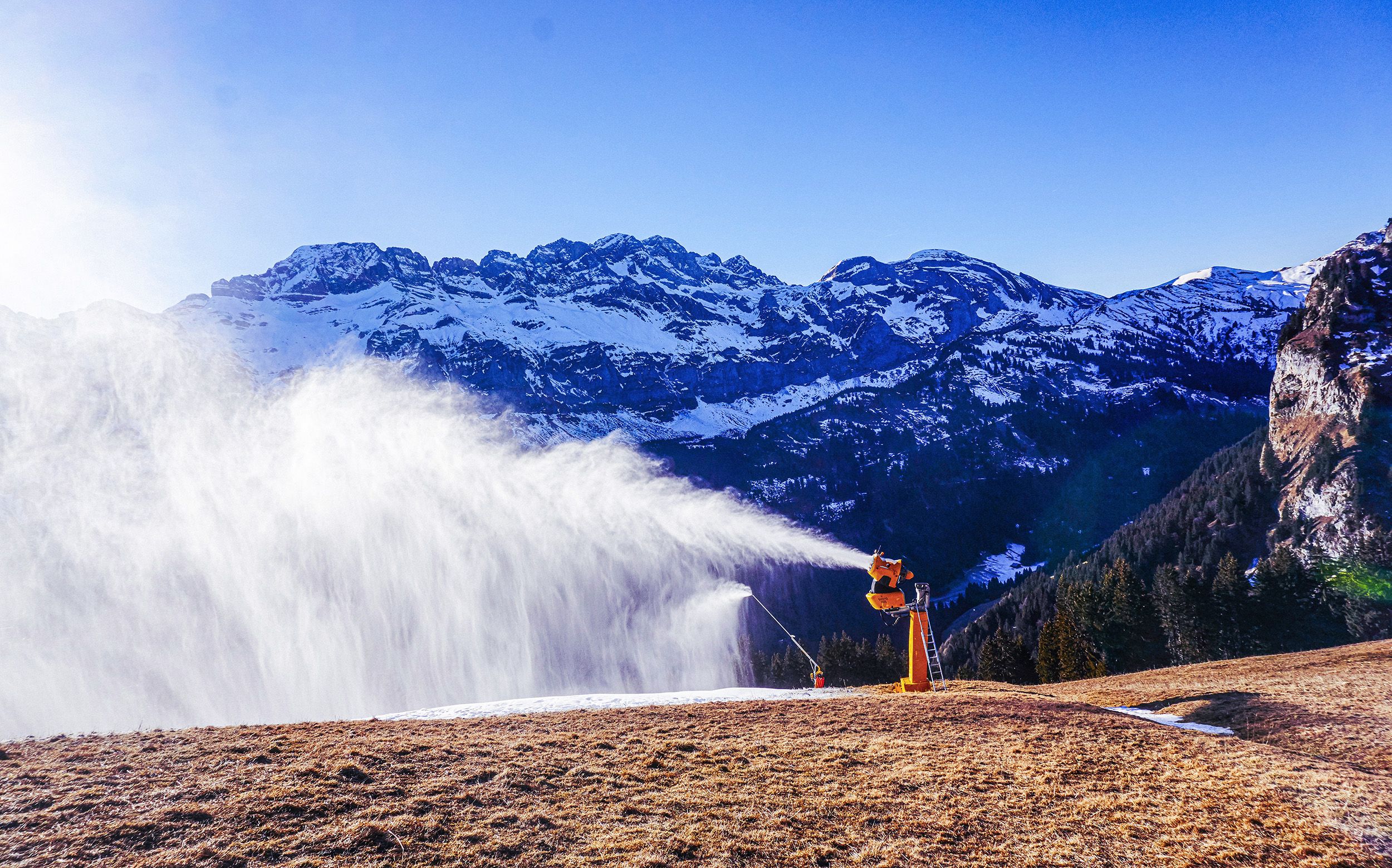
It is no longer uncommon to arrive at a ski resort and find huge snow cannons peppering the landscape to ensure the slopes can still be used.
Without artificial snow, more ski seasons would be cut short or cancelled, and the livelihoods of those who live and work in those areas will come under threat.
When it comes to the Winter Olympics itself, the production of artificial snow is not a new phenomenon - it has been in use since the 1980 Games in Lake Placid.

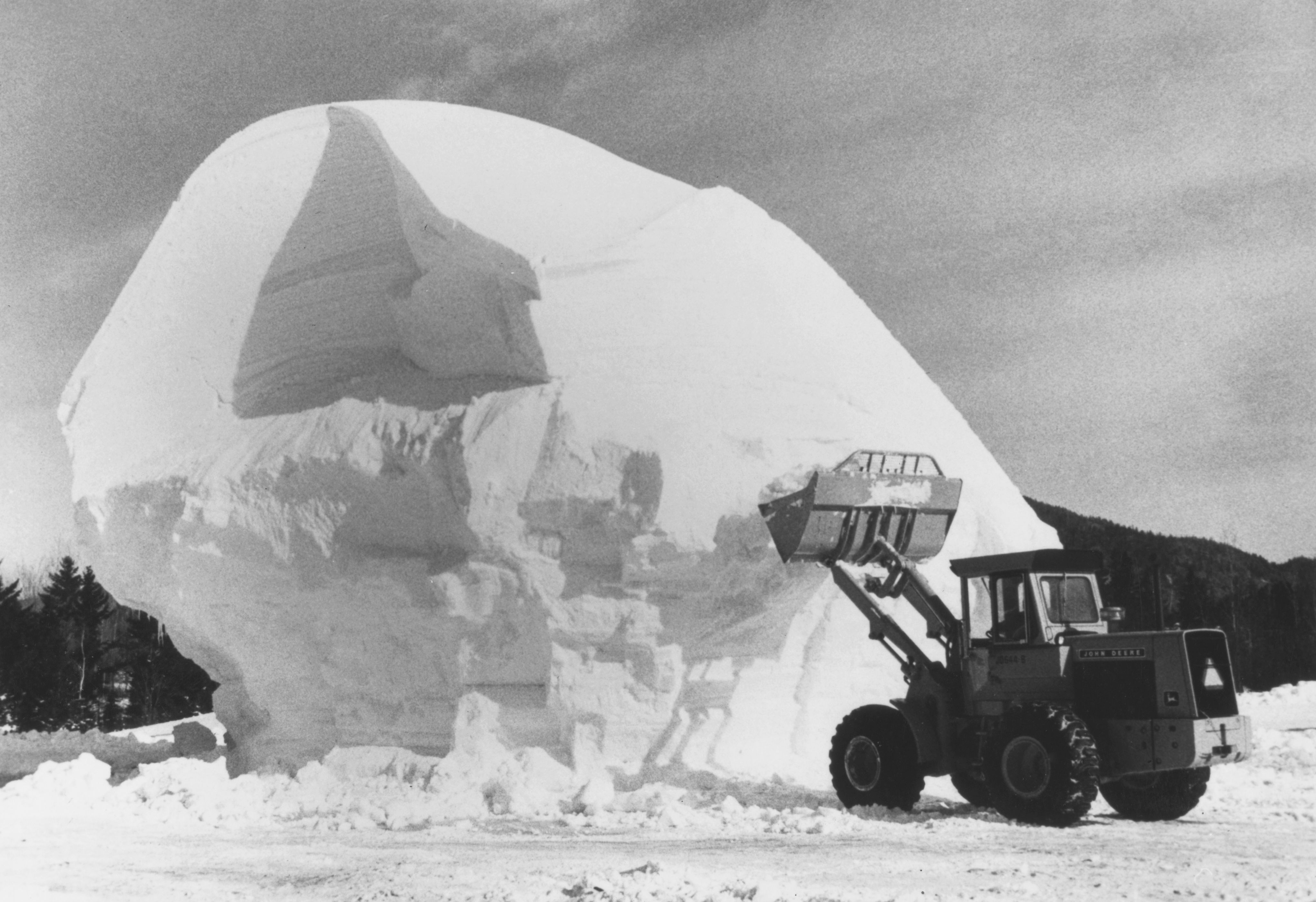
1980 Winter Olympics in Lake Placid, New York
The Beijing Games in 2022 were the first to use almost 100% artificial snow - because the region has very little natural snowfall - and it now seems unlikely an Olympics would ever take place without the need for artificial snow.
% of resorts relying on artificial snow


But the process of snowmaking comes with its own problems, and has been criticised by environmentalists.
It relies on significant volumes of water being available, and the use of snowploughs and helicopters to shift snow from one piste to another has its own environmental impact.
Geologist and conservationist Mario Tozzi said the power required to provide artificial snow to all of Europe's Alpine resorts would equal the annual consumption of 130,000 families of four people.
The organising committee for Milan-Cortina plans to produce 2.4 million cubic metres of artificial snow, requiring 948,000 cubic metres of water. More than half of that - 580,000 cubic metres - will go to Livigno's Mottolino site, which includes a snow park with a half-pipe and Big Air ramp.

A purpose-built reservoir at Monte Sponda - holding 200,000 cubic metres of water at 2,530 metres altitude - will supply Livigno with artificial snow




An Olympic-size swimming pool holds 2,500 m³
The Cortina Winter Olympics will require 948,000m³ of water to create artificial snow.
The equivalent of 379 Olympic-size pools.
Research suggests that, while there are some environmental drawbacks to snowmaking, it is not entirely unsustainable - it just depends where the water is coming from and the emissions used to make it.
Artificial snow at this Games will have been produced using far less water than at Beijing 2022, when 890,000 cubic metres were needed for the Alpine skiing site at Yanqing, and 1.9 million cubic metres for other snowsports.
But the reality is that without artificial snow, it is unlikely future Olympic Games would be able to take place at all.





Milan-Cortina highlights a shift back to a more traditional, Alpine Winter Olympics setting as the IOC recognises the threat of climate change to previous and potential future host cities.
The French Alps will host the 2030 Games, before Salt Lake City in Utah puts on the 2034 edition. The IOC is in talks with Switzerland for 2038.
Those decisions have been taken with various issues in mind - and a location being categorised as 'climate reliable' is of paramount importance.
Initial studies suggested climate change could mean only 10 nations would be capable of hosting the Games in the future.
But more recent research, conducted by Daniel Scott - Professor at the University of Waterloo (Canada) in co-operation with the IOC, widened the pool. It analysed 93 locations made up of previous hosts and potential future ones that were already deemed to meet infrastructure requirements set out by the governing body.
Temperatures both in the build-up to - and during - the Games, along with snowfall and the ability to provide artificial snow, were analysed to determine whether a potential host was climate reliable.
Warm temperatures during the Games can be dangerous as they lead to snow melting and, therefore, an unstable surface on which athletes compete.
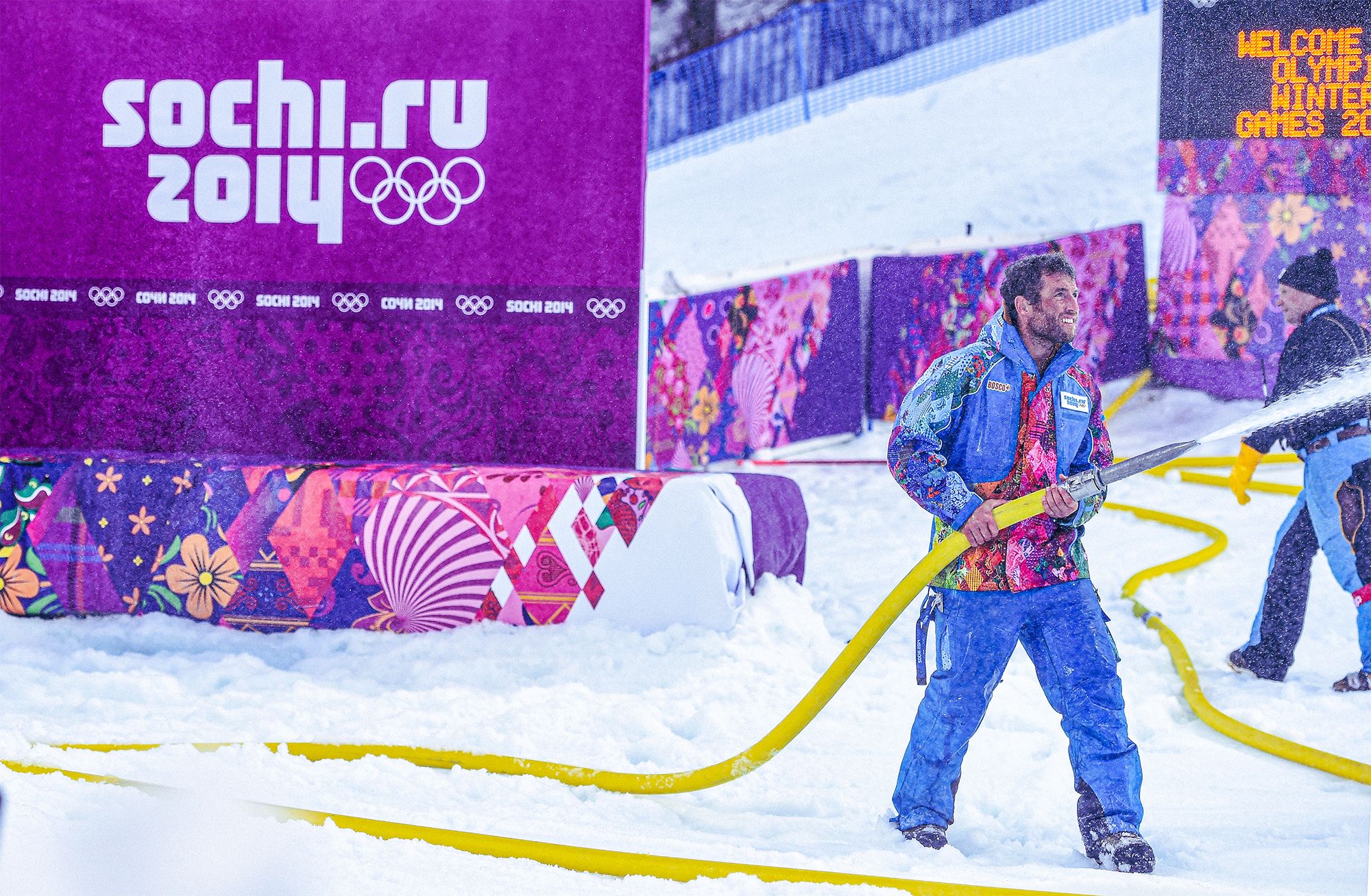
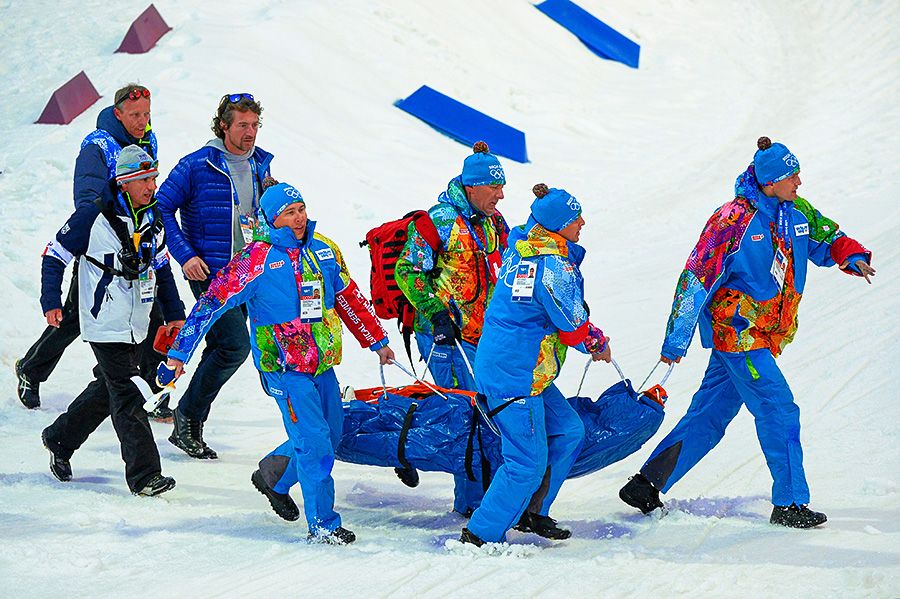
Sochi 2014 recorded the highest temperatures of any Winter Olympics, with highs of 20C. Snow had turned to slush, and many athletes complained about the risk of injury.
"I remember some of the women in cross-country skiing were having to shed layers because they were just overheating in those temperatures," Scott told BBC Sport.
"The injury rate from Vancouver [2010] to Sochi [2014] for the Paralympians in snowsports increased sixfold. Athletes didn't get worse, it was just like skiing in a slushie."
Of the 93 locations analysed in Scott's research, 45-55 were found to be climate reliable for 2080, and therefore capable of hosting the Games.
But, if the aims of the Paris Agreement are not met and carbon emissions increase, that number decreases to about 30.

"There are really two futures," said Scott.
"The first one is if we achieve the Paris Climate Agreement, the number of climate-reliable locations in the 2050s is almost identical to what it is in the 2080s because the climate not entirely stabilises, but pretty close.
"In a high-emission future, where warming continues to accelerate, you end up with a lot fewer locations by the time you get into late century."
The number of locations also decreases over time when factoring in the Paralympics, which is always scheduled to take place in the warmer month of March.
Viable Winter Olympics locations
According to the IPCC, mountain temperatures in regions with reliable observations have increased at an average pace of 0.3C per decade - exceeding the global warming rate of 0.2C per decade since the mid-20th Century.
Scott's research found the average daytime temperature at the Winter Olympics host location has steadily risen.
For Games held from the 1920s to 1950s, the average maximum daily temperature in the host city was 0.4C. For those held between the 1960s and 1990s, that climbed to 3.1C, and in the 21st century - including the Beijing 2022 Games - it has been 6.3C.
Temperature rise of host cities
Average maximum daily temperature at Winter Olympics
In the coming decades, that could increase by another 2-4.4C, depending on low or high-emission futures.
Climate change is not the only factor being analysed by the IOC when it comes to selecting a host.
It also says at least 80% of the venues should already be in existence - to limit the environmental impact of having to build new ones.
That limits the pool of potential hosts further and amplifies the IOC's need to come up with solutions to secure the long-term future of the Games.
An IOC spokesperson told BBC Sport that "climate change is already reshaping winter sport as we know it" and the aim is to protect the Games, minimise the environmental impact and help to safeguard winter economies.

The governing body added "sustainability must be part of the DNA of any hosting project" and said innovation was paramount to finding cleaner energy solutions to the lack of snow.
"From 2030 onwards, climate action is a contractual requirement for future hosts, including obligations to minimise direct and indirect Games-related emissions," it said.
"Any hosting project and Games organisers must commit to tackling climate change, protecting biodiversity and managing resources sustainably."
Infrastructure has been, at times, a sticking point Milan-Cortina, which was selected based on the use of things already in place, with the promise of minimising environmental impact and keeping costs down.
In reality, upgrades to existing buildings have been necessary - and new venues have had to be built.
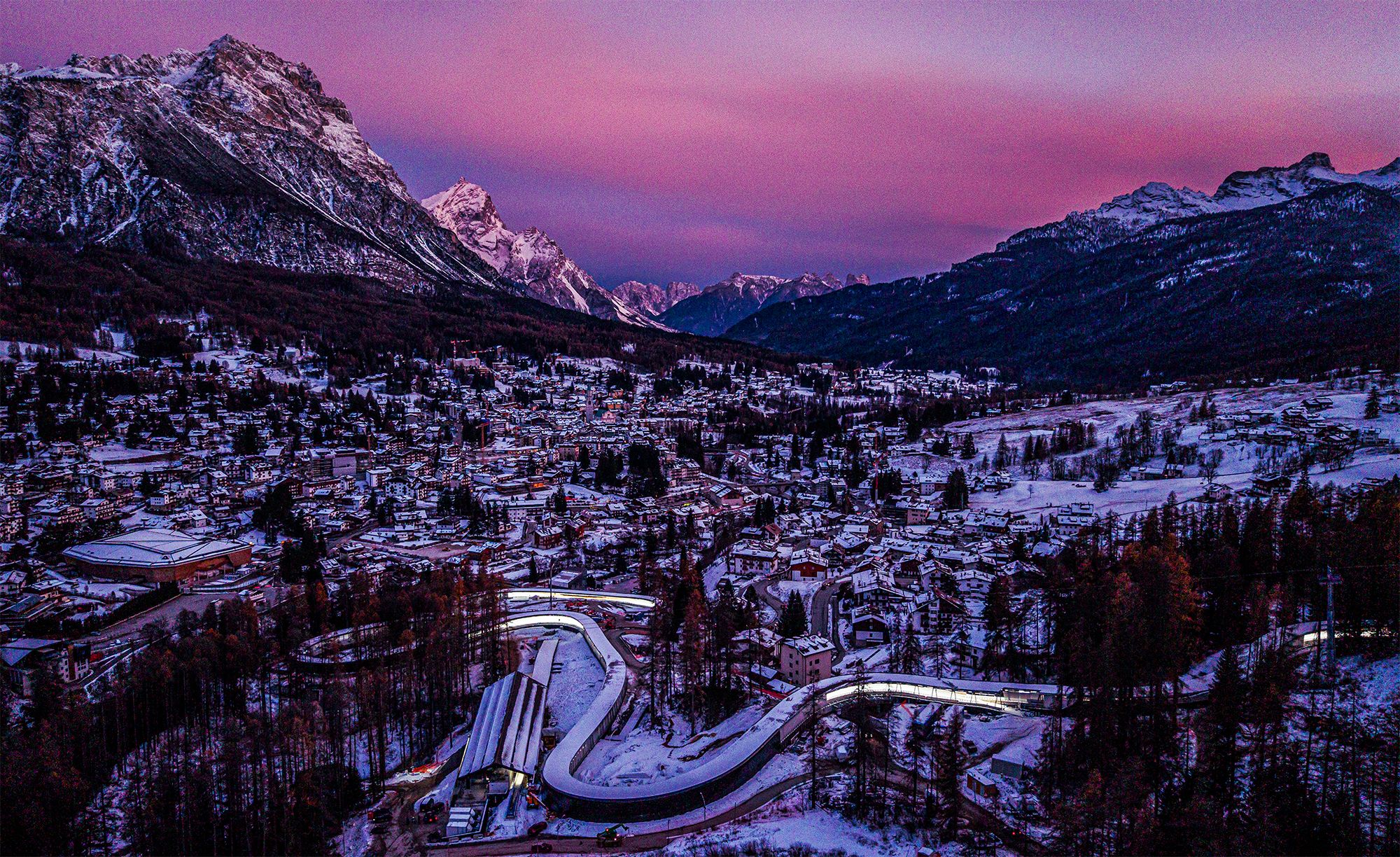
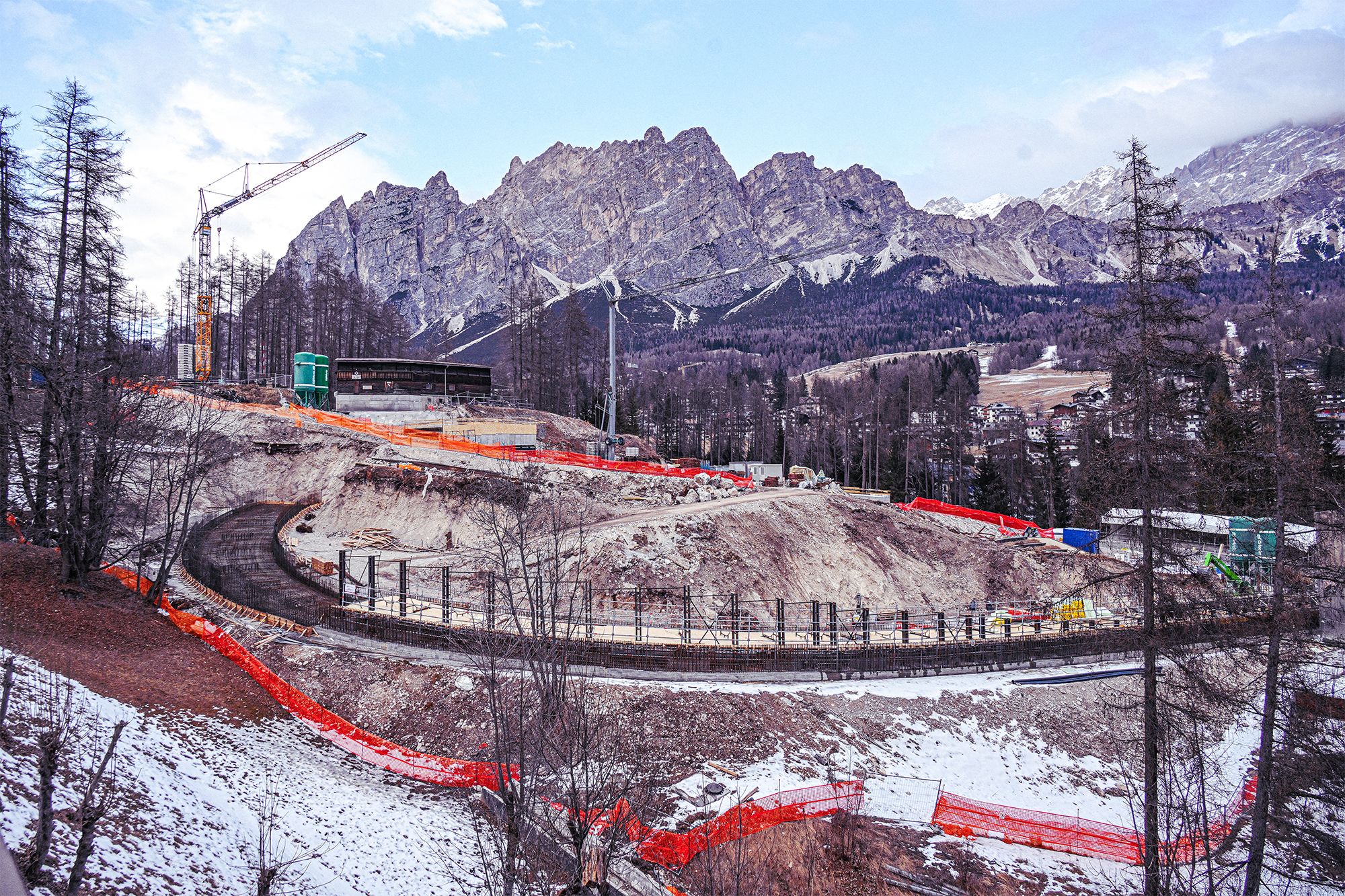
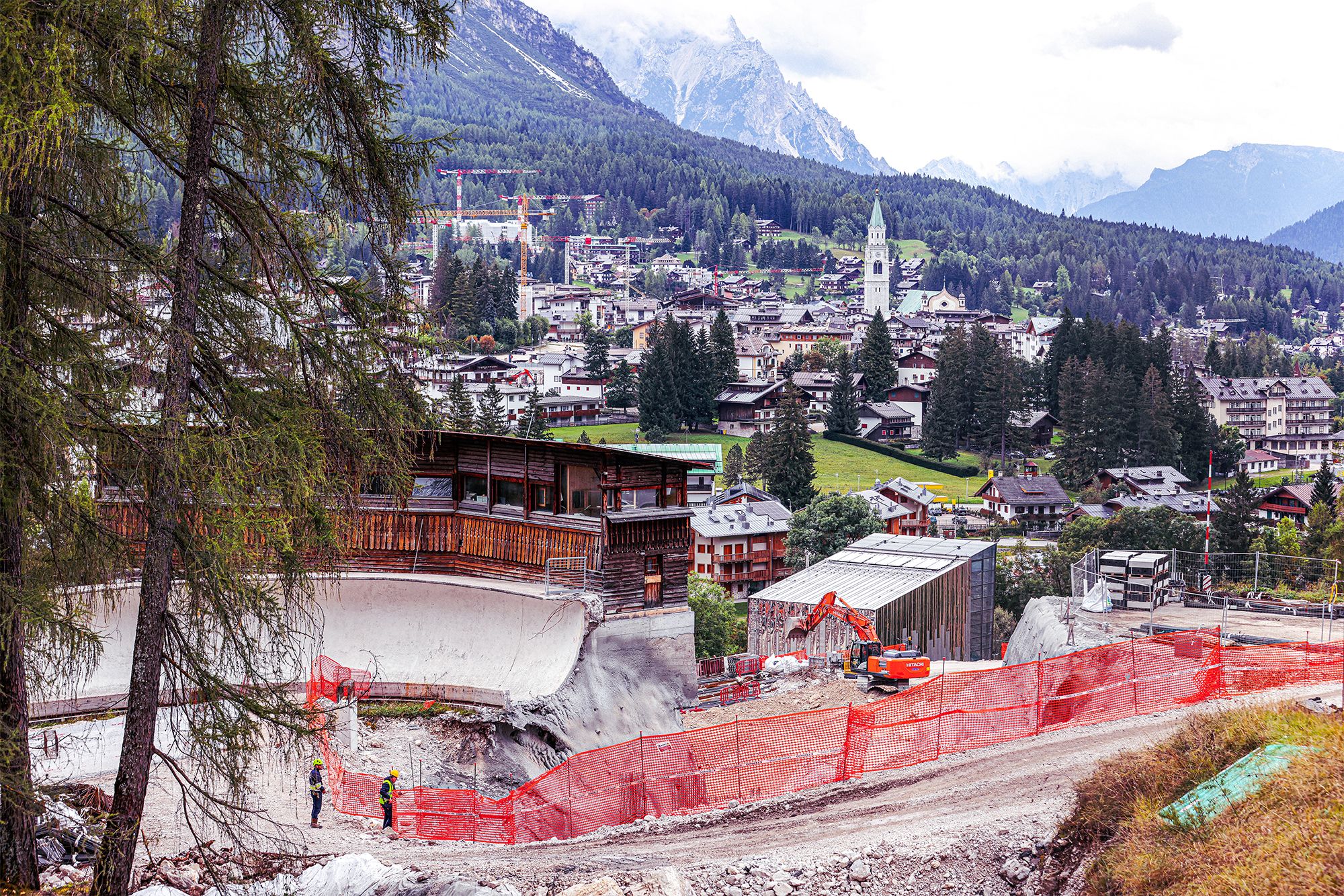
Existing infrastructure was initially going to be used for the sliding track in Cortina - home of bobsleigh, skeleton and luge - but it was eventually decided a new track would be built, leading to criticism over the cost and environmental impact.


The effects of climate change mean the future of both the Winter Olympics and winter sport more broadly are uncertain.
The IOC says it recognises the need to protect the future of the Games and has added sustainability and legacy to the core Olympic pillars of excellence, respect and friendship for Milan-Cortina.
Allocating the host nations for 2030 and 2034 earlier than is usual is one step that has been taken to safeguard the Games, while stating in contracts that hosts must minimise environmental impact is another.
But is enough being done?
Environmentalists have criticised this year's Games for not sticking to promises that were made around sustainability.

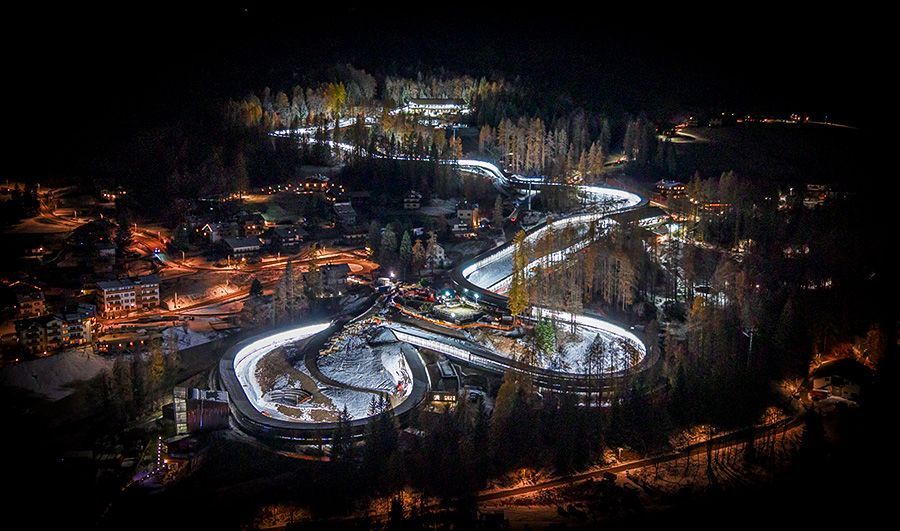
An aerial view of Eugenio Monti Sliding Center
The building of the new sliding centre has been questioned, with suggestions this was a missed opportunity to use the global stage of the Olympics to highlight the effects of climate change.
Cat Ainsworth - CEO of climate action charity Protect Our Winters UK - told BBC Sport: "There is an opportunity to innovate and think, 'how do we run the Games differently? How do we run them in a way that does not damage the places that we need to practise and compete?'
"A key part of that narrative is the communities that live in these regions who are seeing the change all year round and it's affecting their livelihoods, their economies. They are really the people that know first-hand, and moving forward we'd like the Olympic committees to really appreciate and plan with them."
The charity aims to support the IOC in its sustainability goals but says "transparency is key" around decision-making.
"When you're planning an event like the Olympics, the key is transparency of why decisions have been made and what that means from an environmental perspective," said Ainsworth.
While the Winter Olympics is experiencing the effects of climate change, the Paralympics faces an even greater threat.
Being held in the warmer month of March means the lack of snowfall, milder temperatures before and during the Games, and the reliance on artificial snow are all even bigger problems.
Host options are more limited than the Olympics, and International Paralympic Committee president Andrew Parsons said last year that climate change and the resulting lack of snow was a "permanent concern" for the future of the Winter Paralympics.
Professor Scott's latest research suggests possible solutions for protecting the future of both the Winter Olympics and Paralympics:
- Consider shifting to a rotating system between the most climate-reliable locations.
- Bring the Winter Olympics forward by two weeks so the Winter Paralympics can begin in late February.
- Change the Paralympics to two years before or after the Olympics to use the more climate-reliable month of February.
- Shift the competition schedule to earlier in the day, when temperatures are colder.
- Extend the length of the Games by 2-4 days to provide more scheduling flexibility in case of adverse weather.
- Prioritise host locations with high snow-making sustainability potential - using renewable energy to ensure high-efficiency snow production at warmer temperatures.
- Utilise snow farms to stockpile snow from the previous winter.
For Alcott, the issue goes beyond her career.
"I'm really torn because my sons have seen my amazing life through it and they want to be ski racers in the Olympics. And I'm like, do I put them off that?" she said.
"Do we just completely pull the plug on the next generation of athletes and say, 'actually it's a really hard sport, it costs a lot of money, and we haven't taken enough care of our planet for that sport to exist.'
"How do we coexist with the mountains that we love and need?"
There have even been suggestions the Games could be held at an indoor venue - or a man-made one - to allow other countries the opportunity to host.

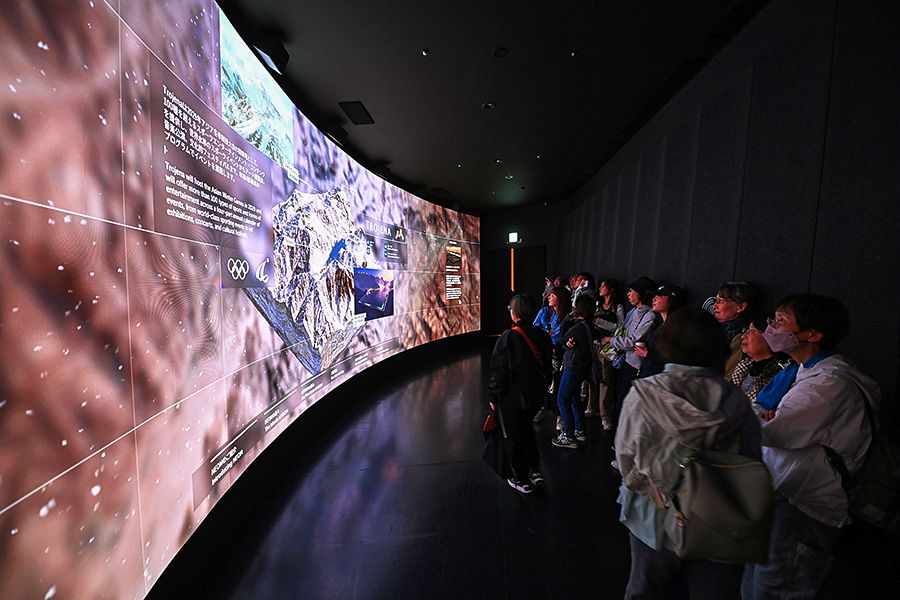
A display showcasing the Trojema resort in the Saudi Arabia Pavilion at the 2025 World Exposition in Osaka
Saudi Arabia won the right to host the 2029 Asian Games, which it planned to hold at man-made mountain resort Trojena, Neom city. Surrounded by the Sarawat mountains, temperatures are cooler in the region and it aims to be a year-round destination for winter sports.
But the event has now been shifted to Almaty in Kazakhstan, with reports suggesting there were delays in construction at the Saudi venue.
Alcott said hosting the Winter Olympics at a man-made venue or entirely indoors "cannot happen" - and Scott does not foresee that outcome.
"I don't see that happening," he said. "I think the IOC got some real criticism from some past decisions in terms of where they hosted the Games in locations that were climatically not optimal.
"I was somewhat surprised with the Asian Games decision. Yes, they can make the snow, but the closest point of water access I could find was the Red Sea that was like 250km away and that would have to be desalinated and piped in. That is hardly a fit with the sustainability pillar that the IOC has."
It seems unlikely, then, that a Winter Olympics would take place entirely indoors - or in a country associated with sunshine, not snow.
But the impact of climate change on winter sport is already being keenly felt - and as snow melts, and options for host nations dwindle, the event is at risk of becoming a thing of the past.
Credits
Written by Jess Anderson
Edited by Anna Thompson
Subbed by Reece Killworth
Design by Andy Dicks
Images by Getty Images
MORE LONG READS


Read all about the 53 athletes representing Great Britain at Milan-Cortina 2026.


The 25th Winter Olympics will feature almost 3,000 athletes from 90 countries competing for 116 medals at Milan-Cortina.
