The Uber-driving English champion & his 30-year fight for a passport

English light-middleweight champion Bilal Fawaz will challenge Ishmael Davis for the British and Commonwealth titles at Nottingham's Motorpoint Arena on Saturday
- Published
The small talk of a taxi ride is the beating heart of British chit-chat - a soundtrack to thousands of journeys across London and beyond.
On Sunday, a passenger might glance at the driver in the rear view mirror and ask the usual: "Good weekend, mate? Get up to much?"
For 37-year-old Bilal Fawaz, the answer could be a little different than the usual traffic complaints or remarks about the drizzle.
"I became a British champion. And then I drove this Uber," he plans to say, using the same casual tone he might use to discuss a bottleneck on the North Circular.
But for that conversation to happen, Fawaz must first handle business this Saturday in Nottingham, where he challenges Ishmael Davis for the prestigious British light-middleweight title.
In boxing, the story of the "working-class hero" - the athlete who still clocks in for a nine-to-five - is a great marketing hook. But for Fawaz, there is no romanticism in the grind.
"I'm an Uber driver. I'm a personal trainer. I'm a fitness instructor. And I'm a professional boxer. That's four jobs," he tells BBC Sport in fight week.
"I was doing Uber the day I came here. I trained clients before I left London. I pay for the car on a subscription every week and if I don't work, money goes out and nothing comes in.
"So on Sunday after the fight, when the kids are asleep, I'll jump in the car, make £70 or £80, park it, sleep, drop them to nursery and train clients again."
Fawaz is articulate and thoughtful, with a hint of theatrical flair that reflects his time at acting school.
But beneath that poise lie challenges far heavier than night shifts or 10-round fights. His fight began long before Nottingham - a childhood marked by abuse, years in the care system and a life spent proving he belongs.
BBC Sport first told Fawaz's story in 2018, revisited it in 2022, and yet he remains in limbo as an English champion still without a passport.
'My childhood trauma still haunts me today'

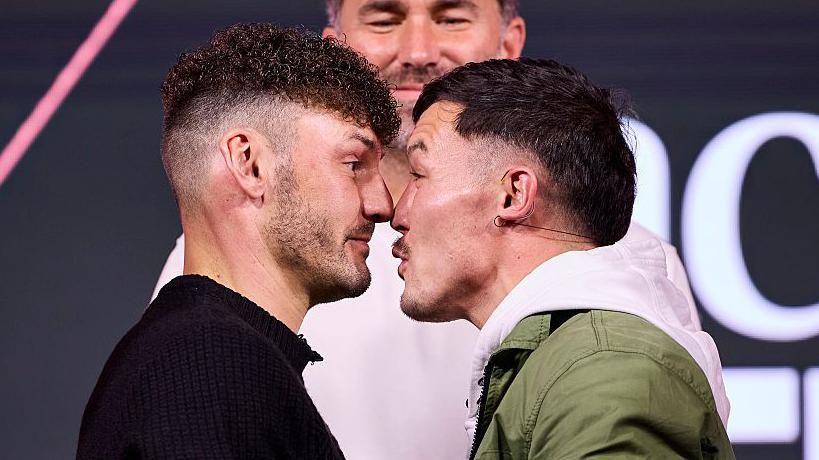
Bilal Fawaz (right) has won 10 professional fights, with one defeat and one draw, while Ishmael Davis (left) has won 15 and lost three
Born in Nigeria to a Beninese mother and a Lebanese father, Fawaz suffered severe physical abuse at the hands of his mother. When he was eight, his father - a distant presence - sent him to live with an uncle instead.
At 14, Fawaz was trafficked to London. He arrived believing he was coming to reunite with his father; instead, he was held in conditions that amounted to modern slavery - locked inside a house and forced to work, cut off from education and the outside world.
"My early years, I wouldn't wish them on anyone," he says. "It strips a kid of the feeling of belonging. It strips away safeness, shelter, trust. Imagine a kid bowling around with no one to talk to. That was me."
When he finally escaped, Fawaz entered the care system - a system designed to protect vulnerable children, but one he believes failed him.
In his youth, Fawaz received convictions for minor offences, including cannabis possession and graffiti. He avoided prison, but his record later complicated his immigration battles.
"People don't tell the youngsters, the young adults, that if you do this, these are the ramifications. If you do that, this is what will happen," he says.
"Social services should have helped me, but who am I? I'm just a number. Those traumas leave spiritual and emotional scars.
"I try to pretend they aren't there, but they haunt me. They make me wonder: What if I'd had parents? What if I'd had guidance?"
Leigh Wood v Josh Warrington 2
Saturday, 21 February
Live text commentary and radio coverage from 19:00 GMT on BBC Radio 5 Sports Extra, BBC Sounds, BBC Sport website and app and from 22:00 on BBC Radio 5 Live.
The 'stateless' boxer making up for lost time
Bilal Fawaz speaking to BBC Sport in 2018, when he was still an amateur
The All Stars boxing gym in Kilburn offered sanctuary. Fawaz flourished as an amateur, becoming an English champion and captaining the national team. Outside the ring, however, uncertainty still defined his life. Fawaz has been held in detention centres twice and faced deportation threats.
"The Nigerian embassy said I'm not a Nigerian. The Lebanese embassy said they don't have any record of me. And Beninese? There's no record because I wasn't born there," he explains.
A judge eventually ruled the Home Office had no lawful grounds to detain him. He was released, effectively stateless.
But despite that ruling, his official status continued to be listed as Nigerian, preventing him from being formally recognised as stateless under UK law. Twice, he watched Olympic dreams and six-figure contracts disappear because he was not legally allowed to work or travel.
Fawaz was finally granted a work permit and turned professional in 2022. Now he must make up for lost time.
"It's better to have a portion of something than nothing at all," he says. "If you keep working hard, the hard work will find a way to engulf the problem and make it tolerable. That is what I'm doing."
English champion but still no British passport

Bilal Fawaz did not realise straight away that he had been declared the winner over Junaid Bostan in their October rematch, after the first fight ended in a draw
After his win over Junaid Bostan last year earned Fawaz the English title, his life remains a series of contradictions.
"How can you be an English champion fighting for a British title and you don't have a British passport? How can you beat the champion of a country and you're not a citizen?" he asks. "I've been here 24 years. I am British. There's no way about it."
Fawaz has a British wife and two sons, aged one and three. When he looks at their passports, he is reminded of a freedom he is still being denied.
"It would mean the world to have one. I want to provide for them, to travel, to give them a better house," he says. "But the Home Office gave me a 10-year route to settlement, which means I'll get my passport in 2034 or 2035. By then, I'll be too old to box."
A Home Office spokesperson told BBC Sport that while it does not routinely comment on individual cases, the decision to place Fawaz on a 10-year route to settlement was not made by the department.
For now, Fawaz's career has a ceiling. He cannot travel abroad for lucrative fights in Saudi Arabia or the US. Instead, a home fight against Newcastle's IBF world champion Josh Kelly is his target. He hopes that continuing to succeed and pick up titles may strengthen his case.
"Maybe the Home Secretary or someone at Parliament can expedite my wait and give me a British passport so I can fight for the country and make it proud," he says.
After a brief pause, he adds: "Actually, I'm already making this country proud."
If you have been affected by any of the issues raised in this story you can visit BBC Action Line.
Related topics
- Published4 days ago
- Published28 April 2024


More boxing from the BBC
- Published16 August 2025