| SEE ALSO |  | | Picture gallery | | | Features index | | | Walk Through Time | | | The Blue Planet | | | WEB LINKS | | Southampton Oceanography Centre | | | FACTS | | Southampton Oceanography Centre is one of the world's largest institutions devoted to research, teaching and technology development in ocean and earth science.
More is known about the surface of Venus than the ocean floor.
More than 70% of the Earth is covered by its oceans.
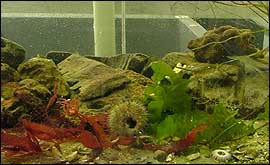
Sea anemones may look like beautiful flowers, but they're actually animals. They are related to jellyfish and coral, but unlike coral they are soft, and unlike jellyfish they don't swim. | | PRINT THIS PAGE | | | View a printable version of this page. | |  |
| | Oceanographers study all aspects of oceans: plants and animals, rocks and reefs, currents, tides and water circulation, seashores and the world's atmosphere.
Over 600 undergraduate and postgraduate students study at Southampton Oceanography Centre's waterside campus which has an aquarium for students to keep live sea life.
Jenny Mallinson's job is to keep plenty of tank space available for students' live marine material and to keep all the animals fed with fresh fish and for the vegetarian guests, seaweed gathered from dives.
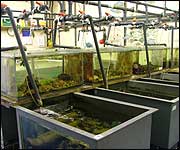 | | The Aquarium's tanks |
"We keep this aquarium for looking after students' research animals - the tanks are designed to have easy access and for us to look after the animals in the best possible way."
The holding tanks in the aquarium are filled with seawater collected from Southampton Water which is then held in two 30,000 gallon underwater tanks.
Some of the tanks' inhabitants don't always behave themselves:
"The crustaceans tend to fight when they're in one tank together, we can't keep them all in separate tanks so we have to put bands on their claws as they're not in a natural environment.
"The glass tanks have demonstrations of different sea beds in them. One of them is based on a Dorset sea bed with a wormery - the worms build tubes out of the sand and build them up so that the sand is at their neck height.
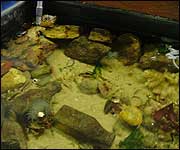 | | The rock pool |
"Then, one day the current changes and it takes all the sand away so you're left with tubes up to a couple of feet high which is a very open structure."
Recent research in the waters off the Dorset coast has revealed that boat traffic is uprooting Rossworms which it's hoped are soon to become a protected species.
"We've brought back some samples of the Rossworm which have been broken off and left on the sea bed. We've put it in the tank here and it's started to re-attach itself onto the bottom. So it's possible that where they've been knocked over, as long as they haven't been mashed completely, the protection will be worthwhile."
One of the Centre's students is currently doing some research on Ragworms which are the long worms (which can grow to over one metre in length!) that anglers dig up for bait. They're tricky to keep so they've come up with an alternative home for them:
"Ragworms are difficult to keep because they live in mud - but if we put them in a tank of mud and they bury themselves and die they'd rot and we'd never learn anything. So we've put tubes in the tanks and the worms are going into them. The funny thing we've found is that they tend to die in the middle and the front and the back are still alive!"
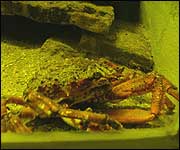 | | One of the aquarium's crabs |
All crustaceans and insects, must shell their exoskeleton (the armoured covering their claws and front part of their body) in order to grow. The new larger exoskeleton grows underneath and needs to time to harden and protect them. This process is called "moulting".
The aquarium's rock pool, is home to a crab, some Scorpion Fish and anemones. The crab, has moulted out of its shell as it's got bigger as Jenny explains:
"They crawl out of their old shell and then what they do is pick up bits of the seabed and put them on their shell. Lobsters moult too, inside their shell they have a softer shell like a skin only bigger.
"They eat and eat and eat until it's really tight and then they come out the side, pump themselves up with water to the new size and then grow the muscle inside the shell until it's time to moult again."
The aquarium isn't open to the public, however the Centre holds monthly talks on the first Thursday of each month on marine conservation topics - after the talks you can visit the aquarium.
The next talk at the Centre is 'Sea Fan (Gorgonian) corals as climate indicators' with Zoe Bond on Thursday 6th January at 7.30pm. |