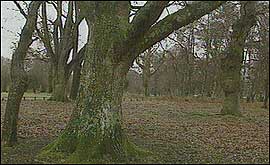
The area now known as the "New Forest" was once dense woodland. During the Bronze age trees were cleared and heathland began to form. Stones heated by fire were dropped into water in earth pits in order to boil the water for cooking. Several of these "boiling mounds" can still be seen in the forest, including one at Cockley hill.
By the Iron Age agriculture had developed the landscape which now included fields, banks and ditches. An Iron Age fort can be found at Castle Hill near Burley.
In the first century AD the Romans arrived and by 300AD the New Forest had become host to a thriving Roman pottery industry.
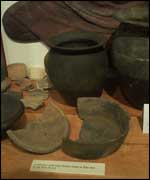 | | Roman pottery |
Pottery from the forest was used all over southern England. The examples seen here are exhibits at the New Forest Museum in Lyndhurst.
Much evidence exists of the Roman occupation, including the remains of a villa at Rockbourne, and pottery is still made in the forest.
Early in the 5th century the Romans left Britain to be replaced by the Saxons from northern Europe, who took control of the country. The Saxons were never centrally organised and over the next few centuries three kingdoms emerged, one of which was Wessex including the New Forest area.
The Saxons territory was constantly raided by Vikings until King Alfred (who may have burnt some cakes) made a big effort and fought them off.
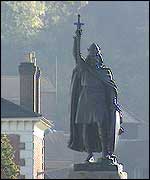 | Statue of Alfred at Winchester |
Alfred's Saxon capital was Winchester, where his statue now stands. For several decades the Vikings stayed away but then they returned with force, attacking all around the coast.
Control of the country collapsed and the Viking King Knut assumed leadership. On his death power fell to a number of competing earls and an ineffective King - Edward
the Confessor.
Wessex was controlled by one of the earls, Harold. When Edward the Confessor died, Harold claimed the throne but in 1066 the Vikings attempted to regain control with an invasion in the north. While Harold was fighting them William of Normandy invaded in the south.
13 days later Harolds army was defeated at the battle of Hastings. Harold himself was killed by an arrow through the eye. William of Normandy (the Conqueror) was crowned King.
King William wasted no time establishing himself. He siezed control of lands and embarked on a programme of castle building. Winchester remained the royal capital and William, who was fond of hunting deer, decided to create a specific area nearby for his sport.
In 1079 the area of some 150 square miles was declared a royal hunting ground by King William. Villages were depopulated and destroyed to clear the way. It is said that 36 churches were demolished during the creation of King William's New Forest.
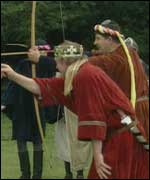 | | King Rufus hunted in the forest |
In 1100 William's son King Rufus was killed by an arrow while hunting in the forest. Rufus had introduced harsh penalties for breaking forest law and was very unpopular. It is thought that he was murdered.
A stone marks the spot where his body was found.
In King Rufus's days the punishment for poaching or taking wood from the forest was sometimes mutilation or death. Eventually, after much discontent, it was recognised that the forest folk had to be allowed some use of the forest in order to survive.
A system of Commoner's rights was established, rights which remains today.
Since then the Commoners have grazed their animals on the forest and its appearance today is largely a result of that grazing, without which the open spaces would disappear under growth.
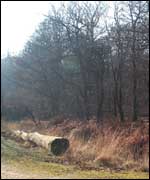 | | New Forest woodland |
The forest has played its part in the nine centuries of political activity since William the Conqueror. Holmsley Heath, for example, became an airfield during World War II, but in many ways the forest itself has changed little over the centuries.
There are areas of ancient woodland which are today almost exactly as they were hundreds of years ago.
The forest has experienced considerable deforestation at different times. An important use of the forest was to provide wood for shipbuilding. During the 17th Century, the Royal Navy built many galleons from New Forest timber.
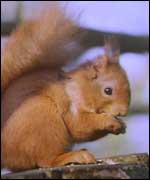 | | Red squirrels were driven out of the Forest |
The forest wildlife has changed over the years. Wild boar were hunted to extinction, and red squirrels were driven out by the more agressive continental grey squirrels.
In 1877 the court of Verderers was established. The ten Verderers together with six Agisters act as a regulatory body to monitior and control activities in the forest.
Today the Verderers work in conjunction with English Nature and the Forestry Commission, who administer and maintain the land on behalf of the nation.
In 1990 a 40mph speed limit was introduced to limit the number of animals killed on roads each year.
After years of lobbying by environmentalists, In 1999 it was anounced that the New Forest, along with the South Downs would become National Parks.
Deputy Prime-Minister John Prescott made the announcement half a century after the first national parks were created after the war: "Fifty years on, I am privileged to begin the process of creating new national parks for the new millennium."
|