Programme 2
First shown November 2004
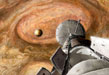  Just over 200 days of travel from the Sun, Pegasus reaches the largest planet of the Solar System, Jupiter. Just over 200 days of travel from the Sun, Pegasus reaches the largest planet of the Solar System, Jupiter. Danger lies in a menace lurking at Jupiter's core - a churning mass of liquid metallic hydrogen that inflates a magnetic bubble around the planet, producing levels of radiation 500 times the dose that would kill a human.  Take a tour of Jupiter Take a tour of Jupiter
To repel these lethal rays, Pegasus generates its own magnetic field. Mission geologist Zoe is to land on Io, one of Jupiter's moons. As the most volcanically active world in the Solar System, it's a geologist's heaven. Find out more about Hermes, the Io lander This scientific bounty does, however, come at a price. Perilously close to the most lethal Jovian radiation belts, Zoe risks severe exposure but she's trained hard for this day and nothing is going to stop her exploring these exotic lava flows. Her exhilaration at being on the surface quickly turns to frustration when her spacesuit malfunctions. Even the most cutting-edge technology and millions of pounds of development cannot guarantee safety in these other worlds. Zoe is forced to cut the mission short. No samples are returned and, to her despair, half the expedition is a failure. 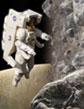 The ringed world of Saturn is almost a year of interplanetary travel away. By the time they reach it, medic John is seriously sick and deteriorating rapidly. He seems to have been exposed to a lethal level of radiation as Pegasus passed the Sun. How does radiation affect your body? Amongst a mesmerising trillion shards of ice and rocks tumbling in endless rings around this gas giant, crew member Nina Sulman conducts a spacewalk. She collects a fragment for testing, hoping it will help establish the rings' origins and age. By the time she returns, John has passed away, no longer able to fight the radiation in his body. His death is a terrible blow to the astronauts. Torn between returning to Earth or venturing on to Pluto, at the edge of the Solar System, the psychological stress takes its toll and the crew take the unprecedented step of cutting contact with Mission Control whilst they make up their minds. Eventually, the astronauts re-establish communication having decided to continue on their Plutonian path. Almost two years elapse before Pegasus draws close to the tiny frozen world of Pluto, its massive moon hanging close by. Tom and Yvan make the descent and spend 10 days constructing a telescope which will remain on the surface after they leave, scouring the Galaxy for other Earth-like planets. 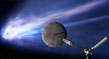 Heading for home, there is one final mission: to land on a newly observed comet, Messier, to sample pristine material from the birth of the Solar System in a search for the organic building blocks of life. Did comets bring life to Earth? As the crew rests inside their lander, the comet suddenly starts breaking up without warning, shedding material into space and blocking a safe return to orbit. Zoe and Nina make a dramatic emergency launch to bring them within sight of Pegasus, but comet debris has breached its hull, injuring Yvan. Tom is busy fighting a fire on board. The safety of Earth suddenly seems a long way off... Play the Space Doctor game Back to Space Odyssey Homepage | 

