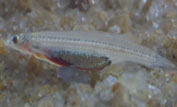
  A name for this bloodsucking fish
The Amazon Abyss expedition discovered this brand new species. Watch the moment it was found.
RealPlayer is needed to view this video. Download it free. The 'vampire' fish is a smaller relative of a notorious fish called the candiru. Some of the candiru's habits are enough to make almost anyone squirm (see "Don't go in the water" below). The new fish is about 25mm long and feeds off larger fish by swimming into their gill slits and sucking their blood. | Don't go in the water The candiru feeds parasitically by burrowing into body orifices then drinking the blood of its victim. It detects urine in the water to find a host. It can lodge itself in the urethra, the tube inside the penis. Barbs along its sides jam it in place. Removing one without surgery is almost impossible. | |
One of the expedition scientists, Mário de Pinna from the University of São Paulo, came up with five suggestions for its scientific name. He offered readers of this website the chance to vote for their favourite. Paracanthopoma draculae
This name is homage to Bram Stoker's fictional vampire, Dracula.
Paracanthopoma irritans
'Irritans' is part of the scientific name for the human flea. Fish probably find this little parasite equally annoying.
Paracanthopoma minuta
This suggested name reflects the fact that the new fish is a small member of the family.
Paracanthopoma nosferatu
One of the earliest film adaptations of the Dracula story is Friederich Murnau's silent 1922 version, Nosferatu.
Paracanthopoma vampyra
If you can't decide which vampire you prefer, you could hedge your bets. Over 10,000 votes were cast. The winning name was Paracanthopoma vampyra. Back to top How species are named The naming conventions for plants, animals and bacteria have been established gradually since the 16th century. The modern binomial system uses a pair of names to describe an organism by its species and its genus (group). It is often credited to the 18th century Swedish scientist Carl von Linné but Casper Bauhin, a botanist working in Switzerland, first used this approach in 1623. Linné (also known as Carolus Linnaeus, perhaps because of his fondness for using Latin words) did formalise the technique. His 1758 publication Systema Naturae is accepted the world over as the basis for all modern species names. What name you are able to give a newly-discovered animal is now ultimately decided by the International Commission on Zoological Nomenclature. Back to top | 
