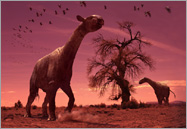
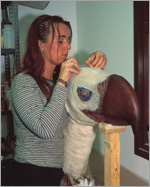
The research for Walking with Beasts was a big job. Researchers Alex Freeman and Paul Chambers worked on the project fulltime for nearly two years, with Assistant Producer Annie Bates in charge of researching the plants and choosing locations for the first nine months. Deciding what to filmThe first task was to choose when each programme was going to be set and which animals should feature. There were a few animals that the team knew they wanted to include, such as the mammoths, and the largest land mammals ever (the indricotheres). Then it was a case of finding really good fossil sites around the world, which represented the 65 million years that the series covered. In fact, more than six sites were considered, and it was hard to have to lose some potentially great programmes, such as one set in Australia based on the Riversleigh fossil site. Choosing filming locationsOnce programme settings had been decided, the researchers' next job was to start collecting fossil information about the animals and plants. Annie Bates started talking to palaeobotanists, who study the fossil plants, about where to locate the best place to film living plants similar to those found millions of years ago. Then she had to find out whether it would be possible to film there. Finally, Annie visited the sites, armed with a video camera, to give the producers an idea of the terrain. Working with the sculptorsMeanwhile, Paul Chambers and Alex Freeman started to work with the sculptors who had to build accurate reconstructions of the animals to be animated. Paul and Alex consulted experts on each animal, getting advice on how they might have looked and behaved, and worked with the producers to develop a storyline to include as much behaviour as was known for each animal. For some of the animals in the series, this was the first time that a model of the creature had ever been built. Adding fur and soundsOnce the models of the animals were ready, the researchers worked with the skin designers to develop appropriate fur colours, and the sound designers to come up with suitable sounds that the animals might have made. For the more recent animals there were cave paintings that gave a very good idea of what colours they would have been in real life, but for a lot of others it was educated guesswork. Bringing the models to lifeFinally, the researchers worked closely with the animators, bringing in experts to look at the movement of each animal, and advise on the behaviour each animal might have shown. After all that it, was an amazing experience to bring the fossils to life and see the "real animals" moving on the screen at last! The teamResearch for a series like Walking with Beasts needed specialist skills, and each of the team had a different area of expertise. Paul Chambers has a degree in geology from the University of Portsmouth(UK), and a MSc and PhD in palaeontology from University College London. He has worked at the London Natural History Museum but more recently has been working as a writer and scientific advisor. He lives in London. Alex Freeman did a degree in zoology at New College, Oxford University, where she undertook research on reconstructing animals from their fossils, and made some early attempts at using computers for 3D modelling of fossils. She then did a doctorate in animal behaviour and evolution at Linacre College, Oxford University, before becoming a researcher for science and natural history films.
|