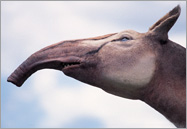
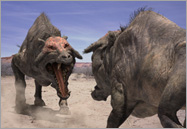
The sound design was by Kenny Clarke. The start of soundMaking the animal sounds for the Walking with Beasts series was a brilliant experience. Together with my partner, Jovan Ajder, we began recording foley sound effects, which are ‘recreated’ sounds made with a variety of props, for film, television and radio productions. We created animal movements and a lot of footsteps, generated by ramming a large log into the ground to get a hollow ‘thud’ for the bigger mammals. The resulting CD still makes me laugh! It is a cacophony of about ten odd-sounding tropical birds with an imaginary creature tearing another apart. Sound qualityThe demo was first auditioned on the PC belonging to executive producer Tim Haines - to my horror - it wasn’t quite the quality I had intended. Actually, it was a good test because many of the creatures needed to sound right on the average television, as well as high quality systems. This gave us an early insight into just how much work was involved in putting together a series on this scale. First we had to generate a sound library and do as much preparation as we could. We had one of two ways to create these sounds: we could either use a huge library of readily available effects (FX), or we could make a smaller library of good FX, manipulating them to give us a much tighter sound. Jovan phoned several countries round the World, had a hilarious conversation in French about Rutting Deer, and investigated umpteen web-based sound FX companies. In despair he approached the Tape Gallery when our monkeys didn’t cut the mustard! Eventually we collected a library of sounds far bigger than we had ever anticipated. Weeks spent at the BBC’s Natural History Unit in Bristol proved unsuccessful. Theoretically a rich vein of sound, they were not always completely ideal. We needed variety within each creature to develop character, and the sounds needed to be clean of background noise. We consoled ourselves knowing that we had a huge range of weird and wonderful sounds for backgrounds with the odd distant and bizarre animal spot FX. We had a great archive, matching or closely covering everything, completing the library and ready to start designing with. Synching upWe had to start working on each programme before the animation was finished, which meant animals walked without their legs moving and talked (as it were) without their lips moving. We worked alongside the series editor and the animators, and luckily the appropriately named TITAN software helped us to track changes in each programme with every new edited version. From an early stage we had a blockomatic (think South Park but more basic) of the early animations with some animatronic shots. We then compiled all the sounds for each programme onto CD and let the animators and directors listen, to get a feel for what we were about to do. The animators were happy when they could physically manipulate the animal according to the sounds we created. We made temporary mixes of the animals for the fine cut (the technical polishing of a near complete programme). They were mixed together with a guide commentary read by either the director or a trained voice artist. The final lockThe dreaded time would come when the pictures would lock and we finally had to make it all come together. Seamlessly fitting all the sounds to the pictures meant that when each animal opened its mouth, the right sound came out. We had a foley session covering movements like footsteps and tearing leaves from branches. Finally, but by no means least, we dealt with all the background sounds. Insects, birds and the completed music and voice over all had to fit perfectly. The final dub took place with Chris Burdon who took our premixed animal sounds, 48 tracks of background sounds, spot FX, foley, music and voiceover. It took a grand total of 64 tracks to produce one polished stereo mix for television. How we made specific animal noisesThe Entelodont sound was a combination of donkey, snake and an elephant growl (similar to the sound used in the original Star Wars film for the Tai Fighter Spaceship!) along with a couple of others, which probably makes it the most complicated of the creatures in the series. It took about ten times as long as any other to do anything with and five times as long to mix. The baby Indricothere was mostly bear and rhino. The main problem was that the baby had to convey several emotions and that did prove tricky, as we didn’t want to miss a trick when he was called upon to pull heartstrings, as it were. Embolotherium was played by a Walrus. Chalicothere was played by our favourite, a hippo. Megatherium was played by goat bleats, pitched down low. After an amusing session with a human voice and harmoniser, we opted to do the hard work for Australopithecus and use real monkey sounds. I am very glad we did as I think the results may have been too much for anyone to bear. Next - Research
|