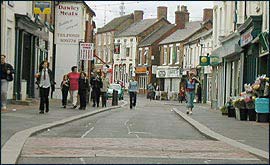
|  | Looking at modern day Dawley, it's amazing to think that this was a Domesday settlement, and could have been established at anytime prior to 1086! It seems that each layer of history in this town has wiped away all trace of what was there before.
There's no better example of this than the fate of Dawley Castle.
In the Middle Ages, Dawley was considered militarily important enough to warrant its own castle, built, it seems, in 1316 by the nobleman William de Morton. 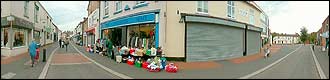 | Click to see our panoramic image of Dawley |
Rather than a conventional castle, the building was apparently more of a fortified manor house, similar in appearance to Stokesay Castle. The manor was later acquired by the Fitz Alans, Earls of Arundel and important Marcher Lords who held several other Shropshire castles, including Shrawardine and Oswestry. But Richard Fitz Alan, Earl of Arundel, fell foul of King Richard II and was executed in 1397. Dawley Castle, then known as Dalileye, was seized by the Crown.  | Stokesay Castle: Could Dawley have looked like this? |
In 1399 Richard was overthrown by Henry IV (you can read more about this here). It was later restored to Richard's son Thomas but was abandoned soon after. The Manor was purchased by Sir Rowland Heywood in 1559 and he or Fulke Compton erected a manor house on the site or nearby, for in 1645 Dawley Manor was to figure in the Civil War. Held by the Royalists, it was surrendered to the Parliament forces, evacuated and fired. In 1648 power was given to the "Committee of Shropshire" to demolish Dawley Castle. It is possible any stone work from the castle would have been robbed out and used in the building of the Dawley Castle Iron Works. Today the exact location of the castle isn't known, but the names of the industrial installations that took over from it provide the odd clue. There are the Castle Pools and nearby the remains of the Castle Ironworks, built by the Darbys in 1810 and in use as a furnace until they were blown out in 1883. Then, behind the site of the Castle Furnace, is a pit bank, the site of the Castle Colliery.
Dawley has a strong mining heritage. Coal seams and Ironstone underneath the area were first mined in the 16th century, although the industrial revolution, born just down the road, made a huge impact on the scale of Dawley's mining... and on the character of the town.
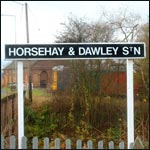 | Horsehay and Dawley station. |
Tons of coal and Ironstone from beneath Dawley were transported throughout the area, including the nearby Horsehay Ironworks.
As the scale of the mining increased, so did the population of the area.
However, mining left its mark on the town. As shallower mines were exhausted, miners turned to deeper seams. Slag heaps and pits scarred the landscape. Towards the end of the nineteenth century, demand for coal and iron started to decline and Dawley felt the squeeze.
The town remained an industrial centre throughout the early twentieth century. Concrete plants, brick works and a string of factories and engineering works opened nearby.
However, the economic decline of the area seemed inevitable. By the beginning of the sixties, it was decided that Dawley was in desperate need of a facelift.
At the same time, planners had recognised that the town was attracting a population overspill from Birmingham and the Black Country.
In 1963 Dawley New Town was born, with the aim of improving the ravaged landscape, a legacy of its industrial past; and to make provision for the predicted population growth.
In 1963, planners designed a new town that would deal with an eventual population of around 90,000. At the time, Dawley was the largest town in the area, with a population of 8,000.
By 1968, Dawley New Town was expanded to take in the towns of Wellington and Oakengates. It was also officially renamed Telford New Town.
Despite the growth of Telford, Dawley, like many other towns in the area has managed to retain its own identity and remains a strong community.
|