Industrial innovation is the hallmark of the Ironbridge Gorge - and the Jackfield Bridge is the second bridge on that site to employ revolutionary construction methods. Half a mile downstream from the historic Iron Bridge, Jackfield Bridge is a vital link between the north and south sides of the river. 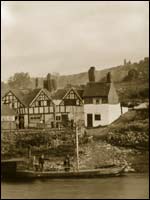 | Watch this space - there will be a bridge here in a few years' time |
Until the beginning of the 20th century, the alternatives were the Iron Bridge - a toll bridge at the time - and a ferry, which had proved to be particularly hazardous when the river was in flood. Not only was there a hazard to life and limb, but as a letter writer in a local newspaper at the time said '...many times have men been stopped from going to their work because they had not a halfpenny to go across the river.' A new bridge was proposed. It was to be toll free, and paid for by public subscription - including £600 in a legacy from one Mr R. Haynes who died in Montevideo, leaving the substantial sum to Ironbridge, his birthplace. 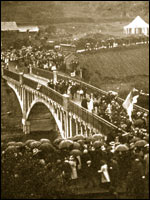 | 1909: The opening of the Free Bridge |
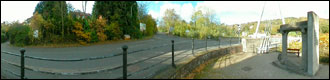
This first bridge, built in 1909, used the then revolutionary reinforced concrete, devised by Frenchman François Benjamin Joseph Hennebique. It was designed by L.S. Mouchel and Partners and built by the Hennebique company of Liverpool. The bridge was a three span open spandrel arch, 'load-tested' with a 14 tonne steam roller, and although narrow by present standards, it successfully carried traffic for many years. The beginning of the end for the Free Bridge came in 1937 when the concrete was found to be decaying and the steel reinfocement began to rust. The next 50 years saw a constant programme of repairs, including spraying of fresh concrete over the structure, but ever more stringent weight restrictions were imposed 12 tons - 10 tons - and then 3 tons in April 1986. The same year, in spite of the bridge being designated a Grade II structure of architectural and historic interest, it was decided that it was no longer safe to carry vehicles. 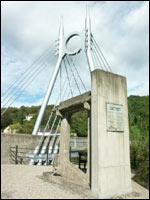 | The remains of the Free Bridge - click in the picture to read the inscription. |
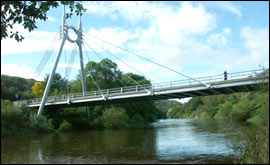
A Bailey bridge was erected with traffic lights controlling the flow accross the single-lane span - the beginning of eight years of frustration for motorists, but better than the 14 mile detour that HGVs would otherwise have had to take. A long period of consultation followed. Various options were discussed, including the restoration of the Free Bridge for use as a footbridge, but in 1993, the Secretary of State gave permission for the Free Bridge to be demolished. Shropshire County Council commissioned a new bridge - it was to be a collaboration between designers Gifford and Partners, architects the Percy Thomas Partnership, main contractors Alfred McAlpine Construction Ltd. and steel sub-contractors Westbury Tubular Structures. The location of the bridge in the Ironbridge Gorge, by then designated a World Heritage Site, demanded a distinctive and innovative design. The design had to take into account the unstable nature of the gorge, the frequent flooding of the river and the increasing demands of the tourist industry. The aim was to match the vigorous and challenging approach of the ironmasters. The solution was a cable stayed bridge with a single A-pylon. It was to have a concrete deck slab between steel beams. Although the bridge site is in one of the more stable parts of the gorge, preparation included injection grouting of the underlying coal strata and the construction of bored pile foundations. The various components were prefabricated 180 miles away in Wetherby, West Yorkshire. The 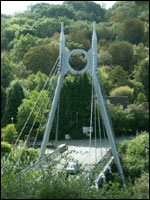 | The modern lines of the Jackfield Bridge contrast with the verdant woodland of the Ironbridge Gorge |
tower was delivered in four sections, laid on its back on the river bank and welded together. The 200 tonne crane was used to hoist the tower into place was itself so big that it had to be transported in sections using four separate low-loaders and it took two days to erect using a further 80 tonne crane. The installation of the steelwork was a technically demanding process and was carefully planned to be carried out within a single day. The fabrication of the bridge took nine months from October 1993 to June 1994. It was open to traffic by August and officially opened on 18th October with a 14 tonne steam roller being first across, echoing the 'load test' on the first bridge. Now, more than ten years on, the bridge has fulfilled all expectations. It carries an immense quantity of traffic, it is reliable and easily maintained. It was described by the Royal Fine Art Commission as 'worthy of the Ironbridge Gorge' and ' an overwhelming success' and, judging by the number of tourists with cameras pausing in their journeys, it is proving an attraction in its own right. Now have a look at our gallery of Jackfield Bridge pictures - historic photographs from the collection of Ron Miles and pictures of the bridge today. |