| WEBLINKS |  | British Archaeology
Simon Denison founded the magazine and is still its editor.
The BBC is not responsible for the content of external websites. | | | SEE ALSO | | Quarry Land
Simon Denison took the concept a step further by mixing photographs from the Clee Hills with portraits and the stories of people who live and work there. Mining in Shropshire
In Shropshire the county's rural landscape has been shaped by its mining past.
Industrial Archaeology
A Shropshire-based group of keen amateur archaeologists have been researching and recording the industrial past of the county and beyond. | | | PRINT THIS PAGE | | | | | WHAT THE CRITICS SAID | | ‘Simon Denison photographs the rural landscape as a constantly changing site of interaction between organic forces and manufactured detritus. He even brings out the beauty in our messed-up countryside’ Robert Clark, The Guardian | | TECHNICAL INFO | | Simon uses Bronica 6x6 and Nikon 35mm cameras. In medium format he mainly uses Ilford HP5 Plus film rated at ISO 200 (overexposed one stop); in 35mm, most images were made on Agfa APX25 – a film that has now been discontinued – rated at ISO 6 (overexposed two stops). Development is in highly diluted (1:3) Perceptol to achieve fine grain, edge sharpness and a full tonal range. Prints are made on Agfa Classic variable contrast fibre-based paper, selenium toned and retouched. In the darkroom, negatives are cropped and tonal areas balanced or emphasised as necessary. Beyond that, no image manipulation takes place. | |
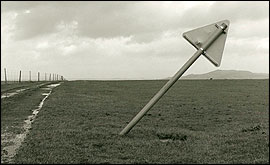
| | But, as the stark pictures of Shropshire photographer Simon Denison show, the rural landscape is not as unspoilt as we think. His monochrome prints capture the signs of past human activity, such as a mattress dumped in a quarry or a pair of gateposts in a field that are the last remnants of a country house. .Sample a selection of Simon Denison's picturespop-upgallery |
And, although he takes pictures all over the UK, Shropshire figures prominently in his work. The Shropshire landscape, especially in the south of the county is an ideal subject, is dotted with places that were once hives of human activity, but now lie silent, still and derelict as nature took them over long ago. Traditionally, landscape photographers concentrate on the scenic side of the countryside, regarding all but the most picturesque human constructions as eyesores which are excluded. But Simon's work is all about these 'eyesores'.
| ‘There is a school of landscape photographers – Fay Godwin is probably the best known – which dismisses the Beautiful Britain cliché. Simon Denison belongs to this school. As the editor of the magazine British Archaeology he is attuned to the traces which man’s progress has left on the landscape. As a photographer he celebrates them . . .
The beauty appears almost accidental in these stark black-and-white images. It is all the more powerful for that. Simon Denison’s imagination is certainly not romantic in the sunsets and seascapes sense of the word, yet it is deeply rooted in Britain’s Romantic (with a capital R) traditions | | | Rachel Campbell-Johnston, The Times |
He says: "Far from corrupting the lyrical beauty of the rural landscape, I believe the works of man intensify it. They are the signs that people have lived on the land and altered it, before moving on or passing away. "Our constructions and discarded possessions often survive after we are gone, but in time they too fall into ruin. "As they decay, they provide a forlorn metaphor for the human condition, standing as poignant reminders of the pasage of time and our own mortality." Simon's fascination with the traces left in the countryside by man is hardly surprising, given his other main occupation as editor of British Archaeology magazine, which he founded in 1995. His photographs have been published in a book, The Human Landscape, and they featured in a travelling exhibition last year, which received critical acclaim. In Shropshire, his work was most recently exhibited at Ludlow Assembly Rooms. Simon, who's married to the painter Susannah Creese and lives with their two small children near Ludlow, was born in 1964 near Cambridge. After reading classics at Oxford University, he studied photography part-time at St Martin's School of Art. His work has been published in several books and magazines, as well as being held in private collections. Before founding British Archaeology he wrote for several national newspapers including the Sunday Times, the Independent, the Guardian and the Sunday Telegraph. His next project is making images on the two Clee Hills. Sample a selection of Simon Denison's picturespop-upgallery |
Copies of the book, The Human Landscape (£12.95), and hand-made, signed copies of any of Simon Denison’s images are for sale. Contact Simon Denison direct on 01584 823323 or by email: simondenison@pobox.comr thllery |