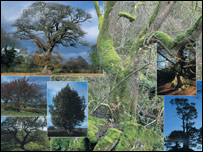
What Is A Veteran Tree? 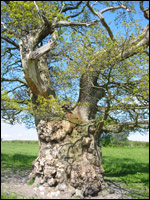 | | Cae Du Oak |
Veteran trees come in many shapes and sizes, but most often the intervention by man in his management of these trees over many years has ensured their longevity. Many of the principal broadleaves, such as oak, ash, beech and sweet chestnut have had a long tradition of uses for which they were regularly pollarded or coppiced.
These regimes meant that the structure of the trees was constantly held in check, and this arrested growth mechanism along with a reduced crown for the root system to support ‘tricked’ the trees into believing that they had yet to reach maturity. They survived. Eventually age, disease and the effects of extreme weather take their toll, and if not actually dying the tree is certainly no longer growing vigorously. Features such as hollow trunks, dead boughs, lost bark and the presence of fungi may well become characteristic. Principal broadleaves with a girth in excess of 3 metres (10ft) at chest height (4ft) would usually be classified as veteran. Other species such as yew, holly, hawthorn or crab-apple, which are very slow growing, may not immediately appear from their size to be veterans, but a 1.5 metre (5ft) girth may well indicate a tree of several hundred years vintage. On the other hand it’s worth noting that some fast growing species such as the willows may grow to veteran proportions in a relatively short space of time.
Where Are The Veteran Trees?
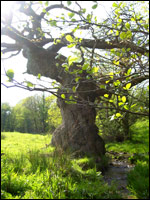 | | Trefonen Hall Oak |
Veteran trees are found throughout the countryside, but there are particular concentrations in certain landscapes. Ancient woodland is a good place to look for huge old coppice stools - small-leaved lime, one of our rarer natives, is something special to seek out. Deer parks and historic parkland will often contain many impressive old pollards, notably oaks and sweet chestnuts –once working trees, but latterly the adornment of the gentry’s formal landscapes.
Hedgerows still contain an abundance of veteran trees, and old specimens of species such as field maple and the scarce native black poplar occur here with some regularity. Individual impressive veterans may be found as field trees, on village greens, in orchards, in churchyards, associated with historic buildings, or simply in your back garden.
What Makes Veteran Trees So Special?
As a vital element of our landscape heritage, many veteran trees have survived for so long because they hold an important place in our history.
There are trees once used as special meeting places, preaching or gospel trees, boundary markers, those associated with kings and queens; heroes and villains, hanging trees and all manner of champion trees; their significance may be national or local. At present very few people are aware of exactly how perilous the survival of veteran trees can be. Most have no formal or legal protection whatsoever, and to this end the Tree Council and its member organisations are currently lobbying government to adopt a ‘Green Monuments’ policy which will ensure that our veteran trees receive the same degree of protection as our ancient monuments, and encourage those who are fortunate enough to own such trees by providing support and advice on how to care for them.
Here For Hundreds Of Years - Gone Tomorrow?
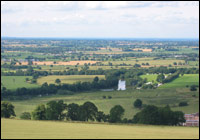 | | Shropshire landscape today |
In recent history numerous veteran trees have been lost or fallen out of management due to agricultural, cultural and industrial change, urban expansion, diseases such as Dutch elm and a variety of species specific phytoptheras.
The great storms of 1987 and 1990 also eradicated numerous ancient trees although, remarkably, some of the very oldest trees, which were hollow, proved extremely resistant to gale damage. 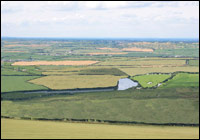 | | Shropshire Landscape Without Trees |
Climate change may well bring yet more extreme weather conditions. Added to these natural imponderables, human beings have the capacity to determine the future of veteran trees, ongoing management being vital for their guaranteed survival. |