 | 13 November 2014 |

| |
| BBC Homepage | | |
| |||
| Contact Us | | |
Nature FeaturesYou are in: Shropshire > Nature > Nature Features > The wonder of Wenlock Edge 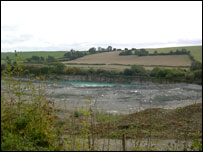 Quarry on Wenlock Edge The wonder of Wenlock EdgeA new book by the National Trust hopes to capture the spirit of Wenlock Edge and wants to hear your memories and experiences. The National Trust, which manages seven miles of Wenlock Edge, wants to hear your memories of the area, particularly if you've got a strong connection with the site. The limestone on Wenlock Edge has been exploited for many years and Peter Carty of The National Trust is particularly keen to hear from old quarry workers, foresters and gamekeepers. The memories will be used within a book that hopes to follow on from the success of Wild Mynd, released in 2007. For more information, or to contribute your memories of Wenlock Edge, contact Peter Carty at The National Trust on 01694 723068.
The 15-mile-long limestone escarpment that makes up Wenlock Edge has a long history of quarrying and industry. Despite this, it is also renowned for its breathtaking views and stunning scenery, which have inspired countless artists, poets and composers. In 2007 it was listed as one of the seven wonders of the West Midlands. Limestone coninues to be removed from the heart of the Edge, at Lea Quarry. Our demand for limestone and its by-products has only intensified over the years. Believe it or not we all come into contact with limestone every day. It's in the toothpaste we brush our teeth with... our houses are held together by it... and we drive our cars over it. Both the beauty and industry on Wenlock Edge is a result of its geological history, as Shropshire Wildlife Turst's Geology Officer Liz Etheridge explained. Geology on the EdgeWenlock Edge is not only one of the best known geological sites in Shropshire, but also one of the most famous in the world. Wenlock's claim to fame is firmly established in international geology. One of the sections of the Silurian Period is even called the Wenlock era (there's also a Ludlow era). Therefore you'll find geologists all over the world referring to some of their rocks as "Wenlockian"! This area is made up mainly of limestone - a rock originally formed from crushed shells, salt water and ancient, tiny sea creatures. These formations were established when this area was about 25/30 degrees south of the equator under a shallow, subtropical sea. At this time (around 425 million years ago) Shropshire was about level with the Seychelles. Even bearing this tropical environment in mind, it's still amazing to see the clear remains of Wenlock Edge's reef and you can still pick up pieces of coral as you walk along the Edge. 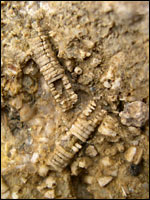 Fossilised crinoids This area is packed with fossils. Our trip with Liz Etheridge, turned up fossilised crinoids (sea lillies), trilobites and seemingly hundreds of brachiopods... all within a matter of minutes! Crinoid fossils are essentially cylindrical. If you see them end-on, they look like tiny tubes. Originally these would have been tubular animals (not plants) with stems that rose up in the warm sea to feed on passing plankton. Meanwhile the far rarer trilobite fossils resemble ancient woodlice. These fossils can still display the clearly defined segments of the once hard trilobite shells. On Wenlock Edge, it's practically impossible not to find brachiopods. Almost every rock you pick up seems to contain these shellfish which look exactly like shells you might pick up on the beach today. 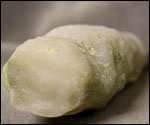 Coral found at Wenlock Edge We also found a piece of tube coral, looking as if it had only recently broken off a reef. However, it was quite dirty and we cleaned it up back at the office. After a bit of a scrub and a vinegar bath, it was far easier to see the white coral base. Limestone reacts quickly with the acid in vinegar to loosen surrounding material. This is why acid rain has such a profound effect on limestone. Although acid rain is far more diluted than vinegar, when you multiply its effect over time, you can start to understand the damage it's doing. Acid rain is created as carbon dioxide is dissolved in the water in our atmosphere. It is also produced by a number of human processes, particularly through industry. Room for a viewAs you stand on Wenlock Edge, one of the most distinctive views is that towards Lea Quarry in the near distance. The bright, lagoon blue water of the settling pool (See main image, top) is caused as the partially-dissolved minerals turn the water slightly opaque, reflecting the light. 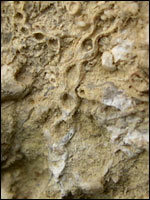 Chain coral found on Wenlock Edge When Lea Quarry has finished its working life, it will revert back to nature. Given enough of a chance, this will become a haven for all sorts of wildlife and wildflowers. Orchids in particular love this type of soil. Evidence of Wenlock Edge's quarrying past is seen a little further along our walk. The restored limekilns and Knowles Quarry not only hint at an industrial past in this beautiful location, but also show how nature can reclaim a site after the machines have left. Once upon a time, lime was burned here so it could then be spread on fields to improve the quality of the soil for farming. Wenlock Edge's underlying geology stretches around 30 miles from Ironbridge to Craven Arms. The escarpment itself is around 15 miles long, from Much Wenlock to Craven Arms. Seven miles of the Edge are owned and managed by the National Trust. Wenlock Edge also falls within the Shropshire Hills Area of Outstanding Natural Beauty (AONB) and views from the top are suitably superb. Within 100 metres of Presthope car park you'll find views of Ape Dale, Caer Caradoc and the Long Mynd. A range of walks (including an all-ability trail) are clearly marked out. For a good idea of what a limestone quarry looks like after quarrying has finished (and nature's given a chance to take over), see our visit to Llanymynech Rocks.last updated: 23/10/2008 at 16:17 Have Your SayComment on this article Keith Wootton mel Jk shaun chambers - tamworth, staffordshire Rosemarie Lynda.braden laura whitten benjaste John Monk SEE ALSOYou are in: Shropshire > Nature > Nature Features > The wonder of Wenlock Edge    5 DAY FORECAST The latest forecast for your area from BBC Weather [an error occurred while processing this directive] |
| | About the BBC | Help | Terms of Use | Privacy & Cookies Policy |
