

Walter McGowan's career in the unpaid ranks saw him suffer only two defeats in 124 bouts while winning a British ABA flyweight title in 1961. Shortly after this wee Walter turned pro under his dad's management. Gans subjected Walter to a strict training regime that included finishing off five miles of roadwork with a swim and being doused in a cold tin bath.
This regime didn't change even when Walter later moved his training quarters to Glenlee House where Ethiopian Emperor and Rasta icon Haile Selaiise had spent his exile after being chased out of his homeland by Benito Mussolini!
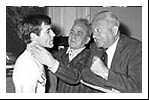
Proof that Joe Gans' regime paid ring dividends can be seen in the clutch of honours and distinctions wee Walter's educated punching, shrewd ring tactics, and a big heart brought him.
 |  |
© SCRAN | |
|
Again, American former world lightweight, light-welter and welterweight champion Barney Ross raved about Walter McGowan when he witnessed the Hamilton-based ace stop tough Italian Nevio Carbi in the sixth round of an eight-round joust staged in 1966 in the opening night of London's World Sporting Club.
Similarly, Walter's British bantamweight title clash with Liverpool's Alan Rudkin in September 1966, at Wembley, was described by Boxing News as "The finest battle by little men seen for years…"
Praise, praise and yet more praise from every authorative quarter for Walter McGowan but in common with all other gifted Caledonian flyweight boxers there was a downside in Walter McGowan's career.
Unlike Scotland's first ever world flyweight champion, Johnny Hill, who beat American "Newsboy" Brown before 28,000 spectators in London in 1928, or Benny Lynch who battled before 30-odd thousand at Shawfield Park in 1937, Walter McGowan only attracted 7,000 fans to see his world flyweight title victory over Salvatore Burruni and a similar small crowd when Walter tied to regain his world crown against Thailander Chartchai Chinoi at the same Wembley venue in 1967.
However, as both Walter's WBC flyweight bouts in Britain and his losing first title defence in Bangkok on 30 December 1966 against Chinoi prove, the biggest bogey to his soaring ring talents was cuts. A severly cut nose put paid to Walter's world championship reign in Thailand. Double eye and forehead cuts cost McGowan victory in his return bout with Chinoi, despite Walter leading widely on points from the fourth round onwards.





