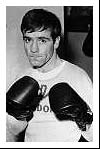
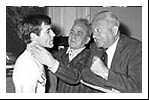
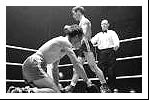
Previous Page Walter McGowan wins flyweight world title 1966BRITISH +EMPIRE FLYWEIGHT CHAMPION-1963-66
BRITISH + EMPIRE BANTAMWEIGHT CHAMPION-1966-68.
40 CONTESTS-WON 32; DREW 1; LOST 7. On Saturday 14 March 1936, the Edinburgh Evening Dispatch announced on its sports pages, "Connolly Taken Distance - Magnificent Display of Pluck By Gans".The report went on to outline how Bathgate fighter Joe Connolly had appeared for the very first time as a top-of-the-bill boxer over 12 rounds. However, it was Connolly's opponent, 'Joe Gans' alias Thomas McGowan, who really stole the show by his fighting display of guts. For example, the Dispatch's boxing scribe continued: "By the end of the seventh session Gans' face was puffed…but he was full of pluck in a contest going continually against him… Gans took further terrific punishment and went down for an eight count in the 10th…another count of 9 came Gans' way in the final round but Connolly could not put him out…" Now, fast forward the march of time by exactly 30 years to Wembley, London. The date? 14 June 1966, when another McGowan, well ahead by the seventh round of his world WBC flyweight title clash against the Sardinian, Salvatore Barruni sustained a gashed eye of sufficent severity to warrant the close inspection of English referee, Harry Gibbs. But still he shrugged off the this handicap to box, as one ringside ring critic put it "like a little master. Using his speed, jabbing in clusters and bringing the right hand home." These were boxing skills which brought him victory and Scotland her fourth world flyweight champion. The McGowan who achieved this famous Wembley ring triumph was Walter McGowan, son of the gallant 1934 vintage Thomas McGowan, aka 'Joe Gans'. A Lanarkshire miner originally, Thomas McGowan was such an unabashed admirer of legendary US Afro-American early-20th century world lightweight champion Joe Gans that he adopted his name as his own "nom du ring". Born on 13 October 1942 in the racecourse town of Hamilton, Walter (like future world flyweight champion Pat Clinton who followed him) had original ambitions to be a jockey, but he soon forgot about that when, guided by his dad who now was permanently known as 'Joe Gans', Walter embarked on a brilliant amateur boxing career. Walter McGowan's career in the unpaid ranks saw him suffer only two defeats in 124 bouts while winning a British ABA flyweight title in 1961. Shortly after this wee Walter turned pro under his dad's management. Gans subjected Walter to a strict training regime that included finishing off five miles of roadwork with a swim and being doused in a cold tin bath. This regime didn't change even when Walter later moved his training quarters to Glenlee House where Ethiopian Emperor and Rasta icon Haile Selaiise had spent his exile after being chased out of his homeland by Benito Mussolini! Proof that Joe Gans' regime paid ring dividends can be seen in the clutch of honours and distinctions wee Walter's educated punching, shrewd ring tactics, and a big heart brought him. Walter McGowan was the only British boxer to win a coveted Lonsdale belt outright after a single defence (there was nobody good enough to challenge him); he was the first winner after 15 years of British boxing's trade paper Boxing News' coveted Certificate of Merit; he was the first ever boxer to defeat Tunisian Jewish bantamweight Felix Brami - a performance Boxing News hailed as "Nothing short of a revelation - McGowan's speed and variety of punches restored our faith in British boxing…"Again, American former world lightweight, light-welter and welterweight champion Barney Ross raved about Walter McGowan when he witnessed the Hamilton-based ace stop tough Italian Nevio Carbi in the sixth round of an eight-round joust staged in 1966 in the opening night of London's World Sporting Club. Similarly, Walter's British bantamweight title clash with Liverpool's Alan Rudkin in September 1966, at Wembley, was described by Boxing News as "The finest battle by little men seen for years…" Praise, praise and yet more praise from every authorative quarter for Walter McGowan but in common with all other gifted Caledonian flyweight boxers there was a downside in Walter McGowan's career. Unlike Scotland's first ever world flyweight champion, Johnny Hill, who beat American "Newsboy" Brown before 28,000 spectators in London in 1928, or Benny Lynch who battled before 30-odd thousand at Shawfield Park in 1937, Walter McGowan only attracted 7,000 fans to see his world flyweight title victory over Salvatore Burruni and a similar small crowd when Walter tied to regain his world crown against Thailander Chartchai Chinoi at the same Wembley venue in 1967. However, as both Walter's WBC flyweight bouts in Britain and his losing first title defence in Bangkok on 30 December 1966 against Chinoi prove, the biggest bogey to his soaring ring talents was cuts. A severly cut nose put paid to Walter's world championship reign in Thailand. Double eye and forehead cuts cost McGowan victory in his return bout with Chinoi, despite Walter leading widely on points from the fourth round onwards. Equally, cut proneness hampered Walter's losing effort to keep his British bantamweight crown against old foe Alan Rudkin at Manchester's Bellevue in May 1968. Yet on other occasions cuts were to emphasise that Walter McGowan had inherited a large portion of his dad Joe Gans' never-say-die ring spirit, as shown against Bathgate's Joe Connolly in 1934. For example, witness Walter's bloody battle with Osamu Miyashita at London's World Sporting Club on 15 March 1967 when the wee man from the Burnbank district of Hamilton also became the first Scottish boxer to fight a Japanese opponent in Great Britian. On this occasion Miyashita ripped open Walter's left eye with a stiff right cross, forcing McGowan to reveal his tactical genius inside the ropes by moving outside the arc of the Nipponese boxer's potent right hand. Similarly, a 10th round cut eye in his first Spetember 1966 British bantamweight clash with Liverpudlian Alan Rudkin only spurred Walter to box even more impressively to score a victory that meant he had imitated fellow Hamilton boxer Jim Higgins, who had won a bantamweight Lonsdale Belt in the 1920s in a record time that stood for over 50 years. Again in 1965 Walter was ahead by the proverbial mile on points against world-rated bantamweight Ronnie Jones from Chicago in a non-title bout in Paisley when a horribly lacerated left eye cost McGowan the verdict: the fight was halted on cuts, making Jones an undeserved victor. Nevertheless, victory was the most common denominator in the McGowan career with the pocket dynamo proving the power of combination punching by stopping just under 50 percent of those whom he defeated in the ring. Of the six british boxers that Walter met in non-title bouts, only one - Edinburgh's 1958 Commonwealth Games flyweight gold medallist Jackie Brown - beat him. McGowan avenged this reverse when the pair met in a Paisley rematch. This emphasises how peerless in Great Britian McGowan was in his eight-year pro career betwen 1961 and 1969.Again, top contemporary Scottish ring coach John McDermott MBE winner of Commonwealth featherweight gold in 1962 as an amateur, sparred often with Scotland's only double outright Lonsdale Belt winner Glasgow bantamweight, Peter Keenan; Scottish lightweight ring legend Ken Buchanan rates McGowan as being the best technical boxer of all the Scotish ring greats. Again, Walter's penchant for collecting honours was shown when he became the first Scottish world boxing champion to be honoured in the Queen's Birthday honours list in 1966. A lifelong Rangers fan who used to train with Ibrox legends like Jim Baxter at Ibrox Park in the 1960s, Walter was also a keen golfer, and in the 1990s trained Palestinian boxers in Israel. A recent period of ill health has not dimmed wee Walter's popularity with the Scottish fight crowd as he always attracts a loud cheer when introduced at Scottish boxing shows. Written by: Brian Donald |