

 |  |
© Hulton Getty | |
|
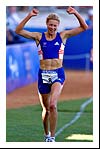
After she finished her schooling she went to university at Cambridge to study medicine, where she took up running and rowing, before a broken wrist forced her to retire from the latter and concentrate on athletics. Her studies then took her to Lincoln College, Oxford, where in 1995, a notice on the college bulletin board prompted her to try the Modern Pentathlon.
As a child she had been involved at her local pony club; therefore she was skilled in two of the disciplines of her new sport, and as a capable swimmer had experience in a third. Although she was a novice at shooting and fencing, she quickly became adept at both and was selected to represent Britain whilst still a student.
Steph won the National Modern Triathlon Championships in 1996, the National Modern Tetrathlon Championships in 1999 and the National Modern Biathlon Championships in 2000, but it was in the Pentathlon that she was to achieve her greatest feats.
She was part of the British team that competed in the World an European Championships from 1998 to 2001 and had picked up silver and bronze medals in the team and relay events before her ultimate triumph.
Juggling training with medical studies became more and more difficult, so in 1999 Steph put her medical career on hold while putting all her efforts into her preparation for the 2000 Olympic Games in Sydney, when the Modern Pentathlon was to be included in the schedule for the first time.
Based on the escapades of a Napoleonic army officer attempting to evade the clutches of the enemy as he attempted to deliver a message, the five disciplines that make up the event are:
Shooting - firing 20 shots with a 4.5mm air pistol;
Fencing - bouts against other competitors in a round-robin format;
Swimming - 200 metres freestyle;
Riding - over a course with 12 jumps before the final event of the day;
Running - when the competitors battle it out over a 3km course.
Page: 12




