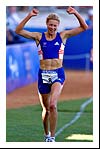
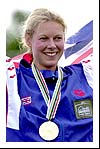
Previous Page Stephanie CookBorn in Irvine, Ayshire in 1972, Stephanie Cook moved to Bedford when she was just two years old; however, she still considers herself to be Scottish.After she finished her schooling she went to university at Cambridge to study medicine, where she took up running and rowing, before a broken wrist forced her to retire from the latter and concentrate on athletics. Her studies then took her to Lincoln College, Oxford, where in 1995, a notice on the college bulletin board prompted her to try the Modern Pentathlon. As a child she had been involved at her local pony club; therefore she was skilled in two of the disciplines of her new sport, and as a capable swimmer had experience in a third. Although she was a novice at shooting and fencing, she quickly became adept at both and was selected to represent Britain whilst still a student. Steph won the National Modern Triathlon Championships in 1996, the National Modern Tetrathlon Championships in 1999 and the National Modern Biathlon Championships in 2000, but it was in the Pentathlon that she was to achieve her greatest feats. She was part of the British team that competed in the World an European Championships from 1998 to 2001 and had picked up silver and bronze medals in the team and relay events before her ultimate triumph. Juggling training with medical studies became more and more difficult, so in 1999 Steph put her medical career on hold while putting all her efforts into her preparation for the 2000 Olympic Games in Sydney, when the Modern Pentathlon was to be included in the schedule for the first time. Based on the escapades of a Napoleonic army officer attempting to evade the clutches of the enemy as he attempted to deliver a message, the five disciplines that make up the event are: Shooting - firing 20 shots with a 4.5mm air pistol;
Fencing - bouts against other competitors in a round-robin format;
Swimming - 200 metres freestyle;
Riding - over a course with 12 jumps before the final event of the day;
Running - when the competitors battle it out over a 3km course. Steph picked up 1,072 points in the first event, which left her some distance behind Emily de Reil from the United States who had scored 1,156 points. De Reil extended her lead after the fencing, picking up a further 800 points, in comparison to Cook's 720. Meanwhile another Briton, Kate Allenby was emerging as a possible medallist having added 920 points to her opening score of 1,036.The margin was further increased after the swimming, with de Reil scoring 1,182 points compared to Cook's 1,138, while Allenby's 1191 further pressed her claims. De Reil again outscored her rivals in the equestrian section, amassing 1,070 points, with Cook and Allenby both gaining 1040, however Cook had remained in touch with the leaders, and with as befitted someone whose sporting background had been in the cross-country, running was her strongest suit and she knew that if she could produce her best, she still had a chance of taking the overall crown. As the event drew to a climax, Cook was back in eighth place, 98 points behind the leader, de Reil, with Allenby also looking strong 44 points ahead of her compatriot. Under the format of the event this led to her starting 49 seconds behind the leader in what was effectively a handicap race. However, in a tense finish, Cook made up the ground to pass the previous leader with 250 metres to go and clinch the gold medal with a score of 5,018 points. De Reil was second, eight points behind with Stephanie's team-mate Kate Allenby in third scoring 5,273 points. Individually she won the World Championships the following summer as well as being part of the Great Britain team that won the relay and team events. She was awarded the MBE for her services to the sport, before opting to retire at the age of 29 to resume her medical career. Written by: Dave Low |