

 |  |
© David Chapman | |
|
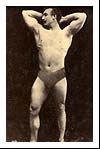
Elliot made it to the final, coming up against Denmark's Viggo Jensen. Both men lifted 110kg. However, the Prince decided to award gold to Jensen, who had lifted the weight cleanly, while Elliot had struggled. Levy disagreed, pointing out that, as both men had lifted the same weight, they should both be given the opportunity to try a heavier weight. Plates were screwed onto the 110kg weights (the heaviest in the building) and both men tried to lift them. However, after another complaint from Levy that Jensen's lift was not legal, the original result was allowed to stand.
The single-handed lift final was scheduled to take place next, and both competitors declined the offer of a rest break. This was less of a contest, however; Jensen had injured his shoulder with his last two-handed lift and could not compete with Elliot's lift of 71kg. Launceston had won, and become Britain's first Olympic Gold medallist!
This success was not the end of the Games for Launceston, though, as he also competed unsuccessfully in the 14-metre rope climb, where he withdrew, and in the Graeco-Roman wrestling, where, after losing his first bout, Elliot protested so badly that he had to be escorted from the stadium.
His impact at the Olympics was not confined to the events, however, as the impression made on the audience by the handsome, well-built Scot was such that he received a proposition of marriage "from a highly-placed female admirer."
Launceston's impressive feats did not end in Athens, of course. In 1898, he broke the record for the single-handed lift set by his mentor, Eugen Sandow. The Athens Games were not the end of the Olympic adventure for Elliot either, as, despite weightlifting's absence from the programme four years later, he claimed 10th place for Britain in the discus at the Paris Olympiad.
 | |
© David Chapman | |
|
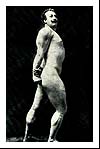
Launceston Elliot retired from the music hall circuit shortly after the end of the Great War as he approached the age of 50, and, after spending a few more years on his farm, retired to Melbourne Australia, where he died on 8 August 1930.
Elliot was born and died in Australia, and lived most of his life in England, but his daughter, Nancy knew how her father would have described himself: "He was called Launceston, as he was conceived in Launceston, the capital of Tasmania. He was born in India, but he was Scottish to the bone."
Page: 12





