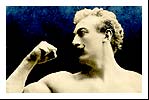
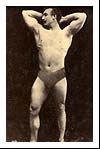
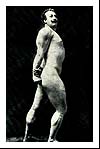
Previous Page Launceston ElliottIt is one of the interesting facts of Scottish sport, and a sign of the age and class to which he belonged, that our nation's first Olympic medal winner was not, in fact, a native of the country, but was born on the other side of the world.Launceston Elliot came from a well-established Borders family, a descendant of the Earl of Minto. His great-grandfather was governor of Madras, his grandfather governor of St Helena and Launceston's father, Gilbert, served as a magistrate in Imperial India, where Launceston was born, on 9 June 1874. Gilbert retired from the civil service in 1887, bringing his family to England where he began farming in Essex. Launceston was 13 at this point and was already attracting attention for his build. Shortly after this, Launceston began to train under the tutelage of the great German weightlifter Eugen Sandow, regarded as the founder of modern-day bodybuilding. Four years later, aged only 16, Launceston competed in the inaugural British weightlifting championships, held in the International Hall of the Café Monico in West London. According to reports, the young man's performances did him no harm, and a further three years on he was to be crowned British champion. In 1896, Launceston decided to enter himself for the first Olympics, held in Athens that summer, and so joined an intrepid, small band of British athletes sailing for Greece from Marseille on board the SS Congo. Also among this group was fellow weightlifter Lawrence Levy, who, as well as competing in the Games, was also reporting on them for a newspaper in Birmingham. It was to be a remarkable time for Launceston, in which he set many firsts. The Games began for him on 6 April 1896, when he finished fourth in the 100m heats. Although he was eliminated, this was the first event of the games, and so Launceston became Britain's first Olympic athlete. He was to make up for this disappointment the next day, however, as he entered both Olympic weightlifting events, the single-handed lift, and the two handed lift. The two-handed lift was held first, with Levy, who had earlier withdrawn due to a row over whether dumbbells or barbells should be used, joining the Crown Prince of Greece on the judging panel.Elliot made it to the final, coming up against Denmark's Viggo Jensen. Both men lifted 110kg. However, the Prince decided to award gold to Jensen, who had lifted the weight cleanly, while Elliot had struggled. Levy disagreed, pointing out that, as both men had lifted the same weight, they should both be given the opportunity to try a heavier weight. Plates were screwed onto the 110kg weights (the heaviest in the building) and both men tried to lift them. However, after another complaint from Levy that Jensen's lift was not legal, the original result was allowed to stand. The single-handed lift final was scheduled to take place next, and both competitors declined the offer of a rest break. This was less of a contest, however; Jensen had injured his shoulder with his last two-handed lift and could not compete with Elliot's lift of 71kg. Launceston had won, and become Britain's first Olympic Gold medallist! This success was not the end of the Games for Launceston, though, as he also competed unsuccessfully in the 14-metre rope climb, where he withdrew, and in the Graeco-Roman wrestling, where, after losing his first bout, Elliot protested so badly that he had to be escorted from the stadium. His impact at the Olympics was not confined to the events, however, as the impression made on the audience by the handsome, well-built Scot was such that he received a proposition of marriage "from a highly-placed female admirer." Launceston's impressive feats did not end in Athens, of course. In 1898, he broke the record for the single-handed lift set by his mentor, Eugen Sandow. The Athens Games were not the end of the Olympic adventure for Elliot either, as, despite weightlifting's absence from the programme four years later, he claimed 10th place for Britain in the discus at the Paris Olympiad. In 1905, due in some part to financial difficulties caused by a rift from his father, Elliot turned professional and became a fixture on the music hall circuit, touring throughout Britain, Europe and even South America. The climax of his show involved a feat of strength where Launceston would carry a bar across his shoulders with a bicycle and rider suspended from either end. Elliot would then start to turn bearing this weight, getting progressively faster until the bikes and riders were horizontal!Launceston Elliot retired from the music hall circuit shortly after the end of the Great War as he approached the age of 50, and, after spending a few more years on his farm, retired to Melbourne Australia, where he died on 8 August 1930. Elliot was born and died in Australia, and lived most of his life in England, but his daughter, Nancy knew how her father would have described himself: "He was called Launceston, as he was conceived in Launceston, the capital of Tasmania. He was born in India, but he was Scottish to the bone." |